AdvancedLogical Reasoning · Lesson 24 of 24 · Updated ·
Strengthen and Weaken the Argument — Find the Gap First
In a strengthen or weaken question you read a short argument, then pick the one option that makes the argument more believable (strengthen) or less believable (weaken). These questions appear in the critical reasoning part of many placement and management tests.
You do not have to decide whether the argument is true. You only check what each new fact does to the argument.
1. Split the argument into three parts
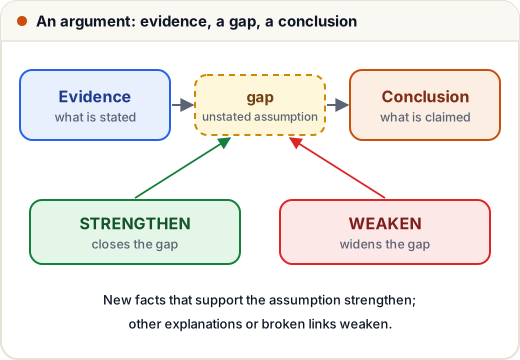
- Evidence — the facts given (often numbers or an observation).
- Conclusion — what the writer claims because of those facts. Look for words like so, therefore, hence, this shows, clearly.
- Gap — the step the writer did not prove. It is the assumption you met in the statements and assumptions lesson.
Example argument
"Students who attended our free aptitude workshop scored 15 marks more on average in the placement test than those who did not. So, the workshop improves test scores."
- Evidence: attendees scored 15 marks more on average.
- Conclusion: the workshop caused the higher scores.
- Gap: the attendees were similar to the others in every other way. Nothing else explains the difference.
Once you see the gap, the question becomes easy: a strengthener supports the gap, a weakener attacks it.
2. How to weaken
There are three common ways to weaken an argument.
| Way | What the option says | For the workshop example |
|---|---|---|
| Another cause | Something else explains the result | Only students who already practise regularly chose to attend. |
| Broken link | The evidence does not really show the claim | The test given to attendees was an easier set. |
| Reverse direction | The "effect" actually caused the "cause" | (Rare here) Good scorers were invited to the workshop. |
The another cause weakener is by far the most common. Whenever an argument says "X happened, then Y happened, so X caused Y", ask: what else could cause Y?
3. How to strengthen
A strengthener does the opposite. It usually:
- Rules out another cause. "Attendees and non-attendees had almost the same scores in the previous mock test." Now the groups were similar before, so the workshop looks like the reason.
- Confirms the link. "Attendees scored higher mainly in the topics the workshop taught."
- Adds more evidence of the same kind. "The same pattern was seen in two other colleges."
A strengthener does not need to prove the conclusion. It only needs to make it more likely.
4. Solved examples
Example 1 — weaken
"Since the city opened its new metro line, the number of road accidents has fallen by 20%. So, the metro has made roads safer."
Which option weakens the argument most?
- (a) The metro is very crowded during office hours.
- (b) In the same period, the city installed speed cameras on all major roads.
- (c) Metro tickets are cheaper than taxis.
- (d) Accidents also happen inside metro stations.
Answer: (b). It gives another cause for the fall in accidents. (a) and (c) are about the metro but do not touch the gap. (d) is about a different kind of accident.
Example 2 — strengthen
"A shop started playing slow music and its average bill went up from ₹420 to ₹480. So, slow music makes customers spend more."
Which option strengthens the argument?
- (a) The shop also started a 30% discount sale the same month.
- (b) The shop's rent was increased this year.
- (c) Prices, products and the number of customers stayed the same during this period.
- (d) Many customers do not like loud music.
Answer: (c). It rules out other causes (price changes, new products), so the music is the likely reason. (a) actually weakens it. (b) is out of scope. (d) is about liking, not spending.
The bill rose by ₹60, which is 60 ÷ 420 ≈ 14.3%. You do not need the number to answer, but tests sometimes add one to distract you.
Example 3 — weaken a prediction
"Our new app had 10,000 downloads in its first week. Therefore, it will have 520,000 downloads in its first year."
The writer assumes the weekly rate (10,000 × 52 = 520,000) will stay the same all year. An option such as "Most apps get the largest share of their downloads in the launch week because of advertising" weakens it by breaking that assumption.
5. Options to reject quickly
- Out of scope: true or interesting, but not about the gap (the rent in Example 2).
- Repeats the evidence: saying again what the argument already said adds nothing.
- Wrong direction: in a weaken question, an option that strengthens (and the other way round). Tests often include one on purpose.
- Too extreme to be needed: an option does not have to prove or disprove everything; reject ones that bring in new topics just because they sound strong.
Common mistakes
- Judging whether the conclusion is true in real life instead of what the option does to the argument.
- Picking an option that is about the same topic but does not touch the gap.
- Forgetting the question type halfway and choosing a strengthener for a weaken question.
- Thinking a weakener must prove the conclusion false. It only has to make it less likely.
Quick recap
- Split the argument: evidence, conclusion, gap (the unstated assumption).
- Weaken: give another cause, break the link, or reverse the direction.
- Strengthen: rule out other causes, confirm the link, or add similar evidence.
- Reject options that are out of scope, repeat the evidence or point the wrong way.