AdvancedLogical Reasoning · Lesson 20 of 24 · Updated ·
Scheduling Puzzles — Days of the Week and Months of the Year
A scheduling puzzle places people (or events) on days of a week or months of a year, often with a second attribute: a subject, a city, a company. It is the same idea as a floor puzzle laid on its side: Monday comes before Tuesday just as floor 1 comes before floor 2.
What makes scheduling puzzles different is the built-in knowledge they rely on:
| Fact | Used in clues like |
|---|---|
| The week order Monday → Sunday (check where the question starts the week) | "the day after", "the first day" |
| Months with 31 days: January, March, May, July, August, October, December | "a month with 31 days" |
| Months with 30 days: April, June, September, November | "a month with 30 days" |
| February has 28 days (29 in a leap year) | "the shortest month" |
Only the months listed in the puzzle count. If the puzzle uses five months, "the month after March" means the next month in that list, not necessarily April. Read the question to see which one it means.
1. A day-based puzzle with two attributes
Six trainees — Ravi, Sana, Tara, Uday, Vani, Wasim — attend a training session on six days, Monday to Saturday, one per day. Each learns a different topic: Java, Python, SQL, C, Excel, Git.
Clues:
- Tara attends on Wednesday.
- Only one person attends between Tara and the person who learns C.
- The person who learns C attends after Tara.
- Uday attends on the day just before the person who learns C, and Uday learns Java.
- Vani attends on the day just after Uday.
- Ravi attends on the first day.
- Sana attends before Tara.
- Python is learnt on Monday.
- The person who learns SQL attends on the day just after the person who learns Git.
Step 1 — clue 1. Tara = Wednesday.
Step 2 — clues 2 and 3. One person between Tara (Wed) and C → C is on Monday or Friday. C is after Tara → C = Friday.
Step 3 — clues 4 and 5. Uday is the day before Friday → Uday = Thursday, Java. Vani is the day after Uday → Vani = Friday, so Vani learns C.
Step 4 — clues 6 and 7. Ravi = Monday. Sana is before Wednesday and Monday is taken → Sana = Tuesday. The last person → Wasim = Saturday.
Step 5 — clue 8. Monday is Ravi → Ravi learns Python.
Step 6 — clue 9. The topics left are SQL, Excel and Git for Tuesday, Wednesday and Saturday. Git must be the day right before SQL. Only Tuesday → Wednesday works → Sana learns Git, Tara learns SQL, and Wasim learns Excel.
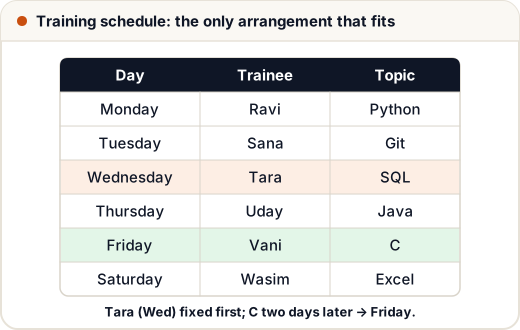
We tested all 720 × 720 combinations of days and topics in Python: only this one fits all nine clues.
Questions you can now answer:
- Who learns SQL? → Tara.
- How many people attend between Sana and Vani? Wednesday, Thursday → 2.
- On which day is Excel taught? → Saturday.
2. A month-based puzzle that needs cases
Five friends A, B, C, D, E have job interviews in five different months of the same year: January, March, April, June, September. (In this puzzle, "between" means between in this list of five months.)
Clues:
- B's interview is in a month with 30 days.
- Exactly one interview is between B's and D's.
- D's interview is in a month with 31 days.
- E's interview is after C's.
- A's interview is the last of the five.
- C's interview is not in January.
Step 1 — clue 5. A = September.
Step 2 — clues 1 and 3. Of the months left, the 30-day ones are April and June; the 31-day ones are January and March. So B ∈ {April, June} and D ∈ {January, March}.
Step 3 — clue 2. One month between B and D:
- Case 1: D = January, B = April (March is between).
- Case 2: D = March, B = June (April is between).
Step 4 — clue 4. Fill each case with C and E, C before E:
- Case 1: March and June are left → C = March, E = June.
- Case 2: January and April are left → C = January, E = April.
Step 5 — clue 6. C is not in January → Case 2 fails.
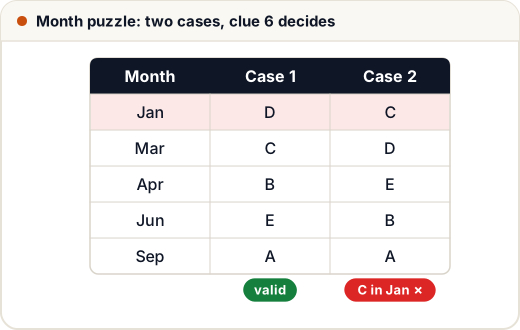
Answer: January D, March C, April B, June E, September A.
3. Turning clues into option lists
The fastest solvers write a short option list for every person before placing anyone.
| Clue type | Turn it into |
|---|---|
| "X is in a month with 30 days" | X ∈ {the 30-day months in the list} |
| "One person between X and Y" | positions differ by 2 |
| "X is just before Y" | position of Y = position of X + 1 |
| "X is not on the first day" | cross out day 1 for X |
| "X is after Y" | X's position > Y's position (any gap) |
Then look for the person with the fewest options and start there. In the month puzzle, A had one option, so A went first.
Common mistakes
- Treating "after" as "just after".
- Counting the two people themselves when a clue says "between".
- Forgetting that the puzzle's month list may skip months.
- Assuming the week starts on Sunday when the puzzle says Monday (or the other way round).
Quick recap
- A scheduling puzzle is a line of days or months — the same tools as floors and rows.
- Know the 30-day and 31-day months by heart.
- Write an option list for each person; start with the person who has the fewest options.
- When two cases appear, fill both and let a later clue reject one.