AdvancedLogical Reasoning · Lesson 21 of 24 · Updated ·
Cubes and Dice — Opposite Faces and Painted Cube Counting
Cube and dice questions test whether you can picture a 3D object from a flat drawing. They look visual, but each type has a fixed rule, so you rarely need to imagine anything.
A cube (or die, plural dice) has 6 faces, 12 edges and 8 corners. Each face touches 4 other faces and is opposite to exactly 1. When you look at a die from a corner, you see 3 faces: top, front and right.
1. The standard die
On a standard die, opposite faces add up to 7:
| Face | 1 | 2 | 3 | 4 | 5 | 6 |
|---|---|---|---|---|---|---|
| Opposite | 6 | 5 | 4 | 3 | 2 | 1 |
Example 1
A standard die shows 2 on top. What is at the bottom? → 7 − 2 = 5.
Only use the sum-7 rule when the question says "standard die". Most reasoning questions use dice with their own numbering, and the rule does not apply. Also note: even when you know all three opposite pairs, there are two different dice that fit (mirror images of each other), so "which number is to the right of 1?" may still need a view.
2. Rule 1 — numbers seen together are never opposite
Two faces that appear in the same view touch each other, so they cannot be opposite.
Example 2
Two views of a die: (top 3, front 2, right 1) and (top 6, front 3, right 4). Which number is opposite 3?
- 3 appears with 2 and 1 in the first view, and with 6 and 4 in the second view.
- So 3 touches 1, 2, 4 and 6.
- Only one number is left → 5 is opposite 3.
This works whenever one number has been seen with four different numbers.
3. Rule 2 — two views with one common number
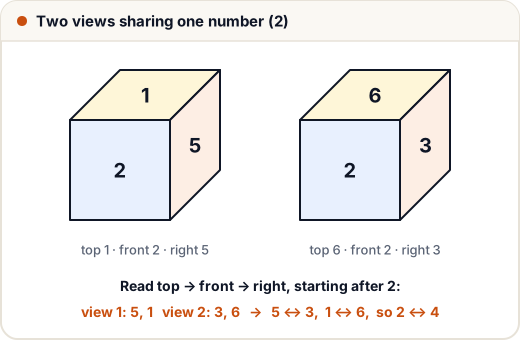
When two views share exactly one number, read each view in the order top → front → right (going round in a circle), starting just after the common number. The numbers in the same place are opposite.
Example 3
View 1: top 1, front 2, right 5. View 2: top 6, front 2, right 3.
- The common number is 2.
- View 1, starting after 2 and going top → front → right round the circle: 5, 1.
- View 2, starting after 2: 3, 6.
- Match the places: 5 ↔ 3 and 1 ↔ 6. The two numbers left, 2 and 4, are opposite each other.
The common number can be in any position; the method is the same. For example, views (top 3, front 1, right 4) and (top 6, front 4, right 5) share 4. After 4: view 1 gives 3, 1; view 2 gives 5, 6 → 3 ↔ 5 and 1 ↔ 6.
We tested this rule on every pair of views of all 30 possible dice that share exactly one number — 6,480 pairs — and it never failed.
4. Rule 3 — same number in the same place
View 1: top 1, front 2, right 5. View 2: top 1, front 5, right 4.
Here 1 is on top in both. Turning the die about the 1–(bottom) axis shows the faces around 1 in order: 2, 5, 4. So 2 and 4 sit on either side of 5 around the top → 2 is opposite 4.
What is opposite 1? 1 has been seen with 2, 5 and 4 — only three numbers. Its opposite is 3 or 6, so the answer is cannot be determined from these views. (Our check over all dice found exactly two dice that fit these two views — one with 3 under 1, one with 6.)
5. Painted cubes cut into small cubes
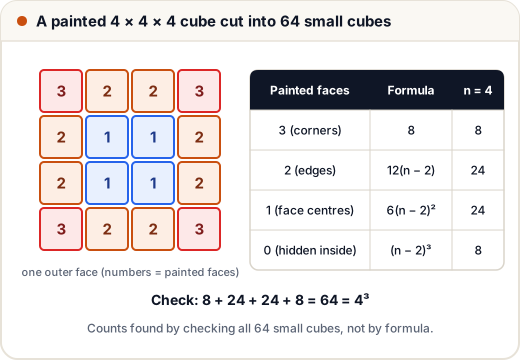
A big cube is painted on all six faces and cut into n × n × n small cubes of equal size. How many small cubes have paint on 3, 2, 1 or 0 faces?
| Painted faces | Where they are | Count |
|---|---|---|
| 3 | the 8 corners | 8 |
| 2 | along the 12 edges, not corners | 12(n − 2) |
| 1 | in the middle of the 6 faces | 6(n − 2)² |
| 0 | hidden inside | (n − 2)³ |
Example 4 — n = 4
- 3 faces: 8
- 2 faces: 12 × 2 = 24
- 1 face: 6 × 2² = 24
- 0 faces: 2³ = 8
- Check: 8 + 24 + 24 + 8 = 64 = 4³ ✓
Example 5 — n = 5
3 faces: 8; 2 faces: 12 × 3 = 36; 1 face: 6 × 9 = 54; 0 faces: 27. Total 125 = 5³ ✓.
(We counted these by checking every small cube in Python for n = 3, 4, 5 and 6; the formulas match each time.)
Always check the total. The four counts must add up to n³. If they don't, one formula was used wrongly.
Common mistakes
- Using "opposite faces add to 7" when the die is not standard.
- Reading the views in different directions. Always use the same order (top → front → right) for both views.
- Saying the opposite is known when a number has been seen with only three others.
- Using n instead of (n − 2) in the painted-cube formulas.
Quick recap
- Standard die only: opposite faces add to 7.
- Faces seen together are never opposite. Seen with four numbers → the fifth is opposite.
- One common number: read top → front → right after it; same places are opposite.
- Painted n³ cube: 8, 12(n − 2), 6(n − 2)², (n − 2)³ — and they add to n³.