Security
Ethical Hacking
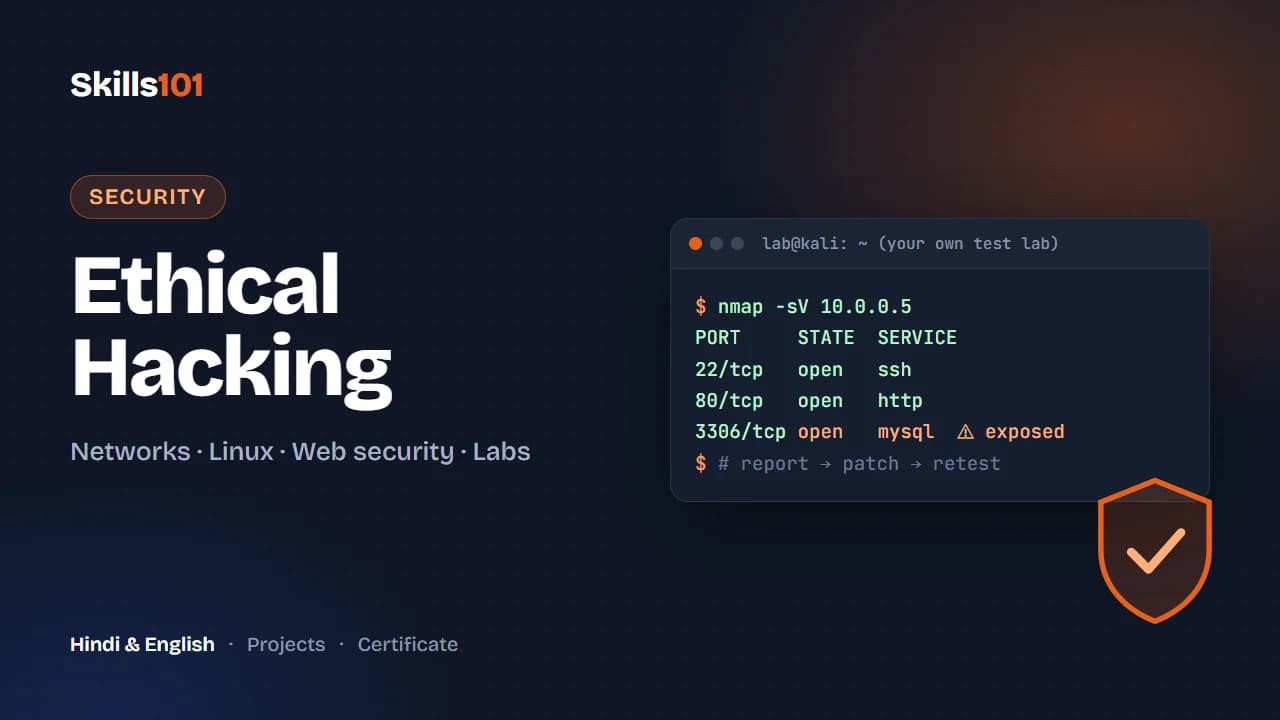
Learn how attackers think — and how to defend systems — legally, in your own lab: reconnaissance, scanning, vulnerabilities, wireless and web security.
- Beginner
- Hindi & English
- Self-paced
- By Pankaj Sharma
32
video lessons
16
written lessons with diagrams
16
lesson quizzes
✓
verifiable certificate
What you'll learn
- Understand the role, ethics and legal limits of ethical hacking
- Perform reconnaissance and scanning on your own lab machines
- Assess vulnerabilities and understand how common exploits work
- Secure wireless networks
- Find and fix web vulnerabilities such as SQL injection and XSS
- Write clear security findings and fixes
Sounds like you?
You’re curious about cybersecurity but need a proper, legal starting point.
You start with the role, ethics and law, then practise reconnaissance and scanning only in your own lab.
You don’t know which security topics to learn next.
The course links into the written Web Security (OWASP Top 10), Computer Networks and Linux lessons, so you have a clear next step.
Your learning path
Each module combines video lessons with written lessons, quizzes and practice. Open a module to see everything in it.
01Foundations and ethicsTypes of hackers, the law, and common threats.▶ 4 videos📘 7 written✅ 7 quizzes
Video lessons
- Understanding the role of ethical hackers
- Overview of different types of hackers and their motivations
- The legal and ethical aspects of ethical hacking
- Introduction to common security threats and attack vectors
02Reconnaissance and scanningFinding hosts, ports and services in your own lab.▶ 8 videos
Video lessons
- Network scanning techniques and tools
- Identifying open ports and services
- Enumeration of target systems for valuable information
- Analyzing system configurations for potential weaknesses
- Network scanning techniques and tools
- Identifying open ports and services
- Enumeration of target systems for valuable information
- Analyzing system configurations for potential weaknesses
03Vulnerabilities, wireless and webAssess and exploit vulnerabilities in a lab, secure Wi-Fi and web apps.▶ 20 videos📘 9 written✅ 9 quizzes
Video lessons
- Understanding vulnerabilities and their impact
- Conducting vulnerability assessments using scanning tools
- Exploiting common vulnerabilities (e.g., SQL injection, cross-site scripting)
- Mitigation techniques for identified vulnerabilities
- Introduction to wireless network security
- Identifying vulnerabilities in wireless networks
- Exploiting wireless network weaknesses
- Securing wireless networks and best practices
- Common web application vulnerabilities (e.g., OWASP Top 10)
- Testing web applications for security flaws
- Cross-site scripting (XSS) and cross-site request forgery (CSRF) attacks
- Securing web applications and coding practices
- Securing network infrastructure (routers, firewalls, etc.)
- Intrusion detection and prevention systems (IDS/IPS)
- Network traffic analysis and packet sniffing
- Incident response and handling security breaches
- Overview of popular ethical hacking tools (e.g., Metasploit, Nmap)
- Developing a career path in ethical hacking and cybersecurity
- Professional certifications and further learning opportunities
- Legal and ethical considerations for ethical hackers
Who this is for
- →Students curious about a cybersecurity career
- →Developers who want to build safer applications
Requirements
- •Basic computer and internet knowledge
- •A laptop that can run a virtual machine for your practice lab
Earn a verifiable certificate
Finish the course to get a certificate with your name and a unique ID that anyone can verify on Skills101 — and add it to LinkedIn in one click. Each written subject you complete earns its own free certificate too.
Your instructor
Pankaj Sharma
Founder, Skills101
About this course
An introduction to ethical hacking and cybersecurity: the role and legal limits of ethical hackers, reconnaissance, scanning and enumeration, vulnerability assessment, wireless security and web application security.
It's paired with Skills101's written Web Security (OWASP Top 10), Computer Networks and Linux for DevOps lessons, so you understand both how attacks work and how to prevent them.
Only test systems you own or have written permission to test. Unauthorised access is a crime under the IT Act, 2000.
Frequently asked questions
Is this legal?
Learning and practising on your own lab or with written permission is legal. Testing other people’s systems without permission is a crime.
Do I need to know programming?
Not to start, but basic Linux, networking and Python help a lot — the linked lessons cover them.
Free