Python Programming · Lesson 12 of 15 · Updated ·
Object-Oriented Programming in Python — Classes, Objects, Inheritance
Object-oriented programming (OOP) groups data and the functions that work on it into one unit called a class. It's how large programs stay organised — and OOP questions appear in almost every fresher interview.
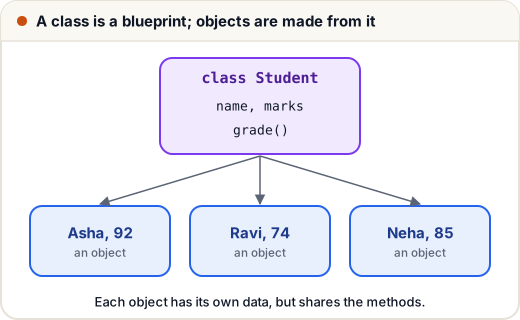
1. A first class
class Student:
    def __init__(self, name, marks):
        self.name = name        # instance attributes
        self.marks = marks

    def grade(self):            # a method
        return "A" if self.marks >= 85 else "B"

asha = Student("Asha", 92)
ravi = Student("Ravi", 74)
print(asha.name, asha.grade())
print(ravi.name, ravi.grade())
Asha A
Ravi B
class Student:defines the blueprint.__init__runs automatically when you create an object (the constructor).selfis the object itself.self.name = namestores data on that object.- Methods are functions inside a class; their first parameter is
self.
2. Class attributes vs instance attributes
class Student:
    college = "Skills101"           # shared by ALL students
    count = 0

    def __init__(self, name):
        self.name = name            # different for each student
        Student.count += 1

a, b = Student("Asha"), Student("Ravi")
print(a.college, b.college, Student.count)
Skills101 Skills101 2
3. Printing objects nicely: str
class Book:
    def __init__(self, title, price):
        self.title, self.price = title, price

    def __str__(self):
        return f"{self.title} (₹{self.price})"

print(Book("Python Basics", 299))
Python Basics (₹299)
Methods with double underscores (__init__, __str__, __len__, __eq__) are called dunder (magic) methods. Python calls them for you.
4. Inheritance
A child class gets everything from its parent class and can add or change things.
class Employee:
    def __init__(self, name, salary):
        self.name, self.salary = name, salary

    def describe(self):
        return f"{self.name} earns ₹{self.salary}"

class Manager(Employee):
    def __init__(self, name, salary, team_size):
        super().__init__(name, salary)     # run the parent's __init__
        self.team_size = team_size

    def describe(self):                    # override
        return super().describe() + f" and manages {self.team_size} people"

print(Employee("Ravi", 40000).describe())
print(Manager("Neha", 90000, 6).describe())
Ravi earns ₹40000
Neha earns ₹90000 and manages 6 people
5. The four pillars (interview favourite)
| Pillar | Meaning | In Python |
|---|---|---|
| Encapsulation | keep data and methods together; hide internals | attributes + methods in a class; _name means "internal" |
| Abstraction | show what it does, hide how | a simple method like account.withdraw(500) |
| Inheritance | reuse code from a parent class | class Manager(Employee) |
| Polymorphism | same method name, different behaviour | describe() in both classes |
The OOP Concepts subject explains these in depth, for every language.
Encapsulation example
class BankAccount:
    def __init__(self, balance):
        self._balance = balance           # "internal" by convention

    def withdraw(self, amount):
        if amount > self._balance:
            return "Insufficient balance"
        self._balance -= amount
        return f"Withdrawn ₹{amount}, left ₹{self._balance}"

acc = BankAccount(1000)
print(acc.withdraw(300))
print(acc.withdraw(5000))
Withdrawn ₹300, left ₹700
Insufficient balance
Common mistakes
- Forgetting
selfas the first parameter of a method. - Writing
name = nameinstead ofself.name = namein__init__. - Forgetting
super().__init__(…)in a child's__init__, so the parent's attributes are missing.
Quick recap
- Class = blueprint; object = an instance made from it.
__init__sets up the object;selfis the object.- Class attributes are shared; instance attributes are per object.
- Inheritance with
class Child(Parent)andsuper(). __str__controls how an object prints.