Cloud & DevOps · Lesson 1 of 9 · Updated ·
What Are DevOps and Cloud? — The DevOps Loop, IaaS vs PaaS vs SaaS and the Big 3 Clouds
Writing code is only half of software. Someone has to build it, test it, ship it to servers, keep it running at 3 a.m., and scale it when 10× more students show up on result day. That's DevOps and cloud — and it's one of the fastest-growing job areas for freshers in India.
1. The problem DevOps solves
Old way: developers wrote code for months, then "threw it over the wall" to an operations team who had to deploy it. Releases were rare, scary and often broke things. Developers said "it works on my machine"; operations said "your code broke production".
DevOps is a culture and set of practices where the same team builds, ships and runs the software, with heavy automation:
- small, frequent releases instead of big rare ones
- every change automatically built and tested (CI — continuous integration)
- deployment automated and repeatable (CD — continuous delivery/deployment)
- infrastructure written as code, versioned in Git
- monitoring, so problems are found by alerts, not angry users
2. The DevOps loop
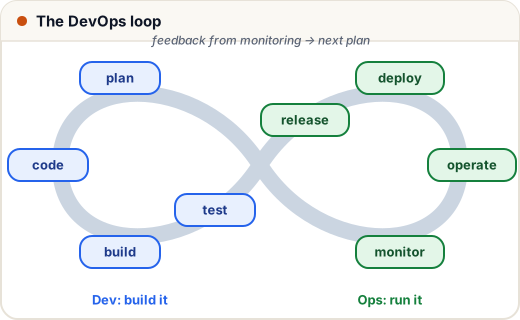
| Stage | What happens | Typical tools |
|---|---|---|
| Plan | tickets, priorities | Jira, GitHub Issues |
| Code | write and review code | Git, GitHub, VS Code |
| Build | compile, package, build images | npm, Maven, Docker |
| Test | unit, integration, security tests | Jest, pytest, JUnit, Selenium |
| Release | version and approve | GitHub Releases, tags |
| Deploy | push to servers | GitHub Actions, Jenkins, Argo CD |
| Operate | run, scale, patch | Kubernetes, Linux, cloud consoles |
| Monitor | metrics, logs, alerts | Prometheus, Grafana, CloudWatch |
You'll learn each stage in this track.
3. What is "the cloud"?
The cloud is renting computing over the internet instead of buying servers. You pay for what you use, get machines in minutes, and can scale up or down.
| Before cloud | With cloud |
|---|---|
| buy servers weeks in advance | start a server in 1–2 minutes |
| pay upfront for peak capacity | pay per hour/second for what you use |
| your team fixes hardware | the provider handles hardware, power, cooling |
| one data centre | data centres worldwide |
4. Service models: who manages what?
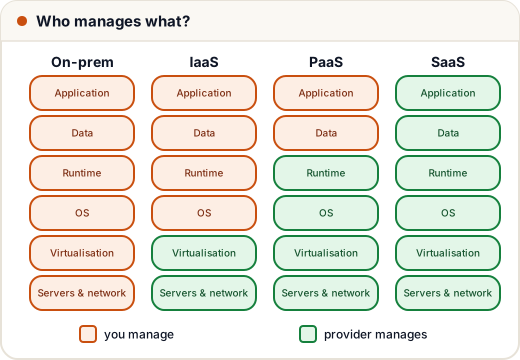
| Model | You manage | Provider manages | Example | Pizza analogy |
|---|---|---|---|---|
| On-premises | everything | nothing | your own server room | make pizza at home |
| IaaS (Infrastructure) | OS, runtime, app, data | hardware, network, virtualisation | AWS EC2, Azure VMs | buy a frozen base, bake at home |
| PaaS (Platform) | your app and data | everything below | Heroku, Render, Google App Engine, Elastic Beanstalk | order delivery, eat at home |
| SaaS (Software) | just your usage/data | everything | Gmail, Zoom, Google Docs | eat at the restaurant |
| Serverless / FaaS | individual functions | servers, scaling | AWS Lambda, Azure Functions | pay per slice |
Rule of thumb: the higher up the stack, the less control but the less work. Startups often begin on PaaS and move to IaaS/Kubernetes when they need more control or lower cost at scale.
5. Regions and availability zones
- Region: a geographic area with several data centres — e.g. AWS Mumbai (ap-south-1) and Hyderabad (ap-south-2), Azure Central India, Google Cloud Mumbai and Delhi.
- Availability Zone (AZ): one or more separate data centres inside a region, with independent power and networking.
Run your app in 2+ AZs so one data-centre failure doesn't take you down. Choose a region close to your users (lower latency) and one that meets data rules (some Indian sectors require data stored in India).
6. The Big 3 clouds side by side
| Need | AWS | Microsoft Azure | Google Cloud |
|---|---|---|---|
| Virtual machine | EC2 | Virtual Machines | Compute Engine |
| File/object storage | S3 | Blob Storage | Cloud Storage |
| Managed SQL database | RDS / Aurora | Azure SQL / Database for PostgreSQL | Cloud SQL |
| Serverless functions | Lambda | Functions | Cloud Run functions |
| Kubernetes | EKS | AKS | GKE |
| Identity & permissions | IAM | Entra ID + RBAC | IAM |
| Monitoring | CloudWatch | Azure Monitor | Cloud Monitoring |
| CDN | CloudFront | Front Door / CDN | Cloud CDN |
Concepts transfer between clouds — learn one deeply (AWS has the largest market share and the most job posts), and you can pick up the others quickly.
7. Case study: result day at a coaching platform
A test-prep site normally serves 2,000 students at a time. On result day, 60,000 arrive within an hour.
- Without cloud/DevOps: the single server maxes out, the site crashes, someone SSHes in and restarts it repeatedly.
- With cloud/DevOps: the app runs as containers behind a load balancer across two AZs; autoscaling adds servers when CPU goes above 60%; static pages are cached on a CDN; alerts warn the team before users notice; after the rush, extra servers shut down so the bill drops back.
You'll be able to explain (and build) every piece of that by the end of this track.
8. Careers
| Role | Focus |
|---|---|
| DevOps engineer | CI/CD, automation, infrastructure as code |
| Cloud engineer | designing and running cloud infrastructure |
| Site Reliability Engineer (SRE) | reliability, monitoring, incident response, performance |
| Platform engineer | internal tools so developers ship easily |
Fresher path: Linux + Git + one language (Python/Go/bash) → Docker → CI/CD → one cloud (AWS) → Kubernetes → Terraform. A cloud certification such as AWS Certified Cloud Practitioner or Solutions Architect – Associate helps you clear HR filters; a deployed project helps you clear interviews.
Common mistakes
- Thinking DevOps is just "a tool" (Jenkins, Docker). It's a way of working; tools support it.
- Running everything in one availability zone.
- Leaving test servers running and getting a surprise bill — always set a billing alert.
Quick recap
- DevOps = one team builds, ships and runs software, with automation (CI/CD, IaC, monitoring).
- Cloud = rent compute on demand. Models: IaaS → PaaS → SaaS (more managed going up), plus serverless.
- Region = geographic area; AZ = isolated data centre(s) inside it. Use 2+ AZs.
- AWS, Azure and GCP offer the same building blocks under different names.