AdvancedVerbal Ability (English) · Lesson 11 of 14 · Updated ·
Pronouns — I or Me, Who or Whom, and Clear Reference
A pronoun is a word that stands in place of a noun, so we do not repeat the noun again and again. In "Priya finished her project and submitted it", her and it are pronouns: "her" stands for Priya, "it" for the project.
Most pronoun errors in tests come from four places: using the wrong form (I/me, who/whom), the wrong number (singular/plural), a wrong -self word, or an unclear reference.
1. Subject form or object form?
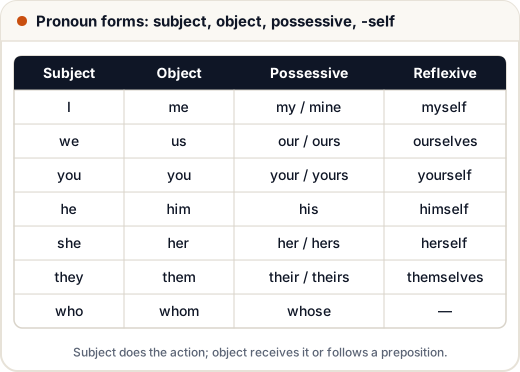
- The subject form (I, he, she, we, they, who) is used for the person doing the action: She wrote the code.
- The object form (me, him, her, us, them, whom) is used for the person receiving the action, and after a preposition such as to, for, with, between, among: The manager called him. The gift is for them.
The cover-up test
When a pronoun is joined to another noun with "and", students often choose the wrong form. Cover the other noun and read the sentence again.
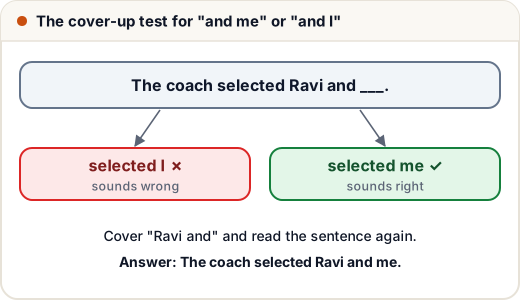
- Ravi and me went to the fair. → cover "Ravi and" → me went ✗ → Ravi and I went.
- The teacher praised Asha and I. → praised I ✗ → praised Asha and me.
- Between you and I ✗ → after the preposition "between" → between you and me.
Politeness rule: in English the speaker usually comes last — you and I, Ravi and me — not I and Ravi.
After "than" and "as"
Complete the hidden verb in your head.
- She is taller than I (am). ✓
- He likes you more than me means "more than he likes me". He likes you more than I (do) means "more than I like you". Both are correct but mean different things.
2. Who or whom?
Who is a subject form, whom is an object form. Use the he/him test: answer the question with he or him.
- ___ called you? → He called me → Who called you?
- ___ did you call? → I called him → Whom did you call?
- The student ___ won the prize is my friend. → he won → who.
- The person to ___ I spoke was helpful. → after "to" → whom.
Remember: him = whom (both end in -m).
Whose shows belonging: The student whose bag was lost. Do not confuse it with who's (= who is).
3. Agreement: singular or plural?
A pronoun must agree in number with the noun it replaces.
| Noun or word | Pronoun to use | Example |
|---|---|---|
| everyone, everybody, each, every, anyone, nobody | singular (his or her / their in modern usage) | Everyone must bring his or her ID. |
| each of the students | singular | Each of the students has his or her own laptop. |
| either of / neither of | singular | Neither of the girls has finished her work. |
| collective noun acting as one unit | it / its | The team has won its first match. |
| both, few, many, several | plural | Both of them did their best. |
Note: in everyday modern English, "Everyone must bring their ID" is widely accepted. Many placement tests still follow the older rule and mark his or her (or his) as correct, so choose the singular form when the options force a choice.
4. Reflexive pronouns (-self words)
A reflexive pronoun (myself, himself, themselves…) is used when the subject and the object are the same person, or for emphasis.
- She taught herself Python. ✓ (she taught she)
- I myself checked every answer. ✓ (emphasis)
- Rohan and myself will present. ✗ → Rohan and I will present.
- Please send the file to myself. ✗ → send the file to me.
Also: hisself and theirselves are not words. Use himself and themselves.
5. Clear reference
Every pronoun must point to one clear noun. If a reader cannot tell who "he" is, the sentence is weak and tests may ask you to improve it.
- Amit told Rahul that he had cleared the interview. (Who cleared it — Amit or Rahul?) → Amit told Rahul, "I have cleared the interview."
- The laptop was on the box, so I opened it. → say the box.
Also avoid a pronoun that refers to no noun at all: In the notice it says… → The notice says…
6. Solved error-spotting examples
| Sentence | Error → fix | Rule |
|---|---|---|
| Me and my friend went to Goa. | Me → My friend and I | subject form; "I" last |
| This is between you and I. | I → me | after preposition |
| Each of the boys have done their homework. | have … their → has … his | each = singular |
| Whom do you think is the best player? | Whom → Who | he is the best player |
| The company gave their staff a bonus. | their → its | company as one unit |
| He and myself prepared the slides. | myself → I | no reflexive as a subject |
Common mistakes
- Using "I" after a preposition: between you and I, for Riya and I.
- Using "myself" because it sounds polite: Contact myself.
- Treating everyone/each as plural in tests that follow the older rule.
- Writing "who's" for "whose", or "it's" for "its".
- Leaving "he" or "it" with two possible meanings.
Quick recap
- Subject: I, he, she, we, they, who. Object: me, him, her, us, them, whom.
- Cover-up test for "X and I / X and me"; after prepositions use the object form.
- he → who, him → whom.
- each, every, either, neither, everyone → singular.
- -self words only when subject and object are the same, or for emphasis.