AdvancedVerbal Ability (English) · Lesson 13 of 14 · Updated ·
Conjunctions and Linking Words — Although, Despite, However, Therefore
A conjunction is a word that joins two words, phrases or clauses: and, but, or, because, although. A wider group, often called connectors or linking words, also includes words such as however, therefore, moreover that link one sentence to the next.
These words carry the logic of a passage. That is why they matter in three kinds of placement questions: fill in the blanks, cloze tests and sentence ordering. Choosing "however" where "therefore" is needed changes the meaning completely.
1. Four jobs a linking word can do
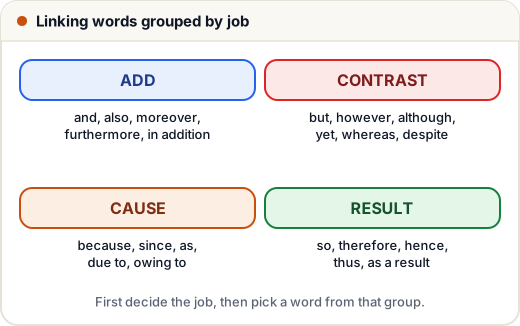
| Job | The second idea… | Examples |
|---|---|---|
| Addition | adds a similar point | The course is free. Moreover, it gives a certificate. |
| Contrast | goes against the first idea | The test was long, but the questions were easy. |
| Cause | gives the reason | The event was cancelled because it rained. |
| Result | gives the effect | It rained heavily; therefore, the event was cancelled. |
Other useful groups: example (for example, such as, for instance), condition (if, unless, provided that), time (when, while, after, before, until, as soon as), and summary (in short, overall, to sum up).
Method for blanks: read both sides of the blank and ask, "Does the second part add to, go against, explain, or follow from the first?" Then choose from that group only.
Worked example
"The app has many useful features. ______, it drains the battery quickly."
The second sentence is a negative point after a positive one → contrast → However. "Therefore" (result) and "Moreover" (addition) are wrong.
2. Coordinating conjunctions (FANBOYS)
Seven short words join two equal clauses: For, And, Nor, But, Or, Yet, So. When they join two full clauses, a comma usually comes before them.
- I studied hard, so I cleared the test.
- She was tired, yet she finished the report.
- He did not call, nor did he send a message. (After "nor", the helping verb comes before the subject.)
3. Although vs despite — the grammar after the word
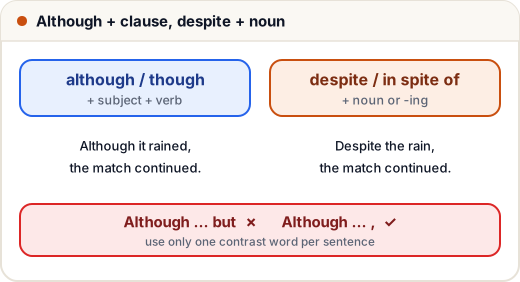
Many contrast and cause words come in two forms. One is followed by a full clause (subject + verb), the other by a noun or an -ing word.
| + clause (subject + verb) | + noun / -ing |
|---|---|
| although / though / even though it rained | despite / in spite of the rain |
| because the train was late | because of / due to / owing to the late train |
| while / when he was studying | during his studies |
- Despite he was ill, he came. ✗ → Despite being ill / his illness, he came. ✓ → or Although he was ill, he came. ✓
- In spite the rain ✗ → In spite of the rain ✓ ("in spite" always needs "of"; "despite" never takes "of").
One contrast word is enough
- Although she studied hard, but she failed. ✗
- Although she studied hard, she failed. ✓ or She studied hard, but she failed. ✓
The same goes for cause and result: Because it rained, so we stayed in ✗ → choose one.
4. However, therefore, moreover — punctuation
These words (called conjunctive adverbs) link two sentences, not two parts of one sentence. They cannot join two clauses with only a comma.
- The plan was good, however it failed. ✗ (two sentences joined by a comma)
- The plan was good. However, it failed. ✓
- The plan was good; however, it failed. ✓
- The plan was good, but it failed. ✓ ("but" can join with a comma)
The same pattern applies to therefore, moreover, furthermore, nevertheless, otherwise, hence.
5. Easily confused pairs
| Pair | Difference | Example |
|---|---|---|
| unless / if not | "unless" already contains "not" | Unless you apply, you won't get it. (not "unless you don't apply") |
| until / unless | time vs condition | Wait until I call. / You can't enter unless you have a pass. |
| as / like | "as" + clause or role; "like" + noun | Do as I say. / She sings like a professional. |
| so that / so | purpose vs result | I left early so that I could catch the bus. / I left early, so I caught the bus. |
| whereas / while | both show contrast between two facts | Ravi likes tea, whereas Asha prefers coffee. |
| lest | "for fear that", followed by should + verb or the base verb | Walk carefully lest you should fall. (not "lest you don't fall") |
Fixed pairs (from the earlier lessons): no sooner … than, hardly / scarcely … when, not only … but also, either … or, neither … nor, both … and, such … that, so … that.
6. Solved examples
| Sentence | Error → fix |
|---|---|
| Though he is rich, but he is humble. | remove but |
| Despite of the traffic, we reached on time. | Despite of → Despite (or In spite of) |
| The flight was delayed because of it was foggy. | because of → because |
| She was ill, therefore she stayed home. | → She was ill*;** therefore, she stayed home.* |
| Unless you don't hurry, you will be late. | don't hurry → hurry |
| No sooner had he arrived when it started raining. | when → than |
Common mistakes
- Using two linking words for one link: although … but, because … so.
- Writing "despite of" or "in spite the".
- Putting a clause after "because of" or "despite".
- Joining two full sentences with "however" and only a comma.
- Adding "not" after "unless" or "lest".
- Choosing a word for its sound rather than its job (addition, contrast, cause, result).
Quick recap
- Decide the job first: add, contrast, cause, result (or example, condition, time).
- although/because + clause; despite/because of + noun or -ing.
- One linking word per link: never "although … but".
- however/therefore link sentences: use a full stop or semicolon before them.
- Learn the fixed pairs: no sooner … than, hardly … when, neither … nor.