AdvancedVerbal Ability (English) · Lesson 10 of 14 · Updated ·
Conditional Sentences — If-Clauses, Types 0 to 3 and "If I Were"
A conditional sentence has two parts: an if-clause (the condition) and a main clause (the result). If you practise daily, you will improve. Here "If you practise daily" is the condition and "you will improve" is the result.
Each type of conditional uses a fixed pair of tenses. Error-spotting questions often break that pair, so once you know the four patterns, these questions become quick marks.
1. The four types
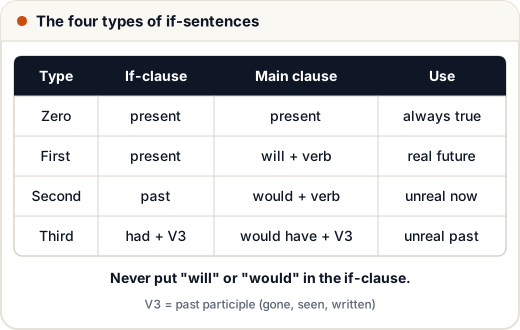
Zero conditional — always true
If + present, present. Used for facts and general rules.
- If you heat water to 100 °C at sea level, it boils.
- If a student misses the deadline, the portal closes.
Here "if" means almost the same as "whenever".
First conditional — a real possibility in the future
If + present, will + base verb.
- If it rains tomorrow, the match will be cancelled.
- If you submit the form today, you will get the admit card by Friday.
Note: the if-clause uses the present tense even though it talks about the future. If it will rain tomorrow ✗.
Second conditional — unreal or unlikely now
If + past simple, would + base verb. It talks about the present or future, but the situation is imaginary or unlikely.
- If I had a car, I would drive to college. (I don't have a car.)
- If she lived nearer, she would visit more often. (She doesn't live nearer.)
With the verb "be", formal English uses were for every subject:
- If I were you, I would accept the offer.
- If he were taller, he could join the team.
Third conditional — unreal past
If + had + past participle, would have + past participle. It imagines a different past, so it often expresses regret.
- If I had left earlier, I would have caught the train. (I didn't leave earlier, so I missed it.)
- If they had checked the code, the app would not have crashed.
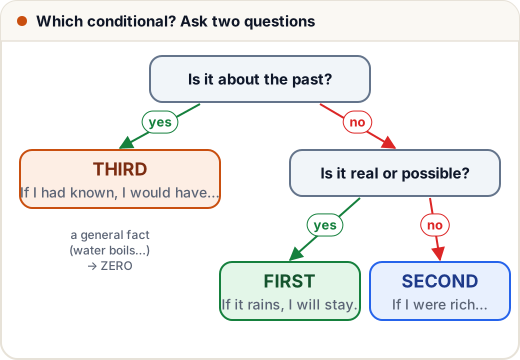
2. Choosing the right type
| Situation | Type | Example |
|---|---|---|
| Fact that is always true | Zero | If you mix red and blue, you get purple. |
| Likely in the future | First | If the bus is late, I will take an auto. |
| Imaginary now | Second | If I knew Japanese, I would apply in Tokyo. |
| Imaginary past | Third | If I had known, I would have helped. |
3. The golden rule: no "will" or "would" in the if-clause
This is the error tests check most often.
| Wrong | Right |
|---|---|
| If you will call me, I will come. | If you call me, I will come. |
| If I would have money, I would buy it. | If I had money, I would buy it. |
| If he would have studied, he would have passed. | If he had studied, he would have passed. |
(One exception: If you would wait a moment, I will check — here "would" is a polite request, not a tense. Tests rarely use it.)
4. Unless, wish and other forms
Unless = if … not
- Unless you hurry, you will miss the bus. = If you do not hurry, you will miss the bus.
- Do not add another "not": Unless you do not hurry ✗.
Wish
"Wish" is followed by the same tenses as the second and third conditionals.
- Present wish: I wish I knew the answer. / I wish I were taller.
- Past wish: I wish I had studied harder last year.
- I wish I know the answer ✗.
Inverted forms (formal)
The word "if" can be dropped by moving the helping verb to the front:
- If I had known → Had I known, I would have come.
- If I were you → Were I you, I would wait.
- If you should need help → Should you need help, call this number.
Provided that, as long as, in case
- You can use the lab provided that you sign the register. (= only if)
- Carry an umbrella in case it rains. (= because it might rain — not the same as "if")
5. Solved examples
| Sentence | Error → fix | Type |
|---|---|---|
| If I will get the job, I will buy a bike. | will get → get | First |
| If I was the principal, I would allow phones. | was → were (formal) | Second |
| If she had asked, I would help her. | would help → would have helped | Third |
| Unless you don't apply, you won't be selected. | don't apply → apply | Unless |
| I wish I can speak French. | can → could | Wish |
Common mistakes
- Putting "will" or "would" in the if-clause.
- Mixing types by accident: If I had money, I will buy it (past + will).
- Using "was" instead of "were" in "If I were you" in formal tests.
- Adding "not" after "unless".
- Confusing "in case" (as a precaution) with "if".
Quick recap
- Zero: present + present (facts). First: present + will (real future).
- Second: past + would (unreal now). Third: had + V3, would have + V3 (unreal past).
- No will/would in the if-clause.
- Unless = if not; wish follows the second and third patterns.