AdvancedVerbal Ability (English) · Lesson 9 of 14 · Updated ·
Modal Verbs — Can, Could, May, Might, Must, Should and Would
A modal verb is a helping verb that adds a meaning such as ability (can), permission (may), advice (should), duty (must) or possibility (might) to the main verb. Placement tests check modals in error spotting, fill in the blanks and sentence improvement, so a few clear rules go a long way.
The main modals are: can, could, may, might, must, shall, should, will, would, plus the semi-modals ought to, need and dare.
1. Three grammar rules for every modal
- A modal is followed by the base form of the verb (the verb with no -s, -ed or -ing).
- She can swim. ✓ — She can swims. ✗ — She can to swim. ✗
- A modal never changes with the subject. There is no -s for he/she/it.
- He must go. ✓ — He musts go. ✗
- Two modals do not go together. Use a phrase such as be able to or have to for the second idea.
- You will can finish. ✗ → You will be able to finish. ✓
The only common exception is ought to, which keeps "to": You ought to apologise.
2. What each modal means
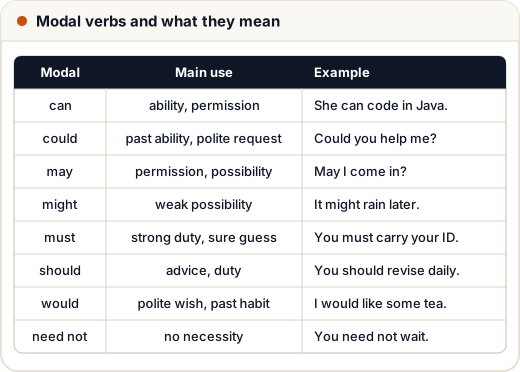
Ability: can, could, be able to
- Riya can solve this puzzle in two minutes. (present ability)
- I could read before I was four. (general ability in the past)
- After three tries, he was able to clear the test. (one success in the past — "could" sounds odd here)
Permission and requests: can, could, may
- You may leave after the test. (formal permission)
- Could you share your notes? (polite request — more polite than "can")
Advice and duty: should, ought to, must, have to
- You should revise every day. (advice)
- Candidates must carry a photo ID. (strong rule)
- I have to catch the 7 am bus. (duty from outside — the timetable)
- You must not use phones in the exam. (it is not allowed)
- You need not / don't have to bring a printout. (it is not necessary)
Must not and need not are very different. "You must not come" = coming is forbidden. "You need not come" = coming is optional.
3. How sure is the speaker?
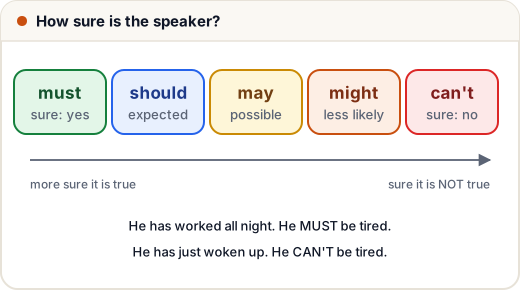
Modals also show how sure we are about something:
- The lights are on. She must be at home. (I am almost sure — a logical guess)
- The train should arrive by 6. (I expect it)
- He may / might call later. (possible; "might" is a little less sure)
- That can't be Rahul — he is in Pune today. (I am almost sure it is not)
Note: the opposite of the "sure guess" must is can't, not "mustn't".
4. Past forms: modal + have + past participle
To talk about the past with a modal, use modal + have + past participle (the third form of the verb, like gone, done, written).
| Form | Meaning | Example |
|---|---|---|
| should have + V3 | it was right, but it did not happen | You should have told me earlier. |
| could have + V3 | it was possible, but it did not happen | We could have won with one more goal. |
| must have + V3 | sure guess about the past | The road is wet. It must have rained. |
| might have + V3 | possible guess about the past | She might have missed the bus. |
| can't have + V3 | sure it did not happen | He can't have finished so soon. |
| needn't have + V3 | it was done, but it was not necessary | You needn't have bought tickets; entry was free. |
Mistake to avoid: should of is never correct. It comes from the spoken sound of should've.
5. Solved error-spotting examples
| Sentence | Error → fix | Rule |
|---|---|---|
| She can speaks three languages. | speaks → speak | modal + base verb |
| You must to submit the form today. | must to → must | no "to" after must |
| He will can join next week. | will can → will be able to | no two modals |
| You need not to worry. | need not to → need not | modal "need" takes base verb |
| I should have went home. | went → gone | have + past participle |
| He ought apologise. | ought → ought to | ought keeps "to" |
Common mistakes
- Adding -s or "to" after a modal: can swims, must to go.
- Using two modals together: will can, might could.
- Mixing up must not (forbidden) and need not (not necessary).
- Writing should of instead of should have.
- Using mustn't to mean "I am sure it is not true" — use can't.
Quick recap
- Modal + base verb; no -s, no "to" (except ought to); never two modals together.
- can/could = ability; may/could = permission; should = advice; must = strong duty.
- must (sure yes) → should → may → might → can't (sure no).
- Past: modal + have + past participle (should have gone, must have rained).