AdvancedVerbal Ability (English) · Lesson 14 of 14 · Updated ·
Cloze Test — Fill the Blanks in a Passage Using Three Clues
A cloze test is a short passage (usually 120 to 250 words) with several words removed. For each blank you choose the best word from four or five options. Many placement tests and bank exams include one in the English section; the exact length and number of blanks vary from test to test.
A cloze test checks everything from the earlier lessons — grammar, vocabulary, prepositions and linking words — but inside a real paragraph. The good news: the passage itself gives you clues. You rarely need a word you have never seen.
1. The 4-step method
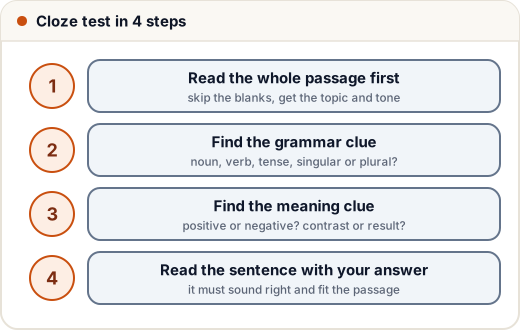
- Read the whole passage once, skipping the blanks. Get the topic (what it is about) and the tone (positive, negative, neutral, warning).
- Grammar clue. What kind of word fits — noun, verb, adjective, preposition, connector? Which tense? Singular or plural?
- Meaning clue. Does the blank continue the idea, contrast it, give a reason or a result?
- Read the full sentence with your choice. It must sound right and fit the passage as a whole.
Steps 2 and 3 usually remove two or three options each. When two options are left, step 4 decides.
2. Three clues around every blank
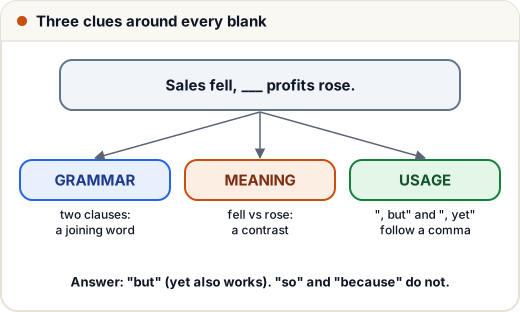
Grammar clue
Look at the words just before and just after the blank.
- After a / an / the → a noun (or adjective + noun).
- After a modal (can, should, must) → base verb.
- After has / have → past participle.
- Before of in "in spite ___ " → of; after "despite" → no of.
- A singular subject needs a singular verb, even if a long phrase sits in between.
Meaning clue
Look for signal words and the general tone.
- but, however, although, yet → the blank goes against what came before.
- and, also, moreover → the blank continues in the same direction.
- because, since → a reason; so, therefore → a result.
- Positive passage (a success story) → positive word; warning passage → negative or cautious word.
Usage clue (collocations)
Some words simply go together in English. These pairs are called collocations.
- make a decision, take a break, pay attention, do homework
- heavy rain, strong tea, high demand, deep concern
- interested in, depend on, responsible for
If an option breaks a collocation (do a decision, strong rain), remove it.
3. A solved passage
Read the passage and choose the best word for each blank.
Online learning has (1) ______ rapidly in India over the last few years. Students in small towns can now attend lectures by teachers they would (2) ______ never meet. (3) ______, this change has also brought problems. Many students do not have a quiet place to study, and slow internet makes live classes (4) ______. Experts say that colleges should (5) ______ both online and classroom teaching rather than choose only one.
| # | Options | Answer | Why |
|---|---|---|---|
| 1 | grown / grow / growing / grows | grown | after "has" → past participle (present perfect) |
| 2 | otherwise / therefore / also / hardly | otherwise | "would otherwise never meet" = without online learning they would never meet them |
| 3 | Moreover / However / Therefore / Because | However | the passage turns from benefits to problems → contrast |
| 4 | easy / difficult / popular / cheap | difficult | slow internet is a problem → negative word |
| 5 | combine / comparing / avoid / combines | combine | after the modal "should" → base verb; "both … and" means use the two together |
Notice how often grammar alone decided the answer (blanks 1 and 5), and how the tone decided the others (3 and 4). Blank 2 needed the meaning of the whole sentence.
4. Common blank types and quick checks
| Blank type | Quick check | Example |
|---|---|---|
| Article | sound of the next word; specific or general? | ___ hour → an |
| Preposition | fixed pair with the verb or adjective | capable ___ → of |
| Verb form | subject, time words, modal or "has" before it | has ___ → taken |
| Connector | contrast, addition, cause, result | It was cheap, ___ it broke → but |
| Vocabulary | tone + collocation | ___ rain → heavy |
| Pronoun | which noun it refers to; singular or plural | The company and ___ staff → its |
5. Mistakes that cost marks
- Filling blanks one by one without reading the passage. The answer to blank 3 often depends on a sentence after it.
- Choosing the "fancy" word. The simple word that fits grammar and tone is usually right.
- Ignoring tense. If the passage is in the past, most verbs stay in the past.
- Two options that are synonyms. If two options mean the same thing and only one answer is allowed, the answer is often a third option. Check grammar again.
- Not re-reading. After you finish, read the whole passage once with all your answers. One wrong connector usually stands out.
Common mistakes
- Picking a word that fits the sentence but not the tone of the whole passage.
- Forgetting fixed prepositions and collocations (depend on, make a decision).
- Missing the singular/plural clue when the subject is far from the verb.
- Spending too long on one blank — mark a guess, move on and return later.
Quick recap
- Read the full passage first for topic and tone.
- Use three clues: grammar (form), meaning (signal words, tone) and usage (collocations).
- Remove options in steps, then read the sentence with your choice.
- Re-read the whole passage at the end.