AdvancedProfessional Skills · Lesson 10 of 12 · Updated ·
Time Management and Focus — Planning Your Week, Deep Work and Beating Procrastination
Two students can have the same 24 hours, the same syllabus and similar ability — and one finishes 300 coding problems and two projects while the other keeps "planning to start". The difference is rarely intelligence. It is how they choose what to work on and how well they focus while working. These are learnable skills, and they matter even more at work.
1. Urgent is not the same as important
Urgent tasks demand attention now (a message, a deadline today). Important tasks move your goals forward (DSA practice, a project, your health). The trap is spending all your time on urgent-but-unimportant things.
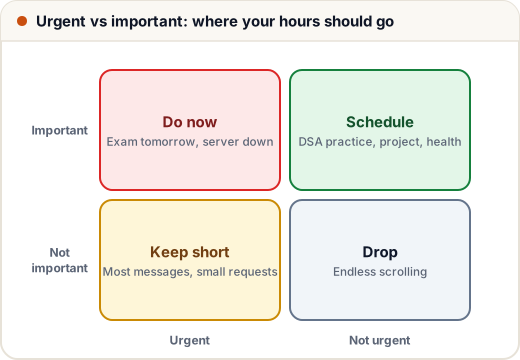
The quadrant that builds careers is important but not urgent. Nobody forces you to practise DSA today — which is exactly why it gets skipped. The fix is to schedule it like a class.
2. Plan your week, not just your day
Once a week (for example Sunday evening), spend 20 minutes:
- Write your 2–3 most important goals for the week: "Finish trees in DSA", "Deploy project version 1", "Two aptitude mock tests".
- Break each into tasks small enough to finish in one sitting.
- Put them into specific time blocks in your calendar, around your fixed classes.
- Leave some empty time — plans that fill every minute always fail.
Each evening, take two minutes to choose tomorrow's top three tasks. In the morning you start working, not deciding.
A realistic example for a final-year student:
| Time block | Mon–Fri | Saturday | Sunday |
|---|---|---|---|
| 7:00–8:30 AM | DSA (focused) | Mock test | Rest / light review |
| After classes | Project or aptitude, 1.5 hours | Project, 3 hours | Weekly plan, 20 min |
| Night | 30 min review, no screens after a fixed time | Free | Free |
Adjust to your own energy — some people focus best early, some late.
3. Deep work: protect focused blocks
Hard work like coding, learning new concepts and writing needs unbroken focus. Every interruption costs time to get back into the task.
- Work in blocks of 45–90 minutes on one task.
- Put your phone in another room or turn on focus mode. Close unrelated tabs.
- Decide what exactly you'll do in the block before starting: "Solve 3 binary-tree problems", not "do DSA".
- Check messages between blocks, not during them.
The Pomodoro technique is a good starting point if long focus is hard: 25 minutes of work, 5 minutes break; after four rounds, a longer break. Increase the work period as your focus improves.
4. Beating procrastination
Procrastination is usually not laziness. It's avoiding a task that feels unclear, too big or unpleasant. Practical fixes:
- Make the first step tiny: "Open the project and read yesterday's code" instead of "build the backend". Starting is the hardest part; continuing is easier.
- The two-minute rule: if something takes less than two minutes (reply, file a form), do it now.
- Make it clear: many tasks feel heavy because you don't know the next step. Write it down.
- Remove friction: keep the laptop charged and the project open; delete or log out of distracting apps during study hours.
- Work with others: a study partner or a fixed group session makes skipping harder.
5. Energy, sleep and health
Time management fails when you are exhausted.
- Sleep around 7–8 hours most nights. Sleeping less to "get more time" usually lowers the quality of every hour you are awake.
- Do your hardest tasks when your energy is highest.
- Short walks, exercise and proper meals improve focus more than another cup of tea.
- Plan rest. A day off each week helps you keep going for months, which is what placement preparation needs.
6. Habits beat motivation
Motivation comes and goes. Habits keep working when motivation is low.
- Tie a new habit to a fixed time or an existing routine: "After breakfast, two DSA problems."
- Start small enough that you can't fail: 20 minutes daily beats a 5-hour plan you abandon after three days.
- Track it visibly — a calendar with ticks, or a streak on a practice site. Try not to miss twice in a row.
7. At work: managing tasks and expectations
The same ideas apply in a job:
- Keep a simple task list, ordered by priority; confirm priorities with your manager when unsure.
- Break big tickets into smaller steps and estimate honestly. Add a buffer for unknowns.
- Block calendar time for focused work, especially if your day fills with meetings.
- If you have too much, say so early and ask which task comes first — don't silently miss everything.
Common mistakes
- Planning everything in detail and then doing none of it.
- Spending the whole day on messages and small tasks.
- "Studying" with the phone next to you.
- Waiting for motivation before starting.
- Cutting sleep to create more time.
- Agreeing to everything at work and then missing deadlines.
Quick recap
- Separate urgent from important; schedule the important-but-not-urgent work.
- Plan the week with 2–3 goals, then choose tomorrow's top three each evening.
- Protect deep work blocks: one task, phone away, a clear target.
- Beat procrastination with a tiny first step and less friction.
- Sleep, energy and small daily habits matter more than motivation.