BeginnerProfessional Skills · Lesson 1 of 12 · Updated ·
Learning How to Learn — Active Recall, Spaced Review and Escaping Tutorial Hell
Technology changes every few years. The Java version, the framework, the cloud tool and the AI assistant you learn in college will all change during your career. The one skill that never goes out of date is learning itself — picking up something new quickly and remembering it. Two students with the same hours can end up at very different levels just because one of them studies in a better way.
This lesson covers the methods that research on memory and learning keeps supporting, and how to use them for coding, aptitude and interviews.
1. Why re-reading feels good but does not work
The most common way to study is to re-read notes, re-watch a video or highlight a textbook. It feels productive because the material looks familiar the second time. But familiarity is not the same as being able to recall something with the book closed — and recall is what an exam, an interview or a real bug needs.
A simple test: close your notes and try to write down the steps of merge sort, or the formula for compound interest. If you cannot, you have not learned it yet, no matter how many times you read it.
2. Active recall: test yourself, don't re-read
Active recall means pulling information out of your memory instead of putting it in again. Every time you successfully recall something, the memory becomes stronger.
Ways to use it:
- After a lesson, close it and write down the 3–5 main points from memory. Then check what you missed.
- Turn headings into questions: "What is a deadlock? What are its four conditions?" and answer them out loud.
- Use quizzes — the quiz after each Skills101 lesson is active recall, not just a score.
- For coding, re-solve a problem from a blank file a few days later instead of reading your old solution.
It feels harder and slower than re-reading. That difficulty is exactly what makes it work.
3. Spaced review: revisit just before you forget
If you study a topic once, you forget most of it within days. If you review it several times with growing gaps, it lasts much longer. This is called spaced repetition.
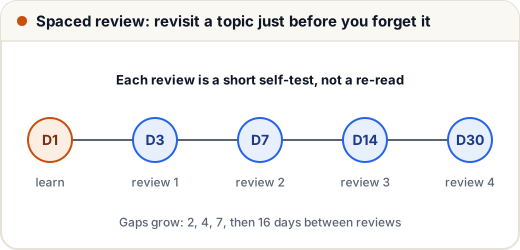
A practical schedule for a new topic:
| Review | When | What to do |
|---|---|---|
| Learn | Day 1 | Study and take the lesson quiz |
| Review 1 | Day 3 | Write the main points from memory |
| Review 2 | Day 7 | Re-solve 1–2 problems without notes |
| Review 3 | Day 14 | Quick quiz or explain it out loud |
| Review 4 | Day 30 | One mixed practice set |
Keep a simple list (a notebook or spreadsheet) of topics with their next review date. Ten minutes of review a day beats one long revision night before the exam.
4. Deliberate practice: work at the edge of your ability
Doing what you are already good at feels nice but adds little. Deliberate practice means:
- Picking a specific weakness ("I can't solve sliding-window problems"), not a vague goal ("get better at DSA").
- Working on problems that are slightly too hard for you.
- Getting feedback quickly — test cases, a mentor, an answer key.
- Fixing the mistake and trying a similar problem again.
Ten focused problems on your weak topic do more than fifty easy ones you can already solve.
5. Learn by building, and escape "tutorial hell"
Tutorial hell is when you watch course after course, follow along, and still cannot build anything on your own. Following someone else's code feels like learning, but every decision was made for you.
The way out:
- After each tutorial section, build something small without the video — change the example, add a feature, use different data.
- Choose one project of your own and get stuck on purpose. Getting stuck and searching the documentation is where real learning happens.
- Follow the rule: one hour of watching needs at least one hour of doing.
6. The Feynman technique: explain it simply
Named after the physicist Richard Feynman, the method is:
- Write the topic name at the top of a page.
- Explain it in simple words, as if to a first-year student.
- Where you get stuck or use jargon you can't explain, go back and study that part.
- Simplify again.
If you can explain recursion or normalisation to a friend in plain language, you understand it. This also prepares you for interviews, where you must explain, not just know.
7. Sleep, breaks and focus
- Sleep is when the brain stores what you learned. Cutting sleep before exams usually costs more than it gains.
- Study in focused blocks (for example 45–50 minutes) with short breaks, with your phone in another room.
- Mix topics in practice (a few arrays, a few strings, a few trees) once you know the basics. Mixing feels harder but trains you to recognise which method fits a new problem — exactly what tests demand.
Common mistakes
- Measuring study by hours instead of what you can recall or build.
- Re-watching a video when you are confused, instead of trying a problem and reading the specific part you need.
- Collecting courses and notes you never practise.
- Studying a topic once and never returning to it until the exam.
- Copying a solution and believing you could have written it.
Quick recap
- Re-reading creates familiarity; active recall creates real memory.
- Spaced review with growing gaps (day 3, 7, 14, 30) keeps knowledge for months.
- Deliberate practice targets one weakness with slightly-too-hard problems and fast feedback.
- Escape tutorial hell by building without the video and getting stuck on purpose.
- If you can explain it simply, you understand it.