BeginnerProfessional Skills · Lesson 4 of 12 · Updated ·
Explaining Your Code and Projects Clearly — The 2-Minute Project Pitch
"Tell me about your project" is one of the most common interview questions for freshers. It is also one of the most often wasted. Students either say one line ("I made an e-commerce website in React") or talk for ten minutes about every button. Both leave the interviewer unsure what you actually did and understood.
Explaining your work is also a daily skill on the job: in stand-ups, code reviews, demos and when asking for help. This lesson gives you a structure you can practise until it feels natural.
1. The 2-minute structure
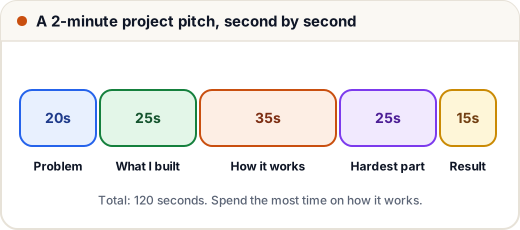
| Part | Time | What to say |
|---|---|---|
| Problem | ~20 s | Who has the problem and why it matters |
| What I built | ~25 s | The solution in one or two sentences, and your role |
| How it works | ~35 s | The main parts and the technology, at the right depth |
| Hardest part | ~25 s | One real difficulty and how you solved it |
| Result | ~15 s | What it achieved — users, speed, a number, or what you learned |
Example, for a college project:
Problem: "At our college, event registrations were done on paper, and organisers spent hours matching payments to names." What I built: "I built a web app where students register and pay for events. I worked on the backend and the database; a friend did the React frontend." How it works: "It's a Spring Boot REST API with PostgreSQL. Students sign in, choose an event, and pay through a payment gateway; a webhook marks the registration as paid." Hardest part: "Payments sometimes succeeded but the webhook arrived twice, creating duplicate entries. I made the webhook handler idempotent by storing the payment ID with a unique constraint." Result: "About 400 students used it for our tech fest, and organisers stopped manual matching completely."
Notice: it says "I" for your own work, names one real problem, and ends with a result.
2. Say what YOU did
Interviewers are judging you, not your team. In group projects, be clear and honest:
- "I designed the database and wrote the payment API" — not "we did everything".
- Do not claim work you did not do. Follow-up questions will reveal it quickly, and honesty is valued more than a bigger claim.
3. Adjust the depth to the listener
The same project needs different explanations for different people:
| Listener | They care about | Go deep on |
|---|---|---|
| HR / non-technical | Impact, teamwork, your role | Problem, result, what you learned |
| Technical interviewer | Your understanding and decisions | Architecture, trade-offs, the hard bug |
| Manager / client | Outcome, time, risk | What it does for users, what's left |
Start at a high level and let them ask for more. A good opening is: "I can go into the architecture or the hardest bug — which would be more useful?"
4. Explain one decision and its trade-off
Strong candidates explain why, not just what:
- "I chose PostgreSQL instead of MongoDB because registrations and payments are related data and I needed transactions."
- "I used server-side pagination because the event list could grow to thousands of rows."
Every real decision has a trade-off. Saying "the downside is that X; I accepted it because Y" shows maturity far beyond listing technologies.
5. Prepare for follow-up questions
After your pitch, expect questions like:
- What would you improve if you had more time?
- How did you test it?
- What happens if two users book the last seat at the same time?
- How would it handle 10 times more users?
- Why did you use this library?
Prepare one honest answer for each. If you don't know something, say so and reason out loud: "I didn't handle that case. I think I would use a database lock or a unique constraint on the seat — let me think through what happens…" Interviewers often care more about your reasoning than a perfect answer.
6. Use a simple picture
When you can draw or share a screen, a simple diagram helps more than words:
Browser (React)  →  Spring Boot API  →  PostgreSQL
                          ↑
              Payment gateway webhook
Practise drawing your project's architecture in five boxes or fewer. If you cannot, you may not understand the whole project yet.
7. Practise out loud
Writing the pitch is not enough — say it:
- Write the five parts in bullet points (not a full script to memorise).
- Say it out loud with a timer; aim for 2 minutes.
- Record yourself once and listen — remove filler and long pauses.
- Practise with a friend who asks follow-up questions.
Prepare a pitch like this for each project on your résumé. Anything on your résumé can be asked.
Common mistakes
- One-line answers that give the interviewer nothing to ask about.
- Ten-minute answers listing every feature.
- Saying "we" for everything, so nobody knows your part.
- Listing technologies without explaining any decision.
- Claiming work or knowledge you don't have.
- Never practising out loud before the interview.
Quick recap
- Use the 2-minute structure: problem, what I built, how it works, hardest part, result.
- Say clearly what you did.
- Adjust depth to the listener; start high-level and offer to go deeper.
- Explain decisions and trade-offs, not just tools.
- Prepare follow-ups, draw the architecture in five boxes or fewer, and practise out loud.