IntermediateProfessional Skills · Lesson 8 of 12 · Updated ·
Selling Yourself — Personal Pitch, Benefits Not Features, Salary Talks and Winning Freelance Clients
Many technical students dislike the word "selling". They imagine pushy salespeople. But every time you ask for a job, an internship, a referral or a freelance project, you are asking someone to choose you — that is selling. Good selling is not tricking people. It is clearly showing how you can solve their problem, with proof.
Nothing earns money until someone says yes. This lesson helps you get more of those yeses, honestly.
1. Think like the buyer
A recruiter, manager or client is asking one question: "Will this person solve my problem with low risk?" They care less about what you find interesting and more about:
- Can you do the work they need?
- Can you learn what you don't know yet?
- Will you be reliable and easy to work with?
So before any interview or proposal, find out what they need: read the job description, the company's product, the client's message. Then talk about that.
2. Benefits, not just features
A feature is what you did. A benefit is why it matters to the listener.
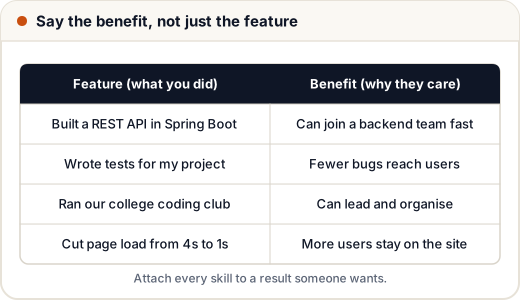
"I know React" is a feature. "I can build responsive screens for your web app — here's a dashboard I built that 200 students use" is a benefit with proof. Connect each skill on your résumé and in your answers to a result someone wants.
3. Your 30-second personal pitch
You will need a short introduction everywhere: "Tell me about yourself", career fairs, LinkedIn messages, networking. A simple structure:
- Who you are: "I'm a final-year BCA student at…"
- What you're good at, with proof: "I build backend APIs in Java and Spring Boot — my event registration app handled 400 students for our tech fest."
- What you're looking for, linked to them: "I'm looking for a backend developer role, and your payments team's work is exactly the kind of problem I enjoy."
Keep it about 30 seconds. Practise it out loud until it sounds natural, not memorised.
4. Proof beats claims
Anyone can write "hard-working, quick learner, team player". These words carry almost no weight. Proof does:
| Claim | Proof |
|---|---|
| "I'm good at DSA." | "I've solved 300 problems; here's my profile." |
| "I'm a quick learner." | "I learned Spring Boot in three weeks and built this deployed API." |
| "I can work in a team." | "I coordinated four people on our final-year project using GitHub pull requests." |
Build proof deliberately: deployed projects, a clean GitHub, certificates from real assessments, contest ranks, internship work, and recommendations.
5. Talking about salary as a fresher
Be realistic and honest:
- Campus placements usually have a fixed package for all freshers in that role. Negotiating is rarely possible; focus on choosing the right company and role.
- Off-campus, startups, internships and later job changes often have some room to discuss.
Tips when there is room:
- Know the range for the role and city from several sources (job posts, seniors, salary websites). Treat any single number as a rough guide.
- When asked for expectations, give a researched range and the reason: "Based on similar backend roles in Bangalore, I'm looking at around X to Y, but I'm flexible for the right learning opportunity."
- Understand the offer: CTC vs in-hand, bonus conditions, bonds and notice period (see the salary offer lesson).
- Be polite and never lie about other offers.
- Remember that early in your career, learning and the team often matter more than a small salary difference.
6. Winning freelance clients
Freelancing is selling in its purest form. A good proposal on a platform or by email:
- Shows you read their request: repeat their main problem in one line.
- Proposes a clear plan: what you'll deliver, in which steps.
- Shows proof: one or two similar pieces of work, with links.
- States price and time clearly: for small projects, a fixed price for a fixed scope is easier for both sides.
- Ends with a simple next step: "Shall we have a 15-minute call tomorrow to confirm the details?"
Example opening:
"You need a booking page for your coaching centre where students can pick a batch and pay online. I've built a similar event registration system with online payments (link). I can deliver the booking page, payment integration and an admin list in 10 days for ₹X, with one round of changes included."
Protect yourself: agree on the scope in writing, take a part payment in advance for larger work, and deliver what you promised on time — repeat clients and referrals are where freelancing becomes stable.
7. Handling "no"
You will hear "no" much more than "yes" — from recruiters, companies and clients. That is normal for everyone.
- Ask for feedback politely when possible.
- Improve one thing each time (pitch, proof, résumé, proposal).
- Keep a simple log of applications and results so you can see what works.
Common mistakes
- Talking only about what you want, not what they need.
- Listing skills without proof or results.
- Generic, copy-pasted applications and proposals.
- Over-promising on a freelance project, then delivering late.
- Lying about other offers or skills.
- Taking rejection personally and stopping.
Quick recap
- Selling is showing how you solve their problem, honestly, with proof.
- Turn features into benefits and back claims with proof.
- Prepare a 30-second pitch: who you are, what you're good at with proof, what you want linked to them.
- Salary: campus packages are usually fixed; elsewhere, use a researched range and understand the offer.
- Freelance proposals: their problem, your plan, proof, price and time, next step.