AdvancedProfessional Skills · Lesson 12 of 12 · Updated ·
Investing Basics for Freshers — Compounding, SIPs, Risk and Avoiding Scams
Saving keeps money safe. Investing puts it to work so it can grow faster than prices rise. You don't need a large salary to start — what matters most is starting early and staying consistent. This lesson explains the core ideas in simple terms. It is general education, not advice to buy any product; returns are never guaranteed, and for big decisions consider a SEBI-registered investment adviser.
Before investing, make sure you have the basics from the previous lesson: a budget, an emergency fund and no expensive debt.
1. Why invest at all: inflation
Prices rise over time — this is inflation. If prices rise 6% a year, something costing ₹100 today costs about ₹106 next year. Money kept in a drawer, or in an account paying less than inflation, slowly buys less. Investing aims to grow money faster than inflation over the long term.
2. Compounding: returns on your returns
Compounding means your returns start earning returns too. At 10% a year, ₹1,000 becomes ₹1,100 after a year; the next year you earn 10% on ₹1,100, not on ₹1,000.
A quick estimate is the rule of 72: divide 72 by the yearly return to find roughly how many years money takes to double.
| Yearly return | Years to double (72 ÷ rate) |
|---|---|
| 8% | about 9 years |
| 10% | about 7.2 years |
| 12% | about 6 years |
The power of compounding grows with time, which is why starting early matters so much.
3. SIP: investing a fixed amount every month
A SIP (systematic investment plan) invests a fixed amount — say ₹3,000 — every month, usually into a mutual fund. It builds the habit automatically, and because you buy every month, you buy more units when prices are low and fewer when high.
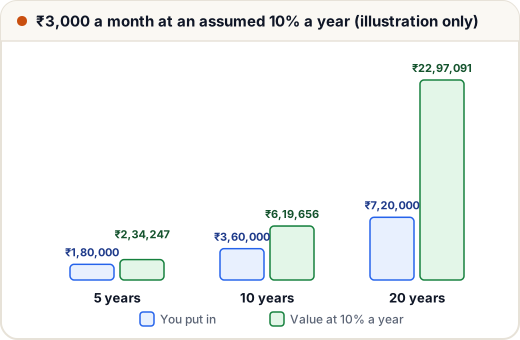
At an assumed 10% a year (an illustration — real returns go up and down and may be lower):
| Period | You put in | Approximate value |
|---|---|---|
| 5 years | ₹1,80,000 | ₹2,34,247 |
| 10 years | ₹3,60,000 | ₹6,19,656 |
| 20 years | ₹7,20,000 | ₹22,97,091 |
Notice that in 20 years, the growth (about ₹15.8 lakh) is more than double what you put in.
Starting early beats investing more later. Under the same 10% assumption:
- Asha invests ₹3,000 a month from age 22 to 32 (₹3.6 lakh in total), then stops and leaves it invested until 60. It grows to about ₹1.01 crore.
- Ravi starts at 32 and invests ₹3,000 a month until 60 (₹10.08 lakh in total). He ends with about ₹55.4 lakh.
Asha put in about a third as much money but ended with nearly twice as much — because her money had ten extra years to compound.
4. Common options, from safer to riskier
| Option | What it is | Risk | Points to know |
|---|---|---|---|
| Savings account / FD | Bank deposit with fixed interest | Low | Good for the emergency fund; returns may barely beat inflation |
| EPF | Provident fund deducted from salary, with an employer contribution | Low | Long-term retirement savings; withdrawal rules apply |
| PPF | Government-backed savings scheme | Low | 15-year lock-in; the government sets the interest rate each quarter |
| Debt mutual funds | Funds that lend to governments and companies | Low to medium | Value can move a little; check fund quality |
| Equity mutual funds / index funds | Funds that own shares of many companies | Higher in the short term | Can fall sharply in some years; suited to goals 5+ years away |
| Individual shares | Buying one company's shares | High | Needs research; one company can fall a lot |
An index fund simply copies a market index (for example the Nifty 50, the 50 large companies) at a low cost. Many beginners start with one because it is diversified and simple.
5. Risk, time and diversification
- Match the investment to the goal's time. Money you need within a year or two (a laptop, a course fee) should be in safe options. Money for goals 5–10+ years away can take market risk, because there's time to recover from bad years.
- Diversify: don't put everything into one share, one sector or one product. A fund holding many companies spreads the risk.
- Expect falls. Markets sometimes drop 20% or more. Investors who panic and sell during falls often lose the most. Decide your plan before the fall, not during it.
- Costs matter: a fund's yearly fee (expense ratio) is taken every year. Over decades, a lower fee can make a real difference.
6. How to spot investment scams
Every year, people lose savings to schemes that sound too good. Warning signs:
- "Guaranteed" high returns — for example "3% every month, no risk". Real investments with high returns carry risk.
- Pressure to decide quickly or to bring in friends to earn more (a sign of a pyramid scheme).
- "Trading tips" groups on Telegram or WhatsApp promising sure profits, and fake trading apps that show profits but don't allow withdrawals.
- Requests to transfer money to a personal account, or to share OTPs and passwords.
- Products from people or apps not registered with the regulator (SEBI for markets, RBI for banks and lenders).
If something sounds too good to be true, it almost always is.
7. A simple starter plan
- Budget and build the emergency fund first.
- Get health cover and, if people depend on you, term insurance.
- Start a small monthly SIP — even ₹500–₹1,000 — in a simple, diversified fund for long-term goals.
- Increase it with every salary hike.
- Review once or twice a year. Don't check daily or react to the news.
Common mistakes
- Waiting to "earn more" before starting.
- Putting short-term money into shares.
- Stopping SIPs or selling in panic when markets fall.
- Chasing last year's best-performing fund or a friend's tip.
- Falling for "guaranteed" monthly returns.
Quick recap
- Inflation shrinks idle money; investing aims to beat it.
- Compounding rewards time — the rule of 72 estimates doubling time.
- A SIP automates investing; starting early can matter more than the amount.
- Choose options by the goal's time: safe for short-term, equity for long-term; diversify.
- Spot scams: guaranteed high returns, pressure and unregistered sellers.