AdvancedInterview & Career · Lesson 14 of 14 · Updated ·
A 12-Week Placement Preparation Plan — Budgeting Your Hours, What to Study Each Week, Tracking Practice and Mock Tests
"Start preparing for placements" is advice every student hears, but it is not a plan. A plan answers four questions: how many hours do I have, what do I study in them, in what order, and how will I know it is working? This lesson builds a 12-week plan that a BCA, MCA or B.Tech student can follow alongside classes. Treat the numbers as an example to adjust, not a rule: your college's placement dates, your target companies and your starting level all change the right plan.
1. Start with an honest hour budget
Most plans fail because they assume time that does not exist. Write down your real free time for a normal week, after classes, travel, assignments and sleep.
Worked example. Riya has classes until 4 pm. She can study 2 hours on each weekday evening and 5 hours on each weekend day.
- Weekdays: 2 h × 5 = 10 hours
- Weekend: 5 h × 2 = 10 hours
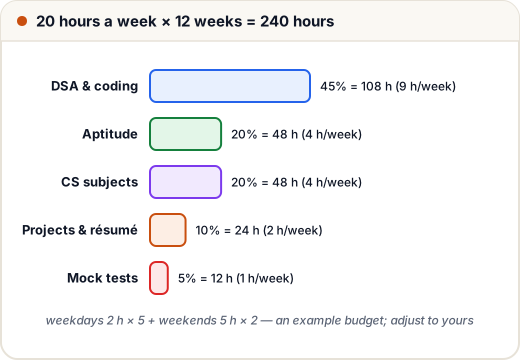
- Per week: 20 hours. Over 12 weeks: 20 × 12 = 240 hours.
That number is the most useful fact in the whole plan. 240 hours is a lot if used steadily, and very little if most of it is lost in the first month and the last week.
2. Split the hours by what the tests check
A typical fresher software process has an online test (aptitude and/or coding), then technical and HR interviews. The exact mix differs by company — mass recruiters often weigh aptitude more, product companies weigh coding more — so tilt the split towards your targets. A balanced starting split:
| Area | Share | Hours (of 240) | Per week |
|---|---|---|---|
| DSA and coding practice | 45% | 108 | 9 |
| Aptitude and reasoning | 20% | 48 | 4 |
| CS subjects (OOP, DBMS, OS, networks) | 20% | 48 | 4 |
| Projects and résumé | 10% | 24 | 2 |
| Mock tests and mock interviews | 5% | 12 | 1 |
What 108 hours of DSA means. If one problem takes about 45 minutes on average — including reading, solving, checking the editorial and writing a short note — then 108 × 60 / 45 = 144 problems. That is a realistic target. It is better to solve 144 problems and understand each one than to skim 400.
3. The three phases
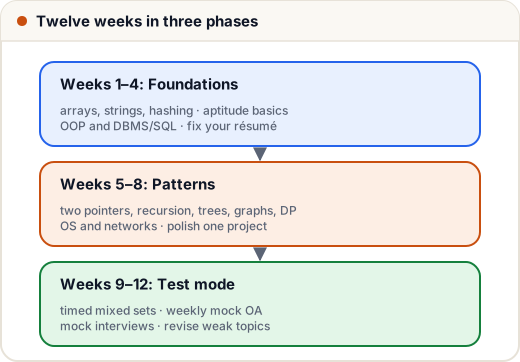
Weeks 1–4: Foundations. Pick one language and stay with it (C++, Java or Python). Practise arrays, strings, hashing, sorting and basic maths problems. In aptitude, cover percentages, ratios, time and work, and number basics. Revise OOP and DBMS/SQL, because they come up in almost every interview. Finish a first version of your résumé by the end of week 2, so you can apply when off-campus openings appear.
Weeks 5–8: Patterns. Most interview problems reuse a small set of ideas: two pointers, sliding window, prefix sums, binary search, recursion and backtracking, stacks and queues, trees, basic graphs (BFS/DFS) and introductory dynamic programming. Study one pattern at a time and solve several problems on it. Add operating systems and computer networks. Improve one project until you can explain every design decision (see portfolio projects).
Weeks 9–12: Test mode. Stop learning many new topics. Do timed, mixed problem sets, because a real test does not tell you which pattern to use. Take one full mock online assessment each week under real conditions (see the online assessment lesson). Do at least two mock interviews with a friend, senior or mentor, and practise explaining your project out loud.
4. A sample week (weeks 5–8)
| Day | 2 h evening / 5 h weekend |
|---|---|
| Monday | DSA: learn one pattern, solve 2 problems |
| Tuesday | DSA: 2 more problems on the same pattern |
| Wednesday | Aptitude: one topic, 20 questions, review the mistakes |
| Thursday | CS subject: one OS or networks topic, write 10 likely interview questions with answers |
| Friday | DSA: 2 problems; re-solve 1 old problem from the log |
| Saturday | 2 h DSA mixed set · 2 h project work · 1 h aptitude |
| Sunday | 2 h mock test or mock interview · 1 h CS revision · 2 h weekly review and next week's plan |
Count it: this week gives 8 hours of DSA, 3 of aptitude, 3 of CS subjects, 2 of project work, 2 of mocks and 2 of review and planning — 20 hours, close to the split in section 2, with the weekly review built in. The exact days do not matter. Fixing each slot in advance matters, so you do not spend the first 20 minutes deciding what to study.
5. Keep a practice log and revise on purpose
Solving a problem once does not mean you can solve it in a test three weeks later. Keep a simple log (a spreadsheet is enough):
| Date | Problem | Pattern | Solved alone? | Time | Key idea in one line | Re-solve on |
|---|---|---|---|---|---|---|
| 3 Mar | Pair with given sum | hashing | yes | 20 min | store complements in a set | 10 Mar |
| 4 Mar | Longest substring without repeat | sliding window | no (hint) | 55 min | move left pointer past the repeat | 7 Mar |
Two habits make the log useful:
- Re-solve problems you needed help with after a few days, and again after about a week, without looking at your old code. If you still cannot, the pattern needs more practice.
- Weekly review (Sunday): count problems solved, list the patterns you got wrong most, and move next week's hours towards them. This review is how the plan corrects itself.
6. When the plan slips
It will slip — exams, illness, a family function. Rules for recovering:
- Do not try to "catch up" by doubling hours. Drop the lowest-value items for that week instead (for example, extra aptitude topics you already score well on).
- Protect the minimum: even on a bad day, solve one problem or revise one topic for 30 minutes. Keeping the habit alive is worth more than the content of that one day.
- Shorter runway? If you have 6 weeks, keep the same three phases but give them 2 weeks each, and cut the problem target in proportion, not the mock tests.
Common mistakes
- Planning with hours you do not have, then giving up when the plan fails in week 2.
- Switching languages or resources every week. Depth in one beats a little of many.
- Spending all the time on DSA and ignoring aptitude, which removes many candidates in the first round of mass-recruiter tests.
- Reading solutions without solving. If you looked at the answer, mark it in the log and re-solve it later.
- Never practising under a timer before the real test.
- Leaving the résumé and project explanation for the last week.
Quick recap
- Budget real hours first: 20 hours a week for 12 weeks is 240 hours.
- Split them across DSA, aptitude, CS subjects, projects and mocks, tilted towards your target companies.
- Three phases: foundations (1–4), patterns (5–8), timed test mode with mocks (9–12).
- Fix study slots in advance; keep a log; re-solve weak problems after a few days and after a week.
- Review every Sunday and move hours to your weakest areas. When the plan slips, cut scope, not sleep.