DBMS & SQL · Lesson 3 of 13 · Updated ·
Keys and Constraints — Primary, Candidate, Foreign, Super and Composite Keys
A key is a column (or set of columns) that identifies rows or links tables. "Explain the types of keys" is one of the most asked DBMS interview questions.
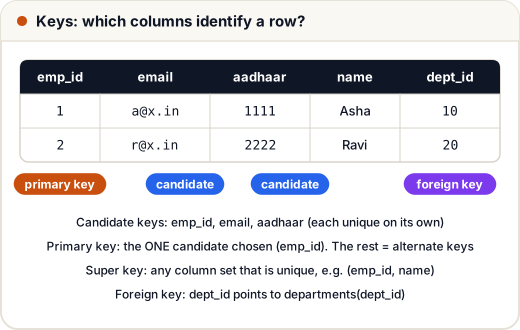
1. Types of keys
| Key | Meaning | In the picture |
|---|---|---|
| Super key | any set of columns that uniquely identifies a row | (emp_id), (emp_id, name), (email, name)… |
| Candidate key | a minimal super key (no extra columns) | emp_id, email, aadhaar |
| Primary key | the candidate key chosen to identify rows; unique and NOT NULL | emp_id |
| Alternate key | candidate keys not chosen | email, aadhaar |
| Foreign key | a column that refers to the primary key of another table | dept_id → departments |
| Composite key | a key made of 2+ columns | (roll_no, course_code) in enrollments |
Every candidate key is a super key, but not every super key is a candidate key.
2. Constraints in SQL
Constraints are rules the database enforces on every insert and update.
CREATE TABLE departments (
    dept_id   INT PRIMARY KEY,
    dept_name VARCHAR(50) NOT NULL UNIQUE
);
CREATE TABLE employees (
    emp_id   INT PRIMARY KEY,
    name     VARCHAR(50) NOT NULL,
    email    VARCHAR(80) UNIQUE,
    salary   INT CHECK (salary > 0),
    city     VARCHAR(30) DEFAULT 'Jaipur',
    dept_id  INT REFERENCES departments(dept_id)
);
INSERT INTO departments VALUES (10, 'Engineering'), (20, 'Sales');
INSERT INTO employees (emp_id, name, email, salary, dept_id) VALUES (1, 'Asha', 'asha@x.in', 60000, 10);
SELECT emp_id, name, city, dept_id FROM employees;
emp_id | name | city | dept_id
1 | Asha | Jaipur | 10
(city got the DEFAULT value because we didn't give one.)
| Constraint | Rejects |
|---|---|
PRIMARY KEY | duplicates and NULLs in the key |
UNIQUE | duplicate values (one NULL usually allowed) |
NOT NULL | empty values |
CHECK (condition) | values that break the rule (salary ≤ 0) |
DEFAULT | — fills a value when none is given |
FOREIGN KEY / REFERENCES | values that don't exist in the parent table |
3. Referential integrity and ON DELETE
A foreign key means "this value must exist over there". What happens if the parent row is deleted?
ON DELETE RESTRICT/NO ACTION— block the delete (the default).ON DELETE CASCADE— delete the child rows too (deleting an order deletes its order items).ON DELETE SET NULL— set the foreign key to NULL.
4. Primary key vs unique key
| Primary key | Unique key | |
|---|---|---|
| How many per table | one | many |
| NULL allowed | no | yes (usually one) |
| Purpose | identify rows | prevent duplicates in other columns |
Common mistakes
- Saying a table can have many primary keys. It has one primary key (which may be composite).
- Thinking a foreign key must be unique. Many employees can have the same dept_id.
- Forgetting NOT NULL on columns that must always have a value.
Quick recap
- Super ⊇ candidate ⊇ primary; the rest of the candidates are alternate keys.
- Foreign key = link to another table's primary key; composite = multi-column key.
- Constraints: PRIMARY KEY, UNIQUE, NOT NULL, CHECK, DEFAULT, FOREIGN KEY.
- ON DELETE CASCADE / SET NULL / RESTRICT decides what happens to child rows.