AdvancedSoftware Engineering · Lesson 11 of 13 · Updated ·
Test Case Design — Equivalence Classes, Boundary Value Analysis, Decision Tables and State Transitions
An exam-registration form accepts age 18 to 25 and marks 40 to 100. Testing every possible pair is impossible in practice, and most pairs would test the same thing anyway. Test case design techniques pick a small set of inputs that is still likely to find the bugs. The testing lesson introduced them in two lines; here you will apply each one fully, the way semester exams and QA interviews ask.
All four techniques here are black-box: they use only the specification (what the program should do), not the code.
1. Equivalence partitioning (EP)
Split each input into classes (partitions) whose values the program should treat the same way. If one value from a class works, the others very likely work too, so you test one value per class.
For age (valid range 18–25):
| Class | Values | Valid? | Pick |
|---|---|---|---|
| E1 | age < 18 | invalid | 15 |
| E2 | 18 ≤ age ≤ 25 | valid | 21 |
| E3 | age > 25 | invalid | 30 |
| E4 | not a number ("abc", blank) | invalid | "abc" |
Rules that examiners look for:
- Each class gets one test case. A range normally gives one valid and two invalid classes.
- Also think of invalid types: blank, letters, negative numbers, decimals where only whole numbers are allowed.
- Combine valid classes of different inputs in one test, but test each invalid class on its own. If one test has two invalid inputs and the form rejects it, you cannot tell which check worked.
2. Boundary value analysis (BVA)
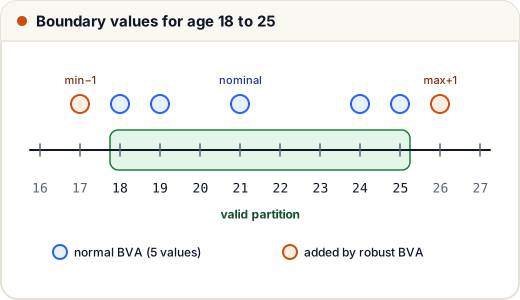
Programmers often write < where they meant <=, so bugs gather at the edges of ranges. BVA tests values at and next to each boundary:
| Variant | Values tested for one variable | Test cases for n variables |
|---|---|---|
| Normal BVA | min, min+1, nominal, max−1, max | 4n + 1 |
| Robust | the above + min−1, max+1 | 6n + 1 |
| Worst-case | all 5 values of every variable combined | 5ⁿ |
| Robust worst-case | all 7 values combined | 7ⁿ |
Where does 4n + 1 come from? BVA uses the single fault assumption: failures are usually caused by one variable at an extreme. So keep every variable at its nominal (middle) value, and move one variable at a time through its four boundary values. That gives 4 cases per variable, plus 1 case with everything nominal.
The program below generates the normal BVA cases for our form:
def bva(ranges):
    nominal = {k: (lo + hi) // 2 for k, (lo, hi) in ranges.items()}
    cases = [dict(nominal)]
    for k, (lo, hi) in ranges.items():
        for v in (lo, lo + 1, hi - 1, hi):
            c = dict(nominal)
            c[k] = v
            cases.append(c)
    return cases

cases = bva({'age': (18, 25), 'marks': (40, 100)})
print(len(cases), 'test cases')
for c in cases:
    print(c['age'], c['marks'])

n = 2
print('robust:', 6 * n + 1, ' worst-case:', 5 ** n, ' robust worst-case:', 7 ** n)
9 test cases
21 70
18 70
19 70
24 70
25 70
21 40
21 41
21 99
21 100
robust: 13  worst-case: 25  robust worst-case: 49
With n = 2: 9 normal cases, 13 robust, 25 worst-case and 49 robust worst-case. Worst-case testing grows fast — with 5 inputs it is 5⁵ = 3,125 cases — so it is kept for critical code.
BVA vs EP: EP picks any value from a class; BVA picks values at the class edges. In practice they are used together: EP finds the classes, BVA chooses the values.
3. Decision table testing
When the output depends on a combination of conditions, list every combination in a table. Example rule: a student gets a fee waiver if marks are 85 or more, OR if family income is below ₹3 lakh AND attendance is at least 75%.
- Conditions: C1 marks ≥ 85, C2 income < ₹3 lakh, C3 attendance ≥ 75%.
- With 3 yes/no conditions there are 2³ = 8 rules (columns).
from itertools import product

for rule, (c1, c2, c3) in enumerate(product('YN', repeat=3), start=1):
    waiver = c1 == 'Y' or (c2 == 'Y' and c3 == 'Y')
    print(f'R{rule}: marks>=85={c1} income<3L={c2} attend>=75={c3} -> {"waiver" if waiver else "no waiver"}')
R1: marks>=85=Y income<3L=Y attend>=75=Y -> waiver
R2: marks>=85=Y income<3L=Y attend>=75=N -> waiver
R3: marks>=85=Y income<3L=N attend>=75=Y -> waiver
R4: marks>=85=Y income<3L=N attend>=75=N -> waiver
R5: marks>=85=N income<3L=Y attend>=75=Y -> waiver
R6: marks>=85=N income<3L=Y attend>=75=N -> no waiver
R7: marks>=85=N income<3L=N attend>=75=Y -> no waiver
R8: marks>=85=N income<3L=N attend>=75=N -> no waiver
Each rule becomes one test case. Rules R1–R4 all give "waiver" whatever C2 and C3 are, so they can be collapsed into one rule written as Y – – (the dash means "does not matter"). The table then has 5 rules instead of 8. The real value of a decision table is that it exposes combinations the specification forgot: what happens when marks are exactly 85, or attendance is not yet recorded?
Cause–effect graphing is a related technique: causes (input conditions) and effects (outputs) are joined with AND, OR and NOT in a graph, and the graph is then converted into a decision table.
4. State transition testing
Some systems react differently to the same input depending on what happened before. An ATM card PIN: three wrong attempts block the card. Draw the states and the events that move between them:
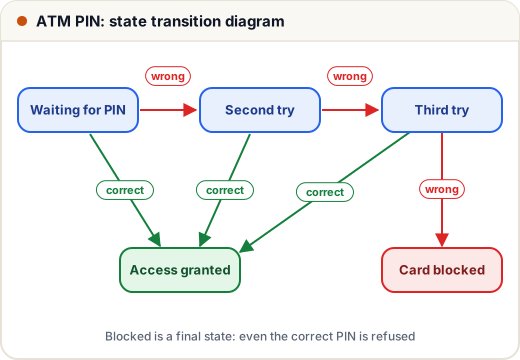
Test cases come from the diagram:
- Every state visited at least once.
- Every transition taken at least once (stronger), e.g. wrong → correct, wrong → wrong → wrong.
- Invalid transitions: a PIN entered after the card is blocked must be refused.
def atm(attempts, correct='4321'):
    state = 'try 1'
    for pin in attempts:
        if state in ('granted', 'blocked'):
            break
        if pin == correct:
            state = 'granted'
        else:
            n = int(state[-1])
            state = 'blocked' if n == 3 else f'try {n + 1}'
    return state

tests = [['4321'], ['1111', '4321'], ['1111', '2222', '4321'],
         ['1111', '2222', '3333'], ['1111', '2222', '3333', '4321']]
for t in tests:
    print(len(t), 'attempt(s) ->', atm(t))
1 attempt(s) -> granted
2 attempt(s) -> granted
3 attempt(s) -> granted
3 attempt(s) -> blocked
4 attempt(s) -> blocked
The last test is the important invalid transition: a correct PIN after blocking must not give access.
5. Choosing a technique
| Situation | Best technique |
|---|---|
| Input with ranges (age, amount, marks) | Equivalence partitioning + BVA |
| Business rules with many conditions | Decision table |
| Behaviour depends on history (login, order status, traffic light) | State transition |
| Many independent options (browser × OS × language) | Pairwise (all-pairs) testing: cover every pair of values, not every combination |
| Testers' experience of typical bugs | Error guessing (empty file, zero, very long text) |
Common mistakes
- Writing two invalid inputs in one EP test case. Test each invalid class alone.
- Using 4n + 1 for robust testing. Robust adds min−1 and max+1, giving 6n + 1.
- Mixing up worst-case 5ⁿ (all combinations) with normal BVA 4n + 1 (one variable at a time).
- Forgetting the nominal case in the count (the "+1").
- In state testing, testing only valid paths. The blocked card accepting a PIN is the dangerous bug.
Quick recap
- EP: one test per class; a range gives one valid and two invalid classes.
- BVA: min, min+1, nominal, max−1, max. Counts: 4n+1 normal, 6n+1 robust, 5ⁿ worst-case, 7ⁿ robust worst-case.
- Decision table: 2ⁿ rules for n yes/no conditions; collapse rules with "don't care" dashes.
- State transition: cover every state, every transition and the invalid transitions.