Software Engineering · Lesson 3 of 8 · Updated ·
Agile, Scrum and Kanban — Sprints, User Stories and Story Points
Almost every company you'll join works in Agile, usually Scrum. Interviewers expect freshers to know the words: sprint, stand-up, backlog, story points.
1. The Agile Manifesto (2001)
Four values — the left side is valued more than the right:
- Individuals and interactions over processes and tools
- Working software over comprehensive documentation
- Customer collaboration over contract negotiation
- Responding to change over following a plan
Key principles: deliver working software frequently (weeks, not months), welcome changing requirements, business people and developers work together daily, and measure progress by working software.
2. Scrum
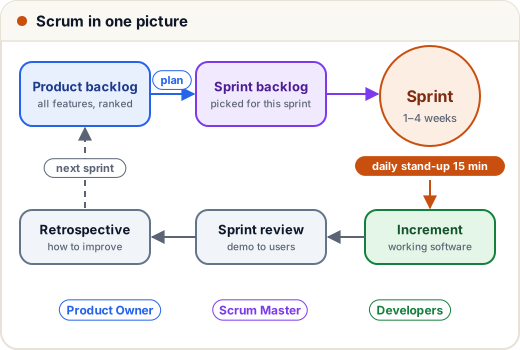
Roles (3)
| Role | Responsibility |
|---|---|
| Product Owner | owns the product backlog, decides priority, represents the customer |
| Scrum Master | coaches the team in Scrum, removes blockers — not a "boss" |
| Developers | the cross-functional team that builds the increment (devs, testers, designers) |
Events (5)
| Event | When / how long | Purpose |
|---|---|---|
| Sprint | fixed 1–4 weeks | the container for all work |
| Sprint planning | start of sprint | pick backlog items, make a plan |
| Daily stand-up (daily scrum) | 15 min every day | what I did, what I'll do, any blockers |
| Sprint review | end of sprint | demo the increment to stakeholders |
| Sprint retrospective | after review | how can the team work better? |
Artifacts (3)
- Product backlog — ordered list of everything the product might need.
- Sprint backlog — items chosen for this sprint plus the plan.
- Increment — working, tested software that meets the Definition of Done.
3. User stories
As a student, I want to see my attendance percentage, so that I know if I can sit the exam.
Acceptance criteria (how we know it's done):
- Shows percentage per subject, rounded to one decimal.
- Shows a red warning below 75%.
Good stories follow INVEST: Independent, Negotiable, Valuable, Estimable, Small, Testable. Big stories are called epics and are split into smaller stories.
4. Story points and velocity
Teams estimate relative effort in story points (often Fibonacci: 1, 2, 3, 5, 8, 13) instead of hours, often by planning poker.
Velocity = story points completed per sprint. If the last three sprints completed 20, 24 and 22 points, the average velocity is 22. A backlog of 110 points then needs about 110 ÷ 22 = 5 sprints.
A burndown chart plots remaining work against days in the sprint; it should slope down to zero.
5. Kanban
A board with columns like To do → In progress → Review → Done. No fixed sprints; work flows continuously. The key rule is a WIP (work-in-progress) limit — e.g. at most 3 cards in "In progress" — to stop multitasking and expose bottlenecks. Popular for support and operations teams.
6. Where DevOps fits
DevOps joins development and operations: automated builds, tests and deployments (CI/CD), infrastructure as code and monitoring. Agile makes you deliver often; DevOps makes delivering often safe and automatic.
Common mistakes
- Calling the Scrum Master the team's manager.
- Changing sprint length every sprint (it should be fixed).
- Treating story points as hours.
Quick recap
- Agile values working software, collaboration and responding to change.
- Scrum: 3 roles (PO, SM, developers), 5 events, 3 artifacts.
- User story: As a … I want … so that …, with acceptance criteria.
- Velocity = points per sprint; Kanban limits work in progress.