Software Engineering · Lesson 6 of 8 · Updated ·
Software Testing — Levels, Black-Box, White-Box and Cyclomatic Complexity
Testing finds defects before users do. A bug found during design costs a little; the same bug found after release can cost 100 times more.
1. Basic terms
- Error (mistake) — a human mistake by a developer.
- Defect (bug / fault) — the wrong code that results.
- Failure — the system behaving wrongly when the defect runs.
- Verification — "Are we building the product right?" (reviews, inspections, walkthroughs — checking against the spec, often without running code).
- Validation — "Are we building the right product?" (running the software to check it meets user needs).
Testing shows the presence of bugs, never their absence — you can't test everything.
2. Levels of testing
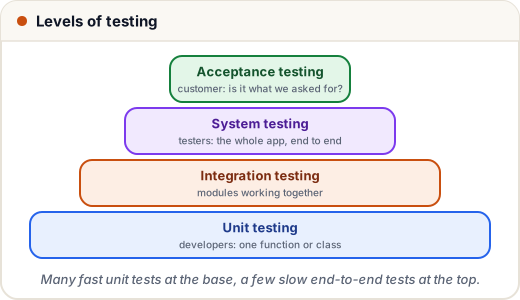
| Level | Tests | Who |
|---|---|---|
| Unit | one function/class in isolation | developers |
| Integration | modules working together | developers/testers |
| System | the complete system against the SRS (functional + performance, security…) | test team |
| Acceptance | does it meet the customer's needs? | customer/users |
Integration approaches: big-bang (all at once — hard to find bugs), top-down (uses stubs for lower modules not ready yet), bottom-up (uses drivers to call lower modules), sandwich (both).
Alpha testing — by real users at the developer's site. Beta testing — by real users at their own location, before the final release.
3. Black-box vs white-box
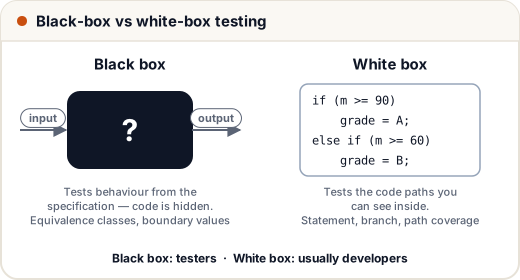
Black-box techniques
Equivalence partitioning — split inputs into classes that behave the same and test one value from each. Age must be 18–60 → classes: below 18 (invalid), 18–60 (valid), above 60 (invalid). Tests: 10, 35, 70.
Boundary value analysis (BVA) — bugs hide at edges, so test min−1, min, min+1, max−1, max, max+1. For 18–60: 17, 18, 19, 59, 60, 61.
Also: decision tables (combinations of conditions) and state transition testing.
White-box techniques
- Statement coverage — every line runs at least once.
- Branch (decision) coverage — every if/else outcome is taken (true and false). Branch coverage is stronger than statement coverage.
- Path coverage — every independent path is tested.
4. Cyclomatic complexity (McCabe)
The number of independent paths through code = the minimum number of test cases for full branch coverage.
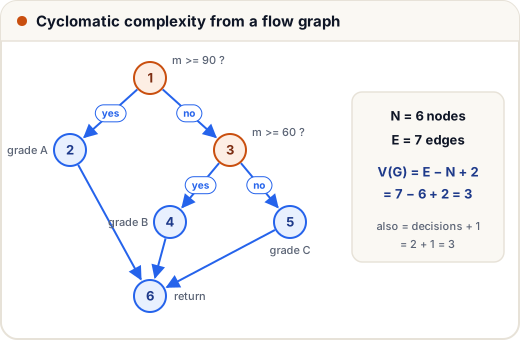
Three equivalent formulas:
- V(G) = E − N + 2 (edges − nodes + 2)
- V(G) = P + 1 (P = number of decision/predicate nodes)
- V(G) = number of regions in the flow graph (including the outside region)
For the grade program: 7 − 6 + 2 = 3, and 2 decisions + 1 = 3. So 3 test cases: marks 95 (A), 75 (B), 40 (C).
A rule of thumb: keep V(G) ≤ 10 per function; higher means harder to test and maintain.
5. More test types
- Regression testing — re-run old tests after a change to make sure nothing else broke (perfect for automation).
- Smoke testing — quick check that the build's main functions work at all.
- Sanity testing — narrow check that a specific fix works.
- Performance, load, stress testing — speed, expected load, beyond-limit load.
- Usability, security, compatibility testing.
Common mistakes
- Swapping verification and validation.
- Using only valid values in BVA — include the invalid neighbours (17 and 61).
- Thinking 100% statement coverage means 100% branch coverage.
Quick recap
- Error → defect → failure. Verification: built right; validation: right product.
- Unit → integration (stubs/drivers) → system → acceptance (alpha, beta).
- Black box: equivalence classes, boundary values. White box: statement, branch, path coverage.
- V(G) = E − N + 2 = decisions + 1.