AdvancedOOP Concepts · Lesson 13 of 16 · Updated ·
UML Class Diagrams to Java Code — Notation, Relationships and Multiplicity
A UML class diagram is a picture of the classes in a program and how they are connected. UML stands for Unified Modeling Language, a standard way of drawing software designs. University exams (software engineering and OOAD papers) ask you to draw one, and low-level design interviews ("design a library system") expect you to sketch one on a whiteboard before writing code.
The good news: a class diagram maps almost one-to-one to Java. Once you know the symbols, you can turn any diagram into code — and any code into a diagram.
1. The class box
A class is a rectangle with three parts: the name, the attributes (fields) and the operations (methods).
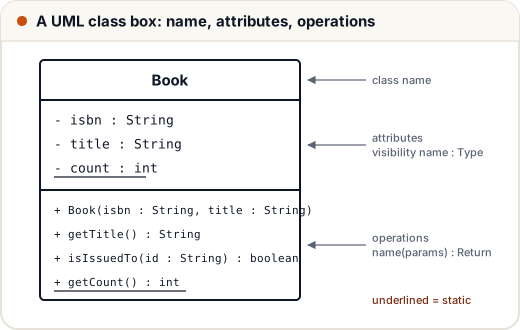
Each attribute is written visibility name : Type, and each operation visibility name(param : Type) : ReturnType. Note that UML puts the type after the name, while Java puts it before.
| UML symbol | Java visibility |
|---|---|
+ | public |
- | private |
# | protected |
~ | package-private (no keyword) |
Two more rules: a static member is underlined, and an abstract class or method is written in italics (or marked {abstract}). An interface is shown with «interface» above its name.
The Book box above becomes:
public class Main {
    static class Book {
        private String isbn;
        private String title;
        private static int count = 0;      // underlined in UML

        public Book(String isbn, String title) {
            this.isbn = isbn;
            this.title = title;
            count++;
        }
        public String getTitle() { return title; }
        public boolean isIssuedTo(String memberId) { return false; }
        public static int getCount() { return count; }
    }

    public static void main(String[] args) {
        new Book("978-81-203-4007-7", "Let Us C");
        Book b = new Book("978-93-5213-008-2", "Core Java");
        System.out.println(b.getTitle() + " | books created: " + Book.getCount());
    }
}
Core Java | books created: 2
2. The six relationship lines
The lines between boxes carry most of the meaning. Learn these six:
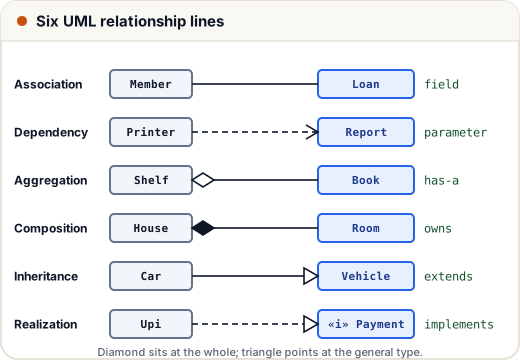
| Relationship | Drawn as | Meaning | Java |
|---|---|---|---|
| Association | solid line (optional open arrow) | "knows / uses" for a long time | a field of the other type |
| Dependency | dashed open arrow | uses briefly | a parameter or local variable |
| Aggregation | hollow diamond at the whole | has-a, parts can live alone | field holding objects created elsewhere |
| Composition | filled diamond at the whole | owns, parts die with the whole | the whole creates its parts |
| Inheritance (generalisation) | solid line, hollow triangle at the parent | is-a | extends |
| Realization | dashed line, hollow triangle at the interface | implements | implements |
A memory trick: the diamond always sits next to the whole (the container), and the triangle always points at the more general type.
3. Multiplicity: how many?
Numbers at each end of a line say how many objects take part:
| Multiplicity | Meaning | Java |
|---|---|---|
1 | exactly one | a single field, never null |
0..1 | zero or one | a single field that may be null (or Optional) |
* or 0..* | any number | a List or Set |
1..* | at least one | a List checked to be non-empty |
Read multiplicity from the far end: on the line Member 1 ——— 0..* Loan, the 0..* next to Loan means "one member has zero or more loans", and the 1 next to Member means "each loan belongs to exactly one member".
4. A full example: a college library
Here is the design, written in text the way you might describe it in an exam:
Library◆——1..*Shelf(composition: shelves are created by the library and do not exist without it)Shelf◇——0..*Book(aggregation: books can be moved to another shelf)Member1——0..*Loan——1Book(associations)Loanusesjava.time.LocalDatefor the due date (dependency on a library class)«interface» Notifiableis realized byMember
And the Java that follows the diagram line by line:
import java.util.*;

interface Notifiable {                        // «interface»
    String notifyMsg(String text);
}

class Book {
    private final String title;
    Book(String title) { this.title = title; }
    String getTitle() { return title; }
}

class Shelf {                                 // aggregation: books are passed in
    private final String code;
    private final List<Book> books = new ArrayList<>();   // 0..*
    Shelf(String code) { this.code = code; }
    void place(Book b) { books.add(b); }
    int size() { return books.size(); }
    String getCode() { return code; }
}

class Library {                               // composition: the library creates its shelves
    private final List<Shelf> shelves = new ArrayList<>(); // 1..*
    Library(int shelfCount) {
        if (shelfCount < 1) throw new IllegalArgumentException("need at least one shelf");
        for (int i = 1; i <= shelfCount; i++) shelves.add(new Shelf("S" + i));
    }
    Shelf shelf(int i) { return shelves.get(i); }
}

class Member implements Notifiable {          // realization
    private final String name;
    private final List<Loan> loans = new ArrayList<>();    // 1 member — 0..* loans
    Member(String name) { this.name = name; }
    Loan borrow(Book b) {
        Loan loan = new Loan(this, b);
        loans.add(loan);
        return loan;
    }
    int loanCount() { return loans.size(); }
    String getName() { return name; }
    public String notifyMsg(String text) { return "To " + name + ": " + text; }
}

class Loan {                                  // association to exactly 1 Member and 1 Book
    private final Member member;
    private final Book book;
    Loan(Member member, Book book) { this.member = member; this.book = book; }
    String describe() { return member.getName() + " has '" + book.getTitle() + "'"; }
}

public class Main {
    public static void main(String[] args) {
        Library lib = new Library(2);
        Book c = new Book("Let Us C");
        Book java = new Book("Core Java");
        lib.shelf(0).place(c);
        lib.shelf(0).place(java);
        System.out.println(lib.shelf(0).getCode() + " holds " + lib.shelf(0).size() + " books");

        Member asha = new Member("Asha");
        Loan loan = asha.borrow(java);
        System.out.println(loan.describe() + ", loans: " + asha.loanCount());
        System.out.println(asha.notifyMsg("return by Friday"));
    }
}
S1 holds 2 books
Asha has 'Core Java', loans: 1
To Asha: return by Friday
Notice how each symbol showed up in code: the filled diamond became "Library creates new Shelf(...) itself", the hollow diamond became "Shelf.place(Book) receives books made elsewhere", 0..* became a List, 1 became a final field set in the constructor, and the realization arrow became implements Notifiable.
5. Tips for exams and interviews
- Find the nouns first. In "members borrow books from the library", the nouns
Member,Book,Libraryare candidate classes; verbs like borrow become methods or association classes (Loan). - Show only what matters. Skip getters and setters unless asked; examiners want the important fields, methods and relationships.
- Label multiplicities on every association — it is the most commonly forgotten part and it carries marks.
- Check each diamond: if the part can exist on its own, it is aggregation (hollow); if it dies with the whole, composition (filled).
- Check each triangle: class → class is
extends(solid line); class → interface isimplements(dashed line).
Common mistakes
- Putting the diamond at the wrong end. It belongs next to the whole, not the part.
- Drawing an arrow from parent to child for inheritance. The triangle points to the parent.
- Writing Java-style
String titleinside the box instead of UML-styletitle : String. - Using a solid line with a triangle for an interface. Implementing an interface is a dashed line.
- Forgetting multiplicity, or reading it from the wrong end.
Quick recap
- A class box has name, attributes (
- title : String) and operations (+ getTitle() : String);+ - # ~give visibility, underline means static, italics mean abstract. - Six lines: association (solid), dependency (dashed arrow), aggregation (hollow diamond), composition (filled diamond), inheritance (solid line + hollow triangle), realization (dashed line + hollow triangle).
- Multiplicity
1,0..1,0..*,1..*becomes a field, an optional field, a list, or a non-empty list. - Diamonds sit at the whole; triangles point at the general type.