AdvancedOOP Concepts · Lesson 16 of 16 · Updated ·
Object Initialization Order in Java — Static Blocks, Instance Blocks and Constructor Chaining
Placement tests often show a short Java program with a few static { } blocks, some { } blocks and constructors spread across a parent and a child class, and ask: "What is the output?" You can answer these with certainty once you know the rules. This lesson builds them up one at a time, with a program for each rule.
1. Static blocks run once, when the class is first used
A static block (static { ... }) belongs to the class, not to any object. Java runs it once, when the class is initialised — that is, the first time the program actually uses the class (creates an object, calls a static method, or reads a static field that is not a constant).
class College {
    static int count;

    static {
        System.out.println("static block: College is ready");
        count = 0;
    }

    College() {
        count++;
        System.out.println("constructor: count = " + count);
    }
}

public class Main {
    public static void main(String[] args) {
        System.out.println("main starts");
        new College();
        new College();
    }
}
main starts
static block: College is ready
constructor: count = 1
constructor: count = 2
Two things to notice. The static block ran after main starts, because College was not used until the first new College(). And it ran only once, even though two objects were created. Static blocks are used to set up static data, such as loading a lookup table.
2. Inside one object: fields and instance blocks, then the constructor body
An instance initialiser block is a plain { ... } inside the class. Java copies field initialisers (like String name = ...;) and instance blocks into every constructor, in the order they appear in the source, right after the call to the parent constructor. So they run before the constructor body.
class Student {
    String name = log("field initialiser");

    {
        log("instance block");
    }

    Student() {
        log("constructor body");
    }

    static String log(String msg) {
        System.out.println(msg);
        return msg;
    }
}

public class Main {
    public static void main(String[] args) {
        new Student();
    }
}
field initialiser
instance block
constructor body
If the instance block were written above the field, it would run first. The rule is "top to bottom in the source", not "fields before blocks".
3. With inheritance: parent before child
Every constructor starts by calling a parent constructor — either one you write as super(...), or an invisible super() that Java adds for you. That gives the full order:
- Static parts of the parent, then of the child — only the first time the classes are used.
- For each new object: the parent's instance part (fields, instance blocks, constructor body).
- Then the child's instance part.
class Person {
    static { System.out.println("Person static block"); }
    { System.out.println("Person instance block"); }
    Person() { System.out.println("Person constructor"); }
}

class Student extends Person {
    static { System.out.println("Student static block"); }
    { System.out.println("Student instance block"); }
    Student() { System.out.println("Student constructor"); }
}

public class Main {
    public static void main(String[] args) {
        System.out.println("--- first object ---");
        new Student();
        System.out.println("--- second object ---");
        new Student();
    }
}
--- first object ---
Person static block
Student static block
Person instance block
Person constructor
Student instance block
Student constructor
--- second object ---
Person instance block
Person constructor
Student instance block
Student constructor
For the second object there are no static lines: classes are initialised only once per program run.
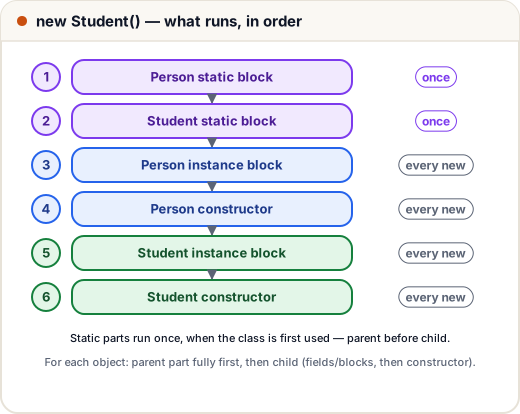
A way to remember it: a child cannot be built before its parent part exists. A Student object contains a Person part, so that part is completed first.
4. Constructor chaining with this() and super()
A constructor can call another constructor of the same class with this(...), or a constructor of the parent with super(...). This is called constructor chaining. It avoids repeating the same assignments in several constructors.
class Ticket {
    String from, to;
    int seats;

    Ticket(String from, String to) {
        this(from, to, 1);                                   // default: 1 seat
        System.out.println("2-argument constructor done");
    }

    Ticket(String from, String to, int seats) {
        this.from = from;
        this.to = to;
        this.seats = seats;
        System.out.println("3-argument constructor: " + seats + " seat(s) " + from + " -> " + to);
    }
}

public class Main {
    public static void main(String[] args) {
        new Ticket("Delhi", "Jaipur");
    }
}
3-argument constructor: 1 seat(s) Delhi -> Jaipur
2-argument constructor done
The rules:
| Rule | Reason |
|---|---|
this(...) or super(...) must be the first statement (the classic rule) | The object must be set up before your code uses it |
A constructor cannot have both this(...) and super(...) | Only one of them can be first; the this(...) target will call super itself |
If you write neither, Java inserts super() | So the parent must have a no-argument constructor, or you get a compile error |
Instance blocks run once per object, even with this(...) | They are copied only into constructors that call super, not this |
Java 25 relaxed the first rule a little: it allows statements before this(...)/super(...) as long as they do not use the object being built (for example, checking an argument). College syllabi and placement tests still assume the classic rule.
The third rule causes a common compile error: if Person has only Person(String name), then class Student extends Person { Student() { } } does not compile, because the hidden super() has nothing to call. The fix is super("some name"); as the first line.
5. The trap: an overridable method called from a constructor
What happens if the parent constructor calls a method that the child overrides?
class Base {
    Base() { describe(); }
    void describe() { System.out.println("Base"); }
}

class Train extends Base {
    String name = "Rajdhani";
    int coaches = 16;

    Train() { describe(); }

    @Override
    void describe() { System.out.println(name + " with " + coaches + " coaches"); }
}

public class Main {
    public static void main(String[] args) {
        new Train();
    }
}
null with 0 coaches
Rajdhani with 16 coaches
The first line is null with 0 coaches. Here is why:
new Train()starts. Memory for all fields is set to default values:nullfor objects,0for numbers.Train()first callsBase().Base()callsdescribe(). Because of runtime polymorphism,Train'sdescribe()runs — butTrain's field initialisers have not run yet.Base()finishes; nownameandcoachesget their values; thenTrain()'s body callsdescribe()again, which prints the real values.
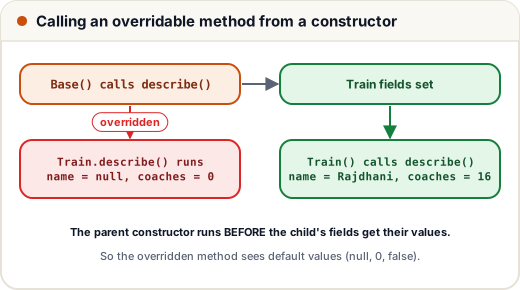
The advice that follows: do not call overridable methods from a constructor. Call only private, static or final methods there, which subclasses cannot override.
Common mistakes
- Thinking static blocks run when the program starts. They run when the class is first used.
- Expecting static blocks to run again for every object.
- Assuming fields are always set before instance blocks. Order is simply top to bottom in the source.
- Putting a statement before
this(...)orsuper(...)— a compile error in Java versions before 25, which most courses and tests still use. - Removing a parent's no-argument constructor and getting "constructor Person in class Person cannot be applied" errors in every subclass.
- Calling an overridable method from a constructor and reading half-initialised fields.
Quick recap
- Static blocks: once per class, at first use, parent before child.
- Per object: parent's fields/instance blocks/constructor body, then the child's.
- Field initialisers and instance blocks run before the constructor body, top to bottom.
this(...)orsuper(...)must come first; if absent, Java addssuper().- Never call an overridable method from a constructor — the child's fields still hold default values.