AdvancedOOP Concepts · Lesson 12 of 16 · Updated ·
Composition vs Inheritance in Java — The Fragile Base Class Problem and How to Choose
You have probably heard "favour composition over inheritance". Most students repeat it in interviews without being able to say why. This lesson shows a real bug that inheritance causes, fixes it with composition, and ends with a simple checklist for choosing between the two.
Quick definitions first:
- Inheritance (
class B extends A): B is an A. B gets all of A's fields and methods and can override them. - Composition: class B has an A in a field and calls it to do part of the work. This calling-through is called delegation.
1. A bug caused by inheritance
The placement cell wants a set of registered students that also counts how many times students were added (for a report). A student writes the obvious subclass of HashSet:
import java.util.*;

class CountingSet extends HashSet<String> {
    private int addCount = 0;

    @Override
    public boolean add(String s) {
        addCount++;
        return super.add(s);
    }

    @Override
    public boolean addAll(Collection<? extends String> c) {
        addCount += c.size();
        return super.addAll(c);
    }

    int getAddCount() { return addCount; }
}

public class Main {
    public static void main(String[] args) {
        CountingSet set = new CountingSet();
        set.addAll(List.of("Asha", "Ravi", "Neha"));
        System.out.println("Students: " + set.size());
        System.out.println("Add count: " + set.getAddCount());
    }
}
Students: 3
Add count: 6
We added three names, but the count says 6. Why? Inside the JDK, HashSet.addAll() (inherited from AbstractCollection) works by calling add() once for each element. Because we overrode add(), each of those calls also increased the counter. Our addAll counted 3, then the three hidden add calls counted 3 more.
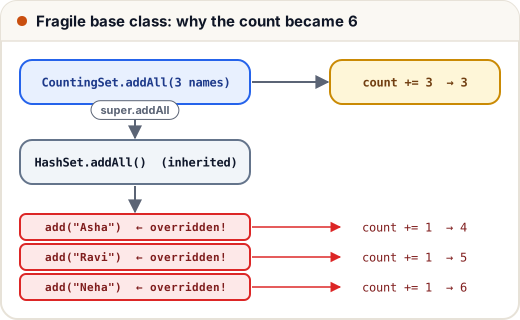
This is the fragile base class problem: a subclass depends on internal details of its parent that are not part of its documented contract. Fixing it by deleting our addAll override would "work" today, but if a future JDK changed addAll to not call add, the count would silently become wrong the other way. With inheritance, you can never be sure.
This example comes from Joshua Bloch's book Effective Java, which is where the advice "favour composition over inheritance" is explained in detail.
2. The same feature with composition
Instead of being a HashSet, our class has a Set and forwards calls to it. It implements only the methods it needs:
import java.util.*;

class CountingSet {
    private final Set<String> inner = new HashSet<>();   // composition: has-a Set
    private int addCount = 0;

    boolean add(String s) {
        addCount++;
        return inner.add(s);                              // delegation
    }

    boolean addAll(Collection<String> c) {
        addCount += c.size();
        return inner.addAll(c);    // inner's add() is HashSet's own, not ours — no double count
    }

    int size() { return inner.size(); }
    int getAddCount() { return addCount; }
}

public class Main {
    public static void main(String[] args) {
        CountingSet set = new CountingSet();
        set.addAll(List.of("Asha", "Ravi", "Neha"));
        set.add("Asha");                                  // duplicate: counted, but not stored twice
        System.out.println("Students: " + set.size());
        System.out.println("Add count: " + set.getAddCount());
    }
}
Students: 3
Add count: 4
Now inner.addAll() calls inner's own add(), which we did not override, so nothing is counted twice. Our class no longer depends on how HashSet works inside — only on its public behaviour.
In real projects you would also make it implements Set<String> so it can be passed anywhere a Set is expected. A class that implements an interface and forwards every call to a wrapped object is called a wrapper or forwarding class — the same idea as the Decorator pattern from the previous lesson.
3. Mixing behaviours: where inheritance runs out
A college sports app has players with different abilities. With inheritance you might write Player → Runner, Player → Swimmer. Now a triathlete needs to run and swim. Java does not allow extends Runner, Swimmer, and creating RunnerSwimmer, RunnerCyclist, … for every mix explodes.
With composition, each ability is an object, and a player has a list of them:
import java.util.*;

interface Ability { String perform(String who); }

class Running implements Ability {
    public String perform(String who) { return who + " runs 5 km"; }
}

class Swimming implements Ability {
    public String perform(String who) { return who + " swims 1 km"; }
}

class Player {
    private final String name;
    private final List<Ability> abilities = new ArrayList<>();
    Player(String name) { this.name = name; }
    Player add(Ability a) { abilities.add(a); return this; }
    void train() {
        for (Ability a : abilities) System.out.println(a.perform(name));
    }
}

public class Main {
    public static void main(String[] args) {
        new Player("Asha").add(new Running()).train();
        new Player("Ravi").add(new Running()).add(new Swimming()).train();
        // abilities can even be added while the program runs
        Player neha = new Player("Neha");
        neha.add(who -> who + " cycles 20 km");
        neha.train();
    }
}
Asha runs 5 km
Ravi runs 5 km
Ravi swims 1 km
Neha cycles 20 km
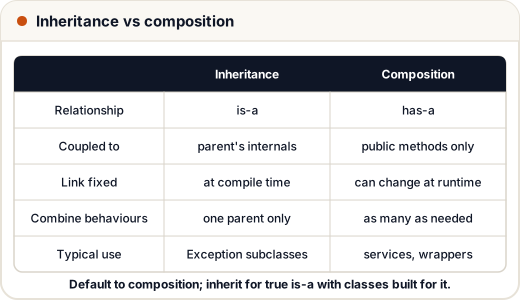
Composition lets you combine behaviours freely and even change them at runtime. Inheritance fixes one parent at compile time.
4. When inheritance IS the right choice
Inheritance is not bad. It is right when all of these are true:
- There is a real is-a relationship: a
SavingsAccountis aBankAccount. - The subclass can be used anywhere the parent is used without surprises (Liskov substitution).
- The parent class was designed for extension — its documentation says which methods are safe to override (for example, abstract classes and template methods), or you own both classes.
Good examples: class InvalidMarksException extends RuntimeException, an abstract Shape with Circle and Rectangle, framework hooks like HttpServlet.doGet().
| Question | If yes → |
|---|---|
| Is it truly "B is an A" in every situation? | inheritance may fit |
| Do you only want to reuse some code of A? | composition |
| Do you need to combine several behaviours? | composition |
| Must the behaviour change at runtime? | composition |
| Is A a class you don't control (JDK, library) that wasn't designed for subclassing? | composition |
Common mistakes
- Extending a class only to reuse a couple of its methods ("
Stack extends Vector" is a famous design mistake in the JDK: a stack should not allow inserting in the middle, but it inheritsinsertElementAt). - Overriding a method of a library class and assuming you know which other methods call it internally.
- Deep inheritance chains (five or six levels) where nobody knows which class a method comes from.
- Saying "composition is always better". The correct answer is: prefer composition by default; use inheritance for genuine is-a relationships with classes designed for it.
Quick recap
- Inheritance = is-a and tight coupling to the parent's internals; composition = has-a plus delegation through public methods.
- The
CountingSetbug (count 6 instead of 3) is the fragile base class problem:addAllsecretly calls the overriddenadd. - Composition avoids it, lets you combine behaviours and change them at runtime.
- Use inheritance for true is-a relationships with classes designed for extension; otherwise compose.