AdvancedOOP Concepts · Lesson 15 of 16 · Updated ·
Shallow Copy vs Deep Copy in Java — Assignment, clone() and Copy Constructors
"What is the difference between a shallow copy and a deep copy?" is a standard Java interview question. It also explains a very common bug: you make a "copy" of an object, change the copy, and the original changes too. To understand why, you need one idea — a variable of a class type holds a reference (an address), not the object itself.
1. Assignment copies the reference, not the object
class Student {
    String name;
    int marks;
    Student(String name, int marks) { this.name = name; this.marks = marks; }
}

public class Main {
    public static void main(String[] args) {
        Student a = new Student("Asha", 80);
        Student b = a;              // no new object is created
        b.marks = 95;
        System.out.println(a.marks + " " + (a == b));
    }
}
95 true
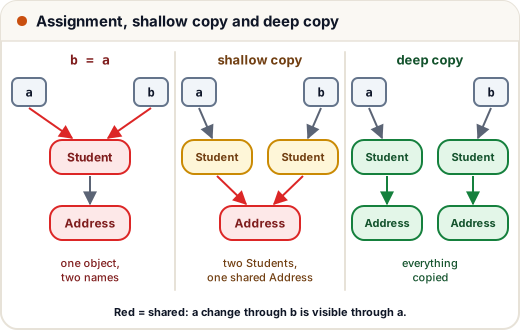
b = a copies the reference. Both names point to the same Student object on the heap, so a change through b is visible through a. a == b is true because == on objects compares references.
There are three levels of "copying":
| Way | New outer object? | Inner objects (fields that are objects) |
|---|---|---|
Assignment b = a | No | Shared |
| Shallow copy | Yes | Shared — only the references are copied |
| Deep copy | Yes | Copied too, all the way down |
2. Shallow copy with clone()
Java has a built-in copy mechanism: Object.clone(). To use it, a class implements the marker interface Cloneable (an interface with no methods; it only "marks" the class as allowed to be cloned) and overrides clone(). Calling super.clone() creates a new object and copies every field value as it is. For a field that holds a reference, the reference is copied — so the copy is shallow.
class Address {
    String city;
    Address(String city) { this.city = city; }
}

class Student implements Cloneable {
    String name;
    Address address;
    Student(String name, Address address) { this.name = name; this.address = address; }

    @Override
    public Student clone() {
        try {
            return (Student) super.clone();       // field-by-field copy
        } catch (CloneNotSupportedException e) {
            throw new AssertionError(e);          // cannot happen: we implement Cloneable
        }
    }
}

public class Main {
    public static void main(String[] args) {
        Student a = new Student("Asha", new Address("Jaipur"));
        Student b = a.clone();
        b.name = "Ravi";                 // re-points b's own field
        b.address.city = "Pune";         // changes the SHARED Address object
        System.out.println(a.name + " lives in " + a.address.city);
        System.out.println((a == b) + " " + (a.address == b.address));
    }
}
Asha lives in Pune
false true
Read the output carefully:
a.nameis stillAsha.b.name = "Ravi"changed which string b's own field points to. It did not change any shared object.a.address.citybecamePune.b.address.city = "Pune"changed theAddressobject, and both students point to the sameAddress.a == bisfalse(two Student objects), buta.address == b.addressistrue(one Address object).
So a shallow copy is safe only when the shared inner objects are immutable (like String, Integer, LocalDate) or are never changed.
3. Deep copy with a copy constructor
A deep copy also copies every mutable object inside. The clearest way to write one is a copy constructor — a constructor that takes another object of the same class and copies it.
import java.util.*;

class Address {
    String city;
    Address(String city) { this.city = city; }
    Address(Address other) { this(other.city); }          // copy constructor
}

class Student {
    String name;
    Address address;
    List<Integer> marks;

    Student(String name, Address address, List<Integer> marks) {
        this.name = name;
        this.address = address;
        this.marks = marks;
    }

    Student(Student other) {                                 // deep copy
        this.name = other.name;                              // String is immutable: sharing is fine
        this.address = new Address(other.address);           // new Address
        this.marks = new ArrayList<>(other.marks);           // new list (Integers are immutable)
    }
}

public class Main {
    public static void main(String[] args) {
        Student a = new Student("Asha", new Address("Jaipur"), new ArrayList<>(List.of(70, 80)));
        Student b = new Student(a);
        b.address.city = "Pune";
        b.marks.add(90);
        System.out.println(a.address.city + " " + a.marks);
        System.out.println(b.address.city + " " + b.marks);
    }
}
Jaipur [70, 80]
Pune [70, 80, 90]
Now the two students are fully independent. Notice the decision made for each field:
String name— immutable, so copying the reference is enough.Address— mutable, so we create a new one (using its copy constructor).List<Integer>— the list is mutable, so we create a new list. TheIntegerelements inside are immutable, so they can be shared.
If the list held mutable objects (say, List<Address>), a real deep copy would also have to copy each element.
4. The array trap: clone() on a 2D array
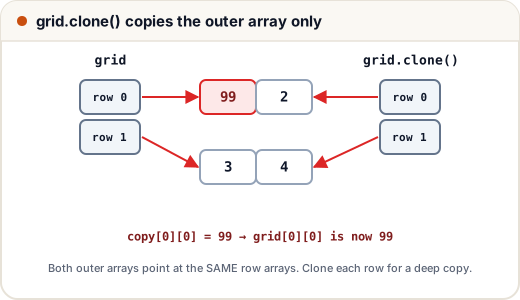
Arrays have a public clone() method. For a 1D array of primitives it gives an independent copy. But a 2D array in Java is an array of arrays — the outer array holds references to row arrays. clone() copies only the outer array, so the rows are shared.
import java.util.Arrays;

public class Main {
    public static void main(String[] args) {
        int[] marks = {70, 80, 90};
        int[] copy = marks.clone();
        copy[0] = 99;
        System.out.println(Arrays.toString(marks));

        int[][] grid = {{1, 2}, {3, 4}};
        int[][] shallow = grid.clone();
        shallow[0][0] = 99;
        System.out.println(Arrays.deepToString(grid));

        int[][] deep = new int[grid.length][];
        for (int i = 0; i < grid.length; i++) deep[i] = grid[i].clone();   // clone each row
        deep[1][1] = 0;
        System.out.println(Arrays.deepToString(grid));
    }
}
[70, 80, 90]
[[99, 2], [3, 4]]
[[99, 2], [3, 4]]
The 1D copy is independent, so marks is unchanged. The 2D clone() is shallow, so grid[0][0] became 99. Cloning each row gives a deep copy, so deep[1][1] = 0 does not touch grid.
5. clone() or copy constructor?
clone() looks convenient, but it has well-known design problems, which is why many Java style guides (including the book Effective Java) recommend copy constructors or copy factory methods instead:
| Problem with clone() | Why it hurts |
|---|---|
Cloneable has no methods | The interface does not promise a public clone(); the method lives in Object and is protected |
| Shallow by default | You must remember to copy every mutable field by hand anyway |
| Skips constructors | Validation in the constructor does not run for the copy |
Fights with final fields | You cannot assign a new deep copy to a final field after super.clone() |
| Checked exception and cast | CloneNotSupportedException and (Student) clutter every call |
A copy constructor (or a static method such as Student.copyOf(other)) is plain Java: it runs your validation, works with final fields, and makes every copying decision visible.
The best option of all is often no copy at all: if a class is immutable (see the lesson on immutable classes and value objects), sharing it is always safe.
Common mistakes
- Thinking
Student b = a;makes a copy. It only makes a second reference to the same object. - Calling
clone()and assuming the nested objects (lists, addresses, arrays) are copied too. - Using
grid.clone()on a 2D array and expecting independent rows. - Forgetting
implements Cloneable:super.clone()then throwsCloneNotSupportedExceptionat runtime. - Deep-copying immutable fields such as
String— it wastes memory and adds nothing. - In a deep copy of a
Listof mutable objects, copying the list but not the objects inside it.
Quick recap
- A variable of a class type holds a reference. Assignment copies the reference.
- Shallow copy: a new outer object whose fields point to the same inner objects.
- Deep copy: the outer object and every mutable object inside are copied.
Object.clone()withCloneablegives a shallow copy; arrays'clone()is shallow for 2D arrays.- Prefer copy constructors or copy factories; prefer immutable objects, which never need copying.