OOP Concepts · Lesson 5 of 8 · Updated ·
Association, Aggregation and Composition — is-a vs has-a
Classes rarely live alone. A Teacher teaches Students, a Team has Players, a House has Rooms. OOP names these relationships, and interviewers like to ask the difference.
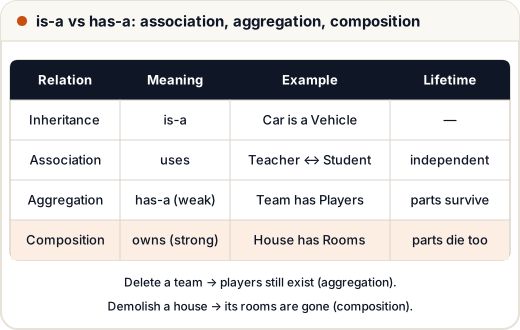
1. is-a vs has-a
- is-a → inheritance: a Manager is an Employee.
- has-a → one object holds or uses another: a Car has an Engine.
has-a comes in three strengths: association → aggregation → composition.
2. Association: "uses" (independent)
Two objects work together, but neither owns the other. Both can exist alone.
class Student:
    def __init__(self, name): self.name = name

class Teacher:
    def __init__(self, name): self.name = name
    def evaluate(self, student, marks):
        return f"{self.name} gave {student.name} {marks} marks"

print(Teacher("Mr. Rao").evaluate(Student("Asha"), 92))
Mr. Rao gave Asha 92 marks
3. Aggregation: "has-a" (weak, parts can live alone)
The container holds references to parts that were created elsewhere and outlive the container.
class Player:
    def __init__(self, name): self.name = name

class Team:
    def __init__(self, name, players):
        self.name = name
        self.players = players          # players passed in from outside

kohli, bumrah = Player("Kohli"), Player("Bumrah")
team = Team("India", [kohli, bumrah])
del team                                 # the team is gone…
print(kohli.name, "still exists")        # …but players are not
Kohli still exists
4. Composition: "owns" (strong, parts die with the whole)
The container creates and owns its parts. Without the container, the parts make no sense.
import java.util.*;

class Room {
    String name;
    Room(String name) { this.name = name; }
}

class House {
    private final List<Room> rooms = new ArrayList<>();
    House(String... roomNames) {
        for (String n : roomNames) rooms.add(new Room(n));   // House creates its rooms
    }
    int roomCount() { return rooms.size(); }
}

public class Main {
    public static void main(String[] args) {
        House h = new House("Hall", "Kitchen", "Bedroom");
        System.out.println(h.roomCount() + " rooms; nobody else holds them");
    }
}
3 rooms; nobody else holds them
When the house object is gone, its rooms go too — they were never shared.
5. The quick test
Ask: "If I delete the whole, do the parts still make sense on their own?"
| Example | Parts survive? | Relationship |
|---|---|---|
| Department — Professors | yes (they can join another dept) | aggregation |
| Order — OrderItems | no (an item belongs to one order) | composition |
| Doctor — Patient | both independent, just interact | association |
| Human — Heart | no | composition |
| Playlist — Songs | yes | aggregation |
In UML diagrams: association = plain line, aggregation = hollow diamond, composition = filled diamond (on the "whole" side).
Common mistakes
- Using inheritance for has-a relationships (
Car extends Engine✗). - Thinking aggregation and composition are the same — the difference is ownership and lifetime.
Quick recap
- is-a → inheritance; has-a → association / aggregation / composition.
- Association: independent objects that interact.
- Aggregation: whole has parts that can live alone (hollow diamond).
- Composition: whole owns parts that die with it (filled diamond).