C++ Programming · Lesson 6 of 9 · Updated ·
The C++ STL — vector, pair, map, set, unordered_map, stack, queue, priority_queue
The Standard Template Library (STL) gives you ready, fast data structures. Knowing them well is half of competitive programming and DSA interviews in C++.
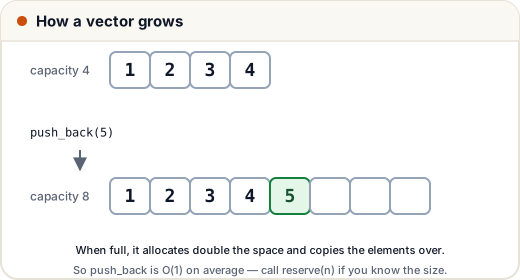
1. vector — the default container
#include <iostream>
#include <vector>
using namespace std;

int main() {
    vector<int> v = {5, 3, 8};
    v.push_back(1);              // add at the end
    v.insert(v.begin(), 9);      // add at the front (slow for big vectors)
    v.pop_back();                // remove last
    cout << v.size() << " " << v.front() << " " << v.back() << " " << v[2] << "\n";
    vector<vector<int>> grid(2, vector<int>(3, 0));   // 2 x 3 filled with 0
    grid[1][2] = 7;
    cout << grid[1][2] << "\n";
    return 0;
}
4 9 8 3
7
2. pair
#include <iostream>
#include <utility>
#include <string>
using namespace std;

int main() {
    pair<string, int> p = {"Asha", 92};
    auto [name, marks] = p;           // structured binding (C++17)
    cout << p.first << " " << p.second << " | " << name << " " << marks << "\n";
    return 0;
}
Asha 92 | Asha 92
3. map and set (sorted, O(log n))
#include <iostream>
#include <map>
#include <set>
#include <string>
using namespace std;

int main() {
    map<string, int> marks;
    marks["Ravi"] = 74;
    marks["Asha"] = 92;
    marks["Neha"] = 85;
    marks["Ravi"] += 5;                       // update
    for (const auto &[name, m] : marks) cout << name << ":" << m << " ";
    cout << "\n" << marks.count("Om") << " " << marks.size() << "\n";

    set<int> s = {5, 1, 5, 3, 1};
    s.insert(4);
    for (int x : s) cout << x << " ";
    cout << "\n" << *s.begin() << " " << *s.rbegin() << "\n";
    return 0;
}
Asha:92 Neha:85 Ravi:79
0 3
1 3 4 5
1 5
mapkeeps keys sorted;setkeeps unique sorted values.marks["Om"]would create "Om" with value 0 — usecountorfindto check without inserting.
4. unordered_map (hash table, O(1) average)
#include <iostream>
#include <unordered_map>
#include <string>
using namespace std;

int main() {
    string text = "banana";
    unordered_map<char, int> freq;
    for (char c : text) freq[c]++;
    cout << freq['a'] << " " << freq['n'] << " " << freq['b'] << "\n";
    return 0;
}
3 2 1
Use unordered_map when you don't need order — it's faster on average. Use map when you need sorted keys or guaranteed O(log n).
5. stack, queue, deque, priority_queue
#include <iostream>
#include <stack>
#include <queue>
#include <vector>
using namespace std;

int main() {
    stack<int> st;
    st.push(1); st.push(2); st.push(3);
    cout << st.top() << " ";          // 3 — last in, first out
    st.pop();
    cout << st.top() << "\n";

    queue<int> q;
    q.push(1); q.push(2); q.push(3);
    cout << q.front() << "\n";       // 1 — first in, first out

    priority_queue<int> maxHeap;
    for (int x : {4, 9, 2, 7}) maxHeap.push(x);
    cout << maxHeap.top() << " ";    // largest first
    priority_queue<int, vector<int>, greater<int>> minHeap;
    for (int x : {4, 9, 2, 7}) minHeap.push(x);
    cout << minHeap.top() << "\n";   // smallest first
    return 0;
}
3 2
1
9 2
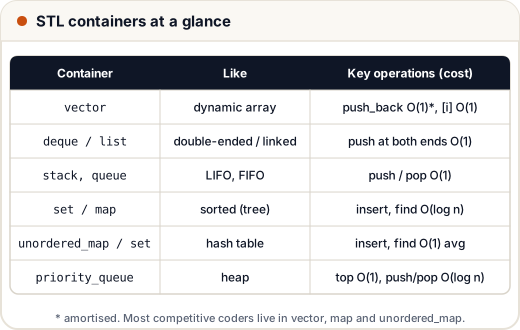
Choosing a container
| Need | Use |
|---|---|
| A list you index and append to | vector |
| Key → value, sorted | map |
| Key → value, fastest | unordered_map |
| Unique values | set / unordered_set |
| LIFO / FIFO | stack / queue |
| Always the largest/smallest | priority_queue |
Common mistakes
- Using
map[key]to check existence (it inserts the key). v.size() - 1whenvis empty —size()is unsigned, so it wraps to a huge number.- Expecting
priority_queueto give the smallest by default (it's a max-heap).
Quick recap
- vector (default), pair, map/set (sorted, log n), unordered_map/set (hash, O(1) avg).
- stack (LIFO), queue (FIFO), priority_queue (max-heap;
greater<>for min-heap). - Check keys with
count/find, not[].