C++ Programming · Lesson 5 of 9 · Updated ·
Operator Overloading, friend Functions and Templates in C++
C++ lets your own types behave like built-in ones (a + b, cout << a) and lets you write code once that works for any type.
1. Operator overloading
#include <iostream>
using namespace std;

class Money {
    long paise;
public:
    explicit Money(long rupees, long p = 0) : paise(rupees * 100 + p) {}
    Money operator+(const Money &o) const { Money m(0); m.paise = paise + o.paise; return m; }
    bool operator==(const Money &o) const { return paise == o.paise; }
    bool operator<(const Money &o) const { return paise < o.paise; }
    friend ostream &operator<<(ostream &out, const Money &m);
};

ostream &operator<<(ostream &out, const Money &m) {
    return out << "Rs " << m.paise / 100 << "." << (m.paise % 100 < 10 ? "0" : "") << m.paise % 100;
}

int main() {
    Money a(199, 50), b(300, 75);
    cout << a + b << " " << (a == b) << " " << (a < b) << "\n";
    return 0;
}
Rs 500.25 0 1
operator+as a member takes the right-hand side as the parameter (thisis the left side).operator<<must be a non-member (the left side isostream), so it's declaredfriendto read private data.- Overload operators only when the meaning is obvious (
+for money is fine;+that deletes a file is not).
Operators you can't overload: ::, ., .*, ?:, sizeof.
2. friend functions and classes
A friend can access a class's private members. Use it sparingly — mainly for operators like << and closely related helper classes. Friendship is not inherited and not mutual.
3. Function templates
#include <iostream>
#include <string>
using namespace std;

template <typename T>
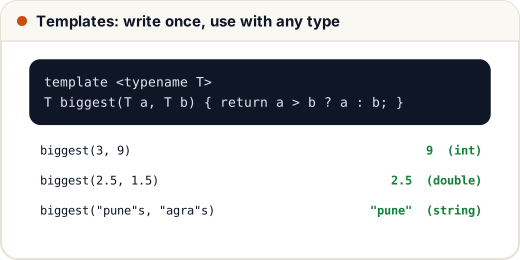
T biggest(T a, T b) { return a > b ? a : b; }

template <typename T>
void printAll(const T &items) {
    for (const auto &x : items) cout << x << " ";
    cout << "\n";
}

int main() {
    cout << biggest(3, 9) << " " << biggest(2.5, 1.5) << " " << biggest(string("pune"), string("agra")) << "\n";
    int marks[] = {70, 85, 92};
    printAll(marks);
    return 0;
}
9 2.5 pune
70 85 92
The compiler generates a separate version for each type you use (instantiation), so templates are as fast as hand-written code.
4. Class templates
#include <iostream>
#include <string>
using namespace std;

template <typename T>
class Box {
    T value;
public:
    explicit Box(T v) : value(v) {}
    T get() const { return value; }
    bool isBiggerThan(const Box<T> &o) const { return value > o.value; }
};

int main() {
    Box<int> a(42), b(7);
    Box<string> name("Skills101");
    cout << a.get() << " " << a.isBiggerThan(b) << " " << name.get() << "\n";
    return 0;
}
42 1 Skills101
vector<int>, map<string, int> and the whole STL (next lesson) are class templates.
Common mistakes
- Making
operator<<a member function (it can't be — the left operand is the stream). - Forgetting to return the stream (
return out;), which breaks chaining. - Putting template definitions in a
.cppfile — templates usually live entirely in headers.
Quick recap
- Overload operators as members (
a + b→a.operator+(b)) or non-members (<<). friendgives a function access to private data; use sparingly.- Function and class templates: write once, the compiler generates per type.
- The STL is built from templates.