Computer Organisation & Architecture (COA) · Lesson 8 of 8 · Updated ·
COA Numericals Practice — 10 Solved Exam Problems on Cache, Pipelining, IEEE 754, Addressing and Disks
COA exams reward a small set of formulas applied carefully. This lesson is a revision set: ten typical questions, each solved by hand and checked in Python. Try each one yourself before reading the solution.
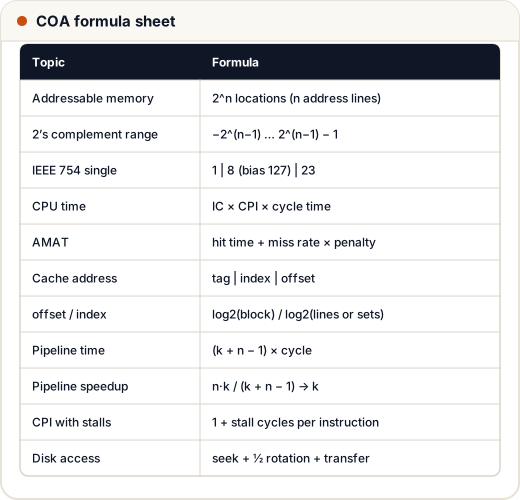
The formula sheet
Problems 1–5
1. Memory size. A byte-addressable memory has 24 address lines. Size? → 2²⁴ bytes = 16 MB.
2. 2's complement. What decimal value does the 8-bit pattern 1010 1100 represent?
→ MSB weight −128: −128 + 32 + 8 + 4 = −84.
3. IEEE 754. What is the single-precision hex for +12.5?
→ 12.5 = 1100.1₂ = 1.1001 × 2³ → sign 0, exponent 3+127 = 130 = 10000010, fraction 1001 000… → 0x41480000.
4. Instruction format. 32-bit instructions, 128 registers, three register operands. Bits left for the opcode? → log₂128 = 7 bits × 3 = 21 → 32 − 21 = 11 bits (2048 opcodes).
5. AMAT (two-level). L1 hit time 1 ns, L1 miss rate 10%, L2 hit time 8 ns, L2 local miss rate 25%, memory 120 ns. → 1 + 0.10 × (8 + 0.25 × 120) = 1 + 0.1 × 38 = 4.8 ns.
import struct

print("1:", 2 ** 24 // 2 ** 20, "MB")
b = "10101100"
print("2:", int(b, 2) - 256 if b[0] == "1" else int(b, 2))
print("3:", hex(struct.unpack(">I", struct.pack(">f", 12.5))[0]))
print("4:", 32 - 3 * 7, "opcode bits")
print("5:", round(1 + 0.10 * (8 + 0.25 * 120), 2), "ns")
1: 16 MB
2: -84
3: 0x41480000
4: 11 opcode bits
5: 4.8 ns
Problems 6–10
6. Cache bits. 32-bit addresses, 256 KB 8-way set-associative cache, 32-byte blocks. Tag, index, offset? → lines = 256 KB / 32 B = 8192; sets = 8192 / 8 = 1024 → index 10 bits; offset log₂32 = 5; tag = 32 − 10 − 5 = 17 | 10 | 5.
7. Set mapping. In a 2-way set-associative cache with 16 lines, which set does main-memory block 45 go to? → sets = 8 → 45 mod 8 = set 5.
8. Pipeline speedup. A 6-stage pipeline, 1 ns per stage, executes 500 instructions without stalls. Time and speedup? → (6 + 500 − 1) × 1 = 505 ns; non-pipelined 500 × 6 = 3000 ns → speedup 5.94.
9. Effective CPI. 25% of instructions are branches; 40% of branches are taken and each taken branch costs 3 stall cycles (predict not-taken). CPI? → 1 + 0.25 × 0.40 × 3 = 1.30.
10. Disk access. 10,000 RPM disk, 3 ms average seek, 200 MB/s transfer, read 8 KB (8192 bytes). Access time? → rotation = ½ × 60/10000 s = 3 ms; transfer = 8192 / 200,000,000 s ≈ 0.041 ms → ≈ 6.04 ms.
import math

addr, cache, block, ways = 32, 256 * 1024, 32, 8
sets = cache // block // ways
off, idx = int(math.log2(block)), int(math.log2(sets))
print("6: tag|index|offset =", addr - idx - off, idx, off)
print("7: set", 45 % (16 // 2))
k, n = 6, 500
print("8:", k + n - 1, "ns, speedup", round(n * k / (k + n - 1), 2))
print("9: CPI", round(1 + 0.25 * 0.40 * 3, 2))
print("10:", round(3 + 0.5 * 60 / 10000 * 1000 + 8192 / 200e6 * 1000, 2), "ms")
6: tag|index|offset = 17 10 5
7: set 5
8: 505 ns, speedup 5.94
9: CPI 1.3
10: 6.04 ms
How to score full marks
- Write the formula first, then substitute — partial credit even if arithmetic slips.
- Units: convert everything (ns/µs/ms, KB = 2¹⁰ bytes in memory questions, but MB/s for transfer rates is usually 10⁶ — read the question).
- Powers of two: know 2¹⁰ = 1024 … 2²⁰ ≈ 1 M, 2³⁰ ≈ 1 G by heart.
- Read the model: hierarchical vs simultaneous AMAT, whether stalls include the first cycle, whether latch delay is given.
- Sanity-check: speedup can't exceed the number of stages; hit ratios are between 0 and 1; tag bits can't be negative.
Where COA meets real programming
- Cache-friendly loops (row-major traversal, struct-of-arrays) can make code several times faster.
- Integer overflow and float precision bugs are COA bugs in disguise.
- Branch-heavy code in hot loops pays misprediction penalties — that's why sorted data sometimes processes faster.
- Understanding DMA and interrupts helps with systems, embedded and OS work.
Quick recap
- Memory: 2ⁿ locations; 2's complement MSB = −2ⁿ⁻¹; IEEE single = 1|8 (bias 127)|23.
- AMAT = hit + miss rate × penalty (nest for levels); address = tag | index | offset.
- Pipeline: (k + n − 1) cycles, speedup nk/(k+n−1); CPI = 1 + stalls/instruction.
- Disk: seek + ½ rotation + transfer.
- Formula first, units carefully, sanity-check the answer.