Java Full Stack Developer Roadmap 2026 — Step by Step for Freshers
Pankaj Sharma ·
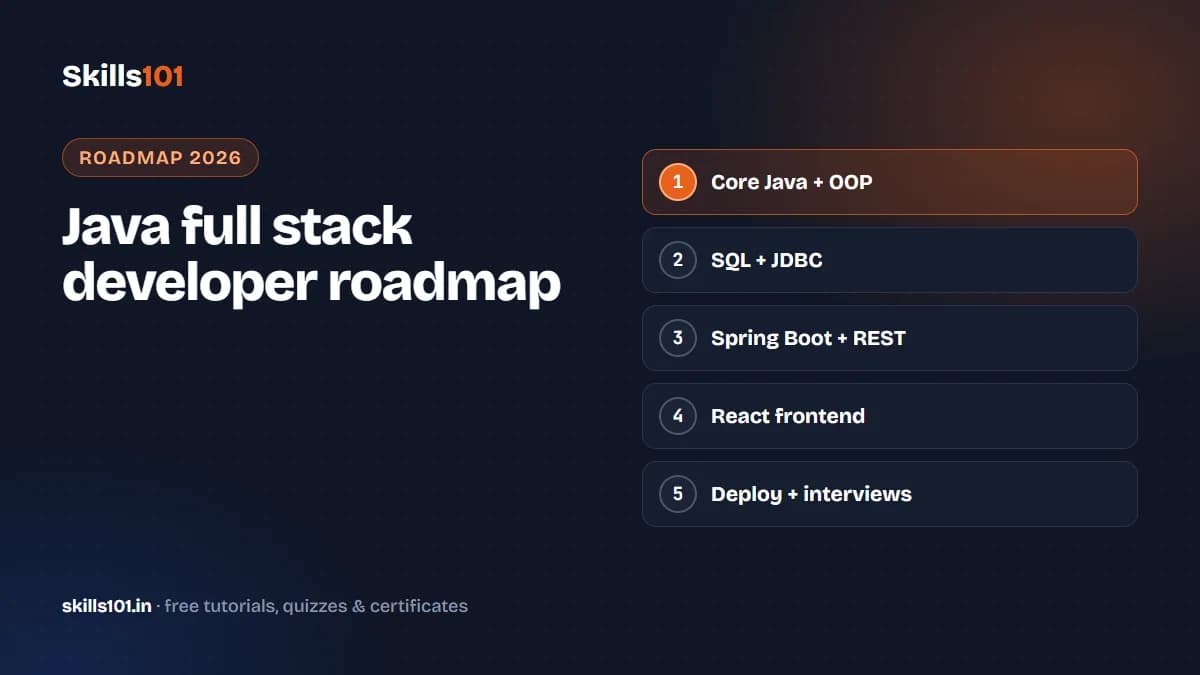
"Java full stack" means you can build a complete web application yourself: the backend in Java with Spring Boot, the database in SQL, and the frontend in HTML, CSS, JavaScript and usually React. It is one of the most common fresher job titles in Indian IT services and product companies, because almost every enterprise system runs on Java.
This roadmap gives you the order to learn things in, how long each stage realistically takes, and what to build at each step so you finish with a portfolio — not just certificates.
The roadmap in short: Core Java + OOP → DSA basics → SQL → JDBC → Spring Boot REST APIs + JPA → Spring Security basics → HTML/CSS/JavaScript → React → Git + testing → deploy a full project → interview prep. About 6 months at 3–4 hours a day.
Stage 1 — Core Java and OOP (4–5 weeks)
This is the foundation every interview tests. Don't rush it.
- Syntax, data types, control flow, arrays and strings — Java tutorials.
- Classes, objects, constructors,
static,final. - The four OOP pillars with your own examples: encapsulation, inheritance, polymorphism, abstraction — OOP course.
- Interfaces vs abstract classes, exception handling, the Collections framework (
List,Set,Map), and Java 8+ lambdas and streams. - Basics of multithreading — what a thread is,
synchronized, why race conditions happen.
Build: a console app — student record system or bank account simulator using classes, collections and exceptions.
Which Java version? Learn on a current LTS (long-term support) release such as Java 21 or 25. Companies still run older versions like Java 8, 11 and 17, so learn what changed in each — especially the Java 8 features (lambdas, streams, Optional), which interviewers love.
Stage 2 — DSA basics in Java (3–4 weeks, in parallel)
Coding rounds decide your first job, so start DSA alongside Stage 1, not after the whole roadmap.
- Arrays, strings, hashing (
HashMap), two pointers, sorting and binary search, recursion, linked lists, stacks and queues. - Solve 2–3 problems a day on a judge — the Skills101 DSA sheet has a live judge that accepts Java.
Stage 3 — SQL and databases (2 weeks)
Every backend developer writes SQL daily.
- Tables, keys, normalisation;
SELECT,WHERE,ORDER BY,GROUP BY/HAVING, joins, subqueries, indexes and transactions — DBMS & SQL. - Install MySQL or PostgreSQL locally and practise on a real dataset.
Stage 4 — JDBC and how Java talks to a database (1 week)
Before using frameworks, connect Java to a database by hand once. You will understand what Spring does for you later.
Connection,PreparedStatement,ResultSet, and why prepared statements prevent SQL injection — JDBC tutorial.
Stage 5 — Spring Boot (5–6 weeks)
This is the heart of Java backend jobs.
- Spring core: dependency injection and beans — Spring core.
- REST APIs: controllers, request/response, status codes — Spring Boot REST API.
- Validation and error handling — validation & exceptions.
- Spring Data JPA / Hibernate: entities, repositories, relationships, transactions — JPA.
- Security basics: authentication with JWT — Spring Security + JWT.
- Testing: JUnit and Mockito — testing.
- API docs: OpenAPI/Swagger — production basics.
Build: a REST API with authentication, validation, pagination and tests — for example, a course-enrolment or expense-tracker API.
Stage 6 — Frontend: HTML, CSS, JavaScript and React (5 weeks)
Full stack means you can build the screen as well.
- HTML and CSS (flexbox, grid, responsive design), then modern JavaScript (ES6+,
fetch, promises,async/await) — web development. - React: components, props, state, hooks, forms, routing, calling your Spring Boot API.
Build: a React frontend for your Stage 5 API — login, list, create, edit, delete.
Stage 7 — Git, deployment and microservices awareness (2–3 weeks)
- Git branching, pull requests and resolving conflicts — Git.
- Package and run your app with Docker — Spring Boot + Docker Compose.
- Deploy it somewhere public so recruiters can click it.
- Understand microservices at a conceptual level (service discovery, API gateway, messaging) — microservices with Spring Cloud. Freshers are rarely asked to build them, but often asked to explain them.
Stage 8 — Interview preparation (ongoing, last 3–4 weeks focused)
- Java interview questions, OOP questions, Spring Boot questions, SQL queries.
- Explain your projects in 2 minutes each: problem, design, one hard bug, what you'd improve.
- Aptitude for the online test — most service companies test it before any coding: placement prep by company.
The 6-month timeline at a glance
| Month | Focus | Output |
|---|---|---|
| 1 | Core Java + OOP, start DSA | console project, 40 problems |
| 2 | Collections, streams, exceptions; DSA; SQL | 80 problems, SQL practice set |
| 3 | JDBC, Spring core, REST APIs | first REST API |
| 4 | JPA, security, testing | secured, tested API |
| 5 | HTML/CSS/JS + React | full stack app (React + Spring Boot + SQL) |
| 6 | Git, Docker, deploy, interview prep | live project link, resume, mock interviews |
Students who already know programming basics can move faster; complete beginners should allow 7–8 months rather than skipping fundamentals.
Projects that make a fresher resume stand out
- Full stack CRUD app with authentication (React + Spring Boot + MySQL), deployed.
- REST API with role-based access (admin/user), validation, pagination and tests.
- One project with a real-world twist — payment sandbox integration, email notifications, file upload, or a scheduled job.
Each one should have a clean README, screenshots and a live link. Recruiters open the link before they read the code.
Common mistakes on the Java full stack path
- Starting Spring Boot before Core Java is solid. You end up copying annotations without understanding them.
- Skipping SQL because "JPA writes it for you". Interviews still ask for joins and
GROUP BY. - Tutorial hopping. Finish one complete project instead of starting five.
- Ignoring DSA and aptitude. Your first job's online test checks them before anyone sees your project.
Learn it free, or with a mentor
Every stage above has a free track on Skills101 — Java, OOP, DSA, SQL, web development, Spring Boot and Git — with a quiz after each lesson and a certificate per subject. If you want live classes, code reviews and mock interviews on top, see the Java Full Stack program.
Frequently asked questions
How long does it take to become a Java full stack developer?
About 6 months at 3–4 hours a day for most students who already know basic programming. Complete beginners should plan 7–8 months and spend longer on Core Java and OOP.
Is Java full stack still in demand in 2026?
Yes. Java with Spring Boot remains one of the most widely used enterprise backend stacks, and Indian IT services and product companies hire Java developers at fresher level every year.
Should I learn React or Angular for Java full stack?
Either works; React is more common in new projects and job posts, so it's the safer first choice. Many enterprise teams use Angular, and the core skills (components, state, calling APIs) transfer.
Do I need to learn microservices as a fresher?
Understand the concepts — service discovery, API gateway, inter-service calls — and be able to explain them. Building a large microservices system is rarely expected at fresher level.
Which Java version should I learn in 2026?
Learn on a current long-term-support release such as Java 21 or 25, and know the key features added since Java 8 (lambdas, streams, records, text blocks), because companies run many different versions.