Theory of Computation (TOC) · Lesson 1 of 8 · Updated ·
Theory of Computation Basics — Alphabets, Strings, Languages and the Chomsky Hierarchy
Theory of Computation asks two big questions: what problems can a computer solve at all, and how much power does a machine need to solve them? The answers explain why regex can't match nested brackets, why compilers have a lexer and a parser, and why no program can detect every infinite loop. It's also a guaranteed GATE topic.
1. Alphabets, strings, languages
| Term | Meaning | Example |
|---|---|---|
| Alphabet Σ | a finite set of symbols | Σ = {0, 1}, or {a, b} |
| String | a finite sequence of symbols | 0110, abba |
| Length |w| | number of symbols | |0110| = 4 |
| Empty string ε | the string of length 0 | |ε| = 0 |
| Σ* (Kleene star) | all strings over Σ, including ε | {ε, 0, 1, 00, 01, …} |
| Σ⁺ | all non-empty strings | Σ* minus ε |
| Language L | any set of strings over Σ (a subset of Σ*) | binary strings ending in 1 |
Operations on strings: concatenation (ab · ba = abba), reverse (abbᴿ = bba), substring/prefix/suffix.
A language can be finite ({a, ab}) or infinite (all palindromes). Most interesting ones are infinite — so we need a finite description of an infinite set: a machine or a grammar.
from itertools import product

sigma = "01"
def strings_up_to(n):
    for k in range(n + 1):
        for t in product(sigma, repeat=k):
            yield "".join(t)

all_strings = list(strings_up_to(3))
print("Σ* up to length 3:", ["ε" if s == "" else s for s in all_strings])
print("count:", len(all_strings), "= 1 + 2 + 4 + 8")

ends_in_1 = [s for s in all_strings if s.endswith("1")]
palindromes = [s for s in all_strings if s == s[::-1] and s]
print("L1 = ends in 1:", ends_in_1)
print("L2 = palindromes:", palindromes)
Σ* up to length 3: ['ε', '0', '1', '00', '01', '10', '11', '000', '001', '010', '011', '100', '101', '110', '111']
count: 15 = 1 + 2 + 4 + 8
L1 = ends in 1: ['1', '01', '11', '001', '011', '101', '111']
L2 = palindromes: ['0', '1', '00', '11', '000', '010', '101', '111']
2. Operations on languages
For languages L₁, L₂:
- Union L₁ ∪ L₂, intersection, complement (Σ* − L)
- Concatenation L₁L₂ = {xy | x ∈ L₁, y ∈ L₂}
- Kleene star L* = ε ∪ L ∪ LL ∪ LLL ∪ … (zero or more pieces from L)
Example: L = {ab} → L* = {ε, ab, abab, ababab, …}.
3. Problems as languages
TOC turns every yes/no question into membership in a language:
- "Is this number prime?" → is the binary string in L = {binary representations of primes}?
- "Is this Java program syntactically valid?" → is it in L = {valid Java programs}?
- "Does this program halt?" → is ⟨program, input⟩ in L_HALT?
A machine accepts (or recognises) a language if it says "yes" exactly for the strings in it. Different machine types have different power.
4. The Chomsky hierarchy
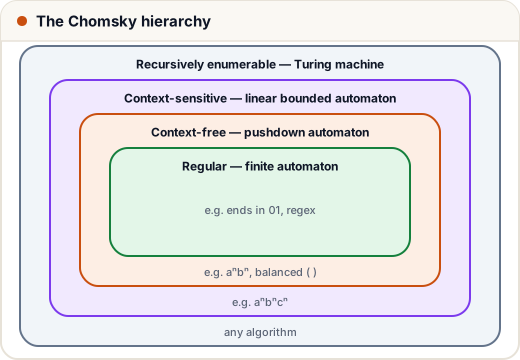
| Type | Language class | Machine | Memory | Example | Used in |
|---|---|---|---|---|---|
| 3 | Regular | Finite automaton (DFA/NFA) | none beyond the state | strings ending in 01 | regex, lexers, input validation |
| 2 | Context-free | Pushdown automaton (PDA) | a stack | balanced brackets, aⁿbⁿ | programming-language syntax, parsers |
| 1 | Context-sensitive | Linear bounded automaton | tape limited to input size | aⁿbⁿcⁿ | — |
| 0 | Recursively enumerable | Turing machine | unlimited tape | anything computable | every algorithm |
Each class strictly contains the one above it: every regular language is context-free, but aⁿbⁿ is context-free and not regular; aⁿbⁿcⁿ is context-sensitive and not context-free.
The rest of this track climbs the hierarchy: finite automata (lessons 2–5), context-free grammars and PDAs (lesson 6), Turing machines (lesson 7), and the limits of computation (lesson 8).
5. Why programmers should care
- Regex engines are finite automata — they can't match arbitrarily nested structures like
((()))or HTML. Use a parser. - Compilers: the lexer uses regular languages (tokens), the parser uses context-free grammars (syntax).
- Validation and protocols: state machines model login flows, order status, network protocols.
- Limits: some problems (halting) are unsolvable by any program — knowing that saves you from attempting them.
Common mistakes
- Confusing ε (the empty string) with ∅ (the empty language, which contains no strings at all).
- Forgetting that Σ* includes ε.
- Thinking a "language" must be a programming language — in TOC it's just a set of strings.
Quick recap
- Alphabet Σ (finite symbols) → strings → Σ* (all strings, incl. ε) → a language is any subset of Σ*.
- Language operations: union, intersection, complement, concatenation, Kleene star.
- Every decision problem = a language membership question.
- Chomsky hierarchy: regular (FA) ⊂ context-free (PDA) ⊂ context-sensitive (LBA) ⊂ recursively enumerable (TM).