Theory of Computation (TOC) · Lesson 4 of 8 · Updated ·
Regular Expressions and Regular Languages — Regex to Automata, Closure Properties and Practical Regex
Finite automata describe regular languages as machines; regular expressions describe the same languages as patterns. Kleene's theorem says they are exactly equivalent — and that equivalence is why grep, form validators and lexers are fast.
1. Formal regular expressions
Built from symbols with three operations (plus brackets):
| Regex | Language | Example |
|---|---|---|
a | {a} | |
ε | {ε} | |
∅ | {} | |
R + S (union, written | in code) | L(R) ∪ L(S) | a + b = {a, b} |
| RS (concatenation) | L(R)L(S) | ab = {ab} |
| R* (Kleene star) | zero or more | a* = {ε, a, aa, …} |
Precedence: star > concatenation > union. So ab* + c means (a(b*)) + c.
2. Writing regex for common languages (Σ = {0, 1})
| Language | Regex |
|---|---|
| all strings | (0+1)* |
ends in 01 | (0+1)*01 |
contains 11 | (0+1)*11(0+1)* |
| starts and ends with the same symbol | 0(0+1)*0 + 1(0+1)*1 + 0 + 1 |
| even length | ((0+1)(0+1))* |
| no two consecutive 1s | (0 + 10)*(ε + 1) |
| exactly two 1s | 0*10*10* |
Let's verify each against a plain definition using Python's re (where | is union and fullmatch means "the whole string"):
import re
from itertools import product

cases = {
    "ends in 01":         (r"[01]*01",            lambda s: s.endswith("01")),
    "contains 11":        (r"[01]*11[01]*",       lambda s: "11" in s),
    "same first & last":  (r"0[01]*0|1[01]*1|0|1", lambda s: len(s) > 0 and s[0] == s[-1]),
    "even length":        (r"([01][01])*",        lambda s: len(s) % 2 == 0),
    "no 11":              (r"(0|10)*(1)?",        lambda s: "11" not in s),
    "exactly two 1s":     (r"0*10*10*",           lambda s: s.count("1") == 2),
}
strings = ["".join(t) for n in range(11) for t in product("01", repeat=n)]
for name, (rx, ok) in cases.items():
    agree = all(bool(re.fullmatch(rx, s)) == ok(s) for s in strings)
    print(f"{name:18} {rx:22} correct on {len(strings)} strings: {agree}")
ends in 01         [01]*01                correct on 2047 strings: True
contains 11        [01]*11[01]*           correct on 2047 strings: True
same first & last  0[01]*0|1[01]*1|0|1    correct on 2047 strings: True
even length        ([01][01])*            correct on 2047 strings: True
no 11              (0|10)*(1)?            correct on 2047 strings: True
exactly two 1s     0*10*10*               correct on 2047 strings: True
3. Regex → automaton (Thompson's construction)
Every regex can be turned into an ε-NFA by combining small pieces:
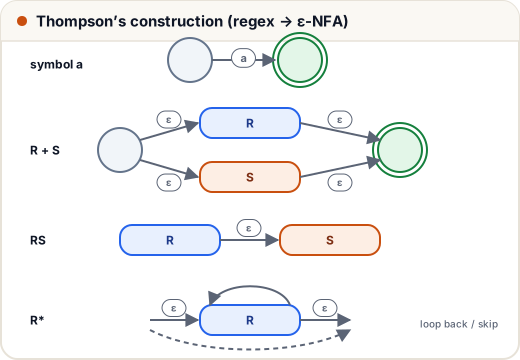
- symbol a: start —a→ accept
- R + S: new start with ε to both, both ε to a new accept
- RS: R's accept ε→ S's start
- R*: new start/accept; ε to skip, ε loop back for repetition
Then subset construction (lesson 3) gives a DFA, and minimisation (lesson 5) gives the smallest DFA. The reverse direction (DFA → regex) uses state elimination or Arden's theorem (R = Q + RP ⇒ R = QP*).
4. Useful identities
| Identity | |
|---|---|
| ε R = R ε = R | ∅ R = R ∅ = ∅ |
| R + ∅ = R | R + R = R |
| (R*)* = R* | ε* = ε, ∅* = ε |
| RR = R* | (R + S)* = (RS)* |
| R(SR)* = (RS)*R |
5. Closure properties of regular languages
If L₁ and L₂ are regular, so are:
| Operation | Why (machine idea) |
|---|---|
| union, concatenation, star | Thompson's construction |
| intersection | product construction (lesson 2) |
| complement | swap accepting states of a complete DFA |
| difference L₁ − L₂ | L₁ ∩ complement(L₂) |
| reverse | reverse all arrows, swap start/accept |
| homomorphism, inverse homomorphism | substitute symbols |
Closure properties are a quick proof tool: e.g. if L were regular, then L ∩ a*b* would be regular too — useful for showing languages are not regular (next lesson).
6. Textbook regex vs regex in code
| Textbook | Python / Java / JS | Note |
|---|---|---|
a + b | a|b or [ab] | |
(0+1)* | [01]* | |
| — | a+ | one or more = aa* |
| — | a? | optional = (ε + a) |
| — | \d, \w, . | character classes |
| — | ^, $, \b | anchors (or use fullmatch) |
| not regular! | backreferences (\w+)\1 | beyond regular languages |
Practical regex engines add features (backreferences, lookarounds) that go beyond regular languages — and backtracking engines can take exponential time on patterns like (a+)+$ against aaaa…b (ReDoS attacks). Prefer simple patterns, anchors and length limits on user input.
import re

pin = re.compile(r"[1-9][0-9]{5}")                    # Indian PIN code: 6 digits, not starting with 0
mobile = re.compile(r"(\+91)?[6-9][0-9]{9}")
for s in ["302029", "012345", "+919876543210", "5876543210"]:
    print(f"{s:14} pin={bool(pin.fullmatch(s))!s:5} mobile={bool(mobile.fullmatch(s))}")
302029         pin=True  mobile=False
012345         pin=False mobile=False
+919876543210  pin=False mobile=True
5876543210     pin=False mobile=False
Common mistakes
- Forgetting precedence:
ab*isa(b*), not(ab)*. - Using
search/matchinstead offullmatchwhen validating (partial matches slip through). - Expecting regex to match nested or counted-equal structures (aⁿbⁿ, balanced brackets).
- Writing ambiguous, backtracking-heavy patterns on untrusted input.
Quick recap
- Regex = union (+), concatenation, star; precedence star > concat > union.
- Regex ⇔ ε-NFA ⇔ NFA ⇔ DFA (Kleene's theorem; Thompson's construction + subset construction).
- Regular languages are closed under union, concatenation, star, intersection, complement, difference, reverse.
- Practical regex adds conveniences; backreferences go beyond regular; beware ReDoS.