Theory of Computation (TOC) · Lesson 6 of 8 · Updated ·
Context-Free Grammars and Pushdown Automata — Derivations, Parse Trees, Ambiguity, CNF, CYK and Stack Machines
Regular languages can't count or nest. Programming languages are full of nesting — brackets inside brackets, blocks inside blocks, expressions inside expressions. Context-free grammars (CFGs) describe exactly this kind of structure, and every compiler's parser is built on one.
1. Context-free grammars
G = (V, Σ, R, S): variables (non-terminals), terminals (the alphabet), rules of the form A → string of variables/terminals, and a start variable S.
aⁿbⁿ:
S → a S b | ε
Derivation of aabb: S ⇒ aSb ⇒ aaSbb ⇒ aabb.
Balanced brackets:
S → ( S ) S | ε
Arithmetic expressions with precedence (the shape of every language spec):
E → E + T | T          (sum of terms)
T → T * F | F          (product of factors)
F → ( E ) | id         (atoms)
Because * lives one level deeper than +, id + id * id can only be parsed as id + (id * id).
2. Derivations and parse trees
A parse tree shows how the start symbol derives a string: internal nodes are variables, leaves (left to right) spell the string.
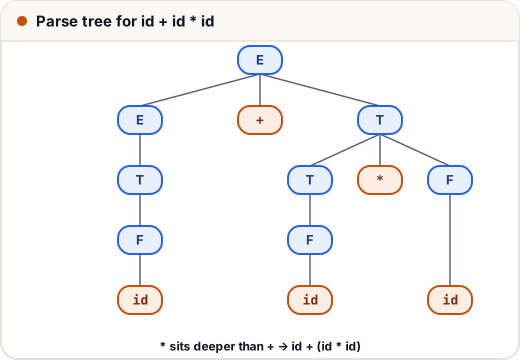
Leftmost derivation: always expand the leftmost variable. Each parse tree corresponds to exactly one leftmost derivation.
3. Ambiguity
A grammar is ambiguous if some string has two different parse trees. The naive expression grammar E → E + E | E * E | id is ambiguous: id + id * id can group either way — which would make 2 + 3 * 4 evaluate to 14 or 20. Let's count parse trees by brute force:
from functools import lru_cache

tokens = ["id", "+", "id", "*", "id"]

@lru_cache(None)
def trees_ambiguous(i, j):          # E -> E + E | E * E | id   over tokens[i:j]
    if j - i == 1:
        return 1 if tokens[i] == "id" else 0
    total = 0
    for k in range(i + 1, j - 1):
        if tokens[k] in "+*":
            total += trees_ambiguous(i, k) * trees_ambiguous(k + 1, j)
    return total

@lru_cache(None)
def E(i, j):                        # E -> E + T | T
    return T(i, j) + sum(E(i, k) * T(k + 1, j) for k in range(i + 1, j - 1) if tokens[k] == "+")

@lru_cache(None)
def T(i, j):                        # T -> T * F | F
    return F(i, j) + sum(T(i, k) * F(k + 1, j) for k in range(i + 1, j - 1) if tokens[k] == "*")

@lru_cache(None)
def F(i, j):                        # F -> id
    return 1 if j - i == 1 and tokens[i] == "id" else 0

print("ambiguous grammar: parse trees for id+id*id =", trees_ambiguous(0, len(tokens)))
print("precedence grammar: parse trees for id+id*id =", E(0, len(tokens)))
ambiguous grammar: parse trees for id+id*id = 2
precedence grammar: parse trees for id+id*id = 1
The precedence grammar has exactly one tree — unambiguous. (Deciding whether an arbitrary CFG is ambiguous is undecidable, and some context-free languages are inherently ambiguous, but practical grammars are designed to avoid it.) The famous dangling else — if a then if b then s1 else s2 — is the same problem; languages resolve it with a rule: else matches the nearest if.
4. Chomsky Normal Form and CYK
Chomsky Normal Form (CNF): every rule is A → BC or A → a (plus S → ε if needed). Any CFG can be converted. CNF makes parse trees binary, which gives:
- a derivation of a string of length n takes exactly 2n − 1 steps;
- the CYK algorithm decides membership in O(n³) using dynamic programming.
CNF for aⁿbⁿ (n ≥ 1): S → AB | AX, X → SB, A → a, B → b.
from itertools import product

cnf = {"S": [("A", "B"), ("A", "X")], "X": [("S", "B")], "A": ["a"], "B": ["b"]}

def cyk(w):
    n = len(w)
    table = [[set() for _ in range(n)] for _ in range(n)]
    for i, ch in enumerate(w):
        table[i][i] = {v for v, rules in cnf.items() if ch in rules}
    for length in range(2, n + 1):
        for i in range(n - length + 1):
            j = i + length - 1
            for k in range(i, j):
                for v, rules in cnf.items():
                    for r in rules:
                        if isinstance(r, tuple) and r[0] in table[i][k] and r[1] in table[k + 1][j]:
                            table[i][j].add(v)
    return "S" in table[0][n - 1]

for w in ["ab", "aabb", "aaabbb", "aab", "abab", "ba"]:
    print(f"{w:7} {cyk(w)}")
ok = all(cyk(w) == (w == "a" * (len(w) // 2) + "b" * (len(w) // 2))
         for n in range(2, 11, 1) for w in ("".join(t) for t in product("ab", repeat=n)))
print("CYK agrees with a^n b^n (n>=1) on all strings of length 2..10:", ok)
ab      True
aabb    True
aaabbb  True
aab     False
abab    False
ba      False
CYK agrees with a^n b^n (n>=1) on all strings of length 2..10: True
5. Pushdown automata (PDA)
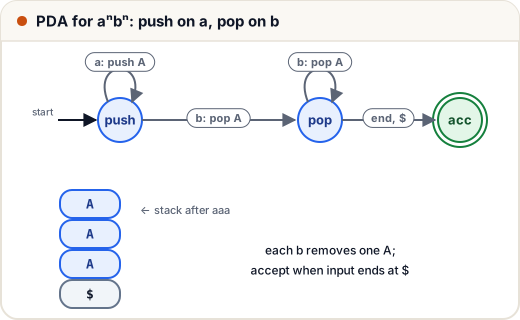
A PDA = finite automaton + a stack. Each move reads an input symbol (or ε), pops the top of the stack, and pushes a string. The stack is exactly what's needed to match nested structure.
PDA idea for aⁿbⁿ: push an A for every a; on each b pop an A; accept if the input ends exactly when the stack is empty again.
def pda_anbn(w, trace=False):
    stack, state = ["$"], "push"
    for ch in w:
        if state == "push" and ch == "a":
            stack.append("A")
        elif ch == "b" and stack[-1] == "A":
            state = "pop"
            stack.pop()
        else:
            return False                     # no valid move: reject
        if trace:
            print(f"  read {ch}  state={state:4}  stack={''.join(stack)}")
    return stack == ["$"]

print("aaabbb:"); print("accepted:", pda_anbn("aaabbb", trace=True))
print([(w, pda_anbn(w)) for w in ["", "ab", "aabbb", "abab", "aaabbb"]])
aaabbb:
  read a  state=push  stack=$A
  read a  state=push  stack=$AA
  read a  state=push  stack=$AAA
  read b  state=pop   stack=$AA
  read b  state=pop   stack=$A
  read b  state=pop   stack=$
accepted: True
[('', True), ('ab', True), ('aabbb', False), ('abab', False), ('aaabbb', True)]
Balanced brackets with several bracket types — the same idea, used in every code editor and compiler:
def balanced(s):
    pairs, stack = {")": "(", "]": "[", "}": "{"}, []
    for ch in s:
        if ch in "([{":
            stack.append(ch)
        elif ch in pairs:
            if not stack or stack.pop() != pairs[ch]:
                return False
    return not stack

for s in ["{[()()]}", "([)]", "((()", "for (i = 0; i < n; i++) { a[i] = (b[i] + c); }"]:
    print(f"{s:45} {balanced(s)}")
{[()()]}                                      True
([)]                                          False
((()                                          False
for (i = 0; i < n; i++) { a[i] = (b[i] + c); } True
6. Facts for exams
- CFG ⇔ PDA (nondeterministic) — same languages.
- Deterministic PDAs are weaker than nondeterministic ones (e.g. even-length palindromes need nondeterminism to "guess the middle") — unlike DFA = NFA. Most programming languages are designed to be parsed deterministically (LL/LR parsers).
- CFLs are closed under union, concatenation, star but not under intersection or complement. (aⁿbⁿcᵐ ∩ aᵐbⁿcⁿ = aⁿbⁿcⁿ, which is not context-free.)
- Pumping lemma for CFLs (s = uvxyz, pump v and y together) shows aⁿbⁿcⁿ and {ww} are not context-free.
Common mistakes
- Thinking an unambiguous grammar exists for every CFL (some are inherently ambiguous).
- Assuming deterministic and nondeterministic PDAs are equally powerful.
- Claiming CFLs are closed under intersection.
- Forgetting the bottom-of-stack marker
$when designing PDAs.
Quick recap
- CFG rules
A → …; derivations and parse trees; leftmost derivation ↔ parse tree. - Ambiguous = two parse trees for one string; fix with precedence levels (E/T/F).
- CNF:
A → BC | a; CYK decides membership in O(n³). - PDA = FA + stack; CFG ⇔ NPDA; DPDA weaker.
- CFLs closed under ∪, concatenation, *; not under ∩ or complement.