C Programming · Lesson 10 of 10 · Updated ·
C Output Questions — Tricky "Predict the Output" Problems Explained
Placement tests love short C programs that ask "what is the output?" They test whether you really understand the rules. Every program below was compiled and run; the output shown is real.
Method: go line by line, keep a small table of every variable's value, and remember the traps: integer division, ++ before/after, short-circuit, switch fall-through, macro expansion, and
sizeofvsstrlen.
1. Integer division and promotion
#include <stdio.h>
int main(void) {
    int a = 7, b = 2;
    float c = a / b;
    float d = (float)a / b;
    printf("%.1f %.1f %d\n", c, d, a % b * 3);
    return 0;
}
3.0 3.5 3
a / b is done in integers (3) before being stored in the float.
2. Short-circuit evaluation
#include <stdio.h>
int main(void) {
    int i = 0, j = 0;
    if (i++ || j++) printf("in ");
    printf("%d %d\n", i, j);
    if (++i || ++j) printf("in ");
    printf("%d %d\n", i, j);
    return 0;
}
1 1
in 2 1
First if: i++ gives 0 (false), so j++ runs too → both 1, no "in". Second: ++i gives 2 (true), so ++j is skipped.
3. Comma operator and assignment in conditions
#include <stdio.h>
int main(void) {
    int x = (1, 2, 3);
    int y = 0;
    if (y = 5) printf("assigned ");
    printf("%d %d\n", x, y);
    return 0;
}
assigned 3 5
The comma operator returns its last value. y = 5 is an assignment with value 5 → true.
4. Loops
#include <stdio.h>
int main(void) {
    int i, count = 0;
    for (i = 10; i > 0; i -= 3) count++;
    printf("%d %d\n", count, i);
    int k = 5;
    while (k--) ;
    printf("%d\n", k);
    return 0;
}
4 -2
-1
i goes 10, 7, 4, 1 (4 rounds), then −2 fails the test. while (k--) checks 5, 4, 3, 2, 1, 0 — the last check sees 0 (stop) but still decrements to −1.
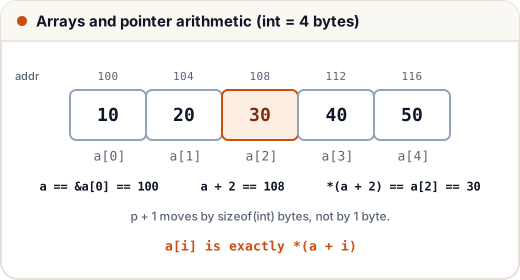
5. Pointers and arrays
#include <stdio.h>
int main(void) {
    int a[] = {10, 20, 30, 40};
    int *p = a + 1;
    printf("%d %d %d\n", *p, *(p + 2), p[-1]);
    printf("%d\n", *p++ + 1);
    printf("%d\n", *p);
    return 0;
}
20 40 10
21
30
*p++ reads *p (20), then moves p. So 20 + 1 = 21, and p now points to 30.
6. Strings and sizeof
#include <stdio.h>
#include <string.h>
int main(void) {
    char s[10] = "code";
    char *t = "code";
    printf("%zu %zu %zu\n", sizeof(s), strlen(s), strlen(t));
    printf("%c %s\n", *(s + 1), s + 2);
    return 0;
}
10 4 4
o de
sizeof(s) is the array size (10), not the text length. s + 2 is the string starting at index 2.
7. Static variables
#include <stdio.h>
int counter(void) {
    static int c = 0;
    c += 2;
    return c;
}
int main(void) {
    int total = 0;
    for (int i = 0; i < 3; i++) total += counter();
    printf("%d\n", total);
    return 0;
}
12
counter returns 2, 4, 6 → total 12.
8. Macros
#include <stdio.h>
#define MUL(a, b) a * b
int main(void) {
    printf("%d %d\n", MUL(2, 3), MUL(1 + 2, 3 + 4));
    return 0;
}
6 11
MUL(1 + 2, 3 + 4) → 1 + 2 * 3 + 4 = 1 + 6 + 4 = 11.
9. Character arithmetic
#include <stdio.h>
int main(void) {
    char c = 'A';
    c += 2;
    printf("%c %d %c\n", c, c, 'a' + 25);
    return 0;
}
C 67 z
10. Recursion
#include <stdio.h>
void f(int n) {
    if (n == 0) return;
    f(n / 2);
    printf("%d", n % 2);
}
int main(void) {
    f(13);
    printf("\n");
    return 0;
}
1101
This prints the binary of 13: the recursive call happens before printing, so the digits come out in the right order.
Common mistakes in these questions
- Forgetting integer division happens before assignment to a float.
- Missing short-circuit (
||stops at the first true). - Mixing up
*p++(value, then move) and(*p)++(increase the value). - Expanding macros without adding brackets mentally.
Quick recap
- Trace line by line with a variable table.
- Watch: integer division, pre/post ++, short-circuit, comma operator,
=in if, macro expansion, sizeof vs strlen, static. - Practise more on our daily question and placement mocks.