C Programming · Lesson 2 of 10 · Updated ·
Data Types, Variables, Operators and printf/scanf in C
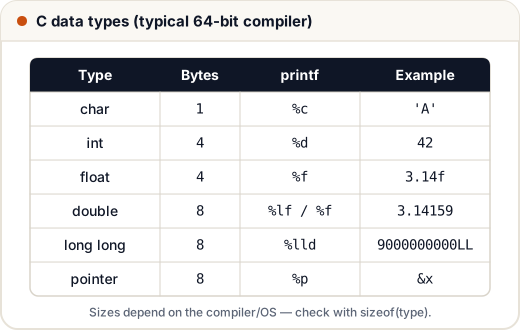
In C, every variable has a type that decides how many bytes it uses and what values it can hold.
1. Declaring variables
#include <stdio.h>

int main(void) {
    char grade = 'A';
    int age = 21;
    float price = 99.5f;
    double pi = 3.14159265;
    printf("%c %d %.1f %.4f\n", grade, age, price, pi);
    printf("char=%zu int=%zu double=%zu\n", sizeof(char), sizeof(int), sizeof(double));
    return 0;
}
A 21 99.5 3.1416
char=1 int=4 double=8
sizeofgives the size in bytes (%zuprints it).- Uninitialised local variables contain garbage — always give a starting value.
Format specifiers
| Specifier | Type |
|---|---|
%d / %i | int |
%u | unsigned int |
%ld / %lld | long / long long |
%f | float or double (printf) |
%lf | double (scanf) |
%c | char |
%s | string |
%p | pointer (address) |
%x | hexadecimal |
%.2f = 2 decimal places, %5d = width 5 (right-aligned), %-5d = left-aligned.
2. Reading input with scanf
#include <stdio.h>

int main(void) {
    // Input: 12 30
    int a, b;
    scanf("%d %d", &a, &b);
    printf("sum = %d\n", a + b);
    return 0;
}
sum = 42
Note the
&before each variable: scanf needs the address where it should store the value. Forgetting&is one of the most common C bugs (strings are the exception — covered later).
3. Arithmetic and integer division
#include <stdio.h>

int main(void) {
    printf("%d %d %d\n", 17 / 5, 17 % 5, -17 / 5);
    printf("%.2f\n", 17 / 5.0);
    printf("%.2f\n", (float)17 / 5);
    printf("%d\n", 7 / 2 * 2);
    return 0;
}
3 2 -3
3.40
3.40
6
int / intcuts the decimal part (towards zero: −17/5 = −3).- Make one side a float (
5.0or a cast) to get decimals. 7 / 2 * 2=3 * 2= 6, not 7.
4. Increment and decrement
#include <stdio.h>

int main(void) {
    int i = 5;
    int a = i++;   /* use 5, then i becomes 6 */
    int b = ++i;   /* i becomes 7, then use 7 */
    printf("%d %d %d\n", a, b, i);
    return 0;
}
5 7 7
Never write
i = i++or usei++twice in one expression (i++ + i++). That's undefined behaviour in C — different compilers give different answers.
5. Relational, logical and other operators
- Relational:
== != > < >= <=→ result is 1 (true) or 0 (false). - Logical:
&&,||,!— with short-circuit: ina && b, ifais false,bis never evaluated. - Assignment:
+= -= *= /= %= - Ternary:
cond ? x : y - Bitwise:
& | ^ ~ << >>(x << 1doubles x).
#include <stdio.h>

int main(void) {
    int x = 5;
    printf("%d %d %d\n", x > 3, x == 4, !x);
    printf("%d %d %d\n", 6 & 3, 6 | 3, 6 ^ 3);
    printf("%d %d\n", 5 << 2, 20 >> 1);
    int y = 0;
    if (x > 10 && ++y) { }
    printf("y = %d\n", y);
    return 0;
}
1 0 0
2 7 5
20 10
y = 0
(++y never ran because x > 10 was false — short-circuit.)
6. Constants and type casting
#define PI 3.14159      /* macro: text replaced before compiling */
const int MAX = 100;    /* a read-only variable */
int r = (int)9.99;      /* explicit cast → 9 */
Common mistakes
- Forgetting
&in scanf. - Expecting
5 / 2to be 2.5. - Using
%dto print a float (garbage output). - Using
=instead of==in conditions (if (x = 5)is always true!).
Quick recap
- Types: char (1), int (4), float (4), double (8) bytes typically; check with sizeof.
- printf/scanf use format specifiers; scanf needs
&. - int/int truncates; % gives the remainder.
i++vs++i; never modify a variable twice in one expression.- Relational results are 1 or 0; && and || short-circuit.