C Programming · Lesson 8 of 10 · Updated ·
Dynamic Memory in C — malloc, calloc, realloc, free and Linked Lists
Arrays need their size at compile time. Dynamic memory lets you decide the size while the program runs — for example, after reading how many students there are.
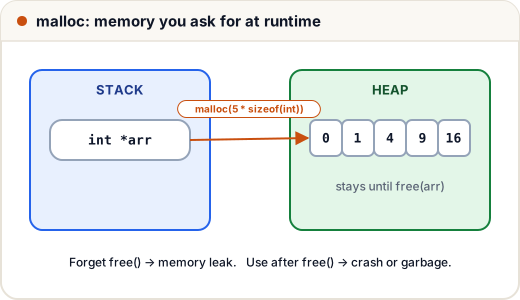
All functions are in <stdlib.h>.
1. malloc and free
#include <stdio.h>
#include <stdlib.h>

int main(void) {
    int n = 5;
    int *arr = malloc(n * sizeof(int));     /* n ints on the heap */
    if (arr == NULL) {                       /* always check */
        printf("out of memory\n");
        return 1;
    }
    for (int i = 0; i < n; i++) arr[i] = i * i;
    for (int i = 0; i < n; i++) printf("%d ", arr[i]);
    printf("\n");
    free(arr);                               /* give it back */
    arr = NULL;                              /* avoid a dangling pointer */
    return 0;
}
0 1 4 9 16
2. malloc vs calloc
malloc(bytes) | calloc(count, size) | |
|---|---|---|
| Arguments | total bytes | number of items, size of each |
| Initial values | garbage | all zero |
| Speed | slightly faster | zeroing costs a little |
int *a = calloc(5, sizeof(int)); /* {0, 0, 0, 0, 0} */
3. realloc: grow or shrink
#include <stdio.h>
#include <stdlib.h>

int main(void) {
    int cap = 2, n = 0;
    int *v = malloc(cap * sizeof(int));
    for (int x = 1; x <= 5; x++) {
        if (n == cap) {                         /* full → double the capacity */
            cap *= 2;
            int *bigger = realloc(v, cap * sizeof(int));
            if (!bigger) { free(v); return 1; }
            v = bigger;
        }
        v[n++] = x * 10;
    }
    printf("n=%d cap=%d last=%d\n", n, cap, v[n - 1]);
    free(v);
    return 0;
}
n=5 cap=8 last=50
This "double when full" idea is exactly how Python lists and Java ArrayLists grow.
Assign realloc's result to a temporary first: if it fails it returns NULL, and writing
v = realloc(v, …)would lose the original pointer (a leak).
4. Common memory bugs
| Bug | What happens | Prevent it |
|---|---|---|
| Memory leak | memory never freed; long-running programs grow until they crash | free everything you malloc |
| Dangling pointer | using memory after free | set the pointer to NULL after free |
| Double free | freeing the same block twice → crash | NULL after free (free(NULL) is safe) |
| Buffer overflow | writing past the allocated size | track sizes carefully |
Tools like Valgrind and AddressSanitizer find these bugs.
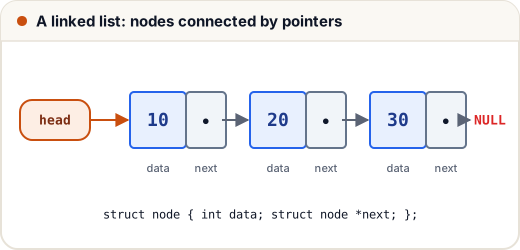
5. A linked list
#include <stdio.h>
#include <stdlib.h>

typedef struct Node {
    int data;
    struct Node *next;
} Node;

Node *push_front(Node *head, int value) {
    Node *n = malloc(sizeof(Node));
    n->data = value;
    n->next = head;
    return n;                     /* the new node is the new head */
}

int main(void) {
    Node *head = NULL;
    for (int v = 30; v >= 10; v -= 10) head = push_front(head, v);
    for (Node *p = head; p != NULL; p = p->next) printf("%d -> ", p->data);
    printf("NULL\n");
    while (head) {                /* free every node */
        Node *next = head->next;
        free(head);
        head = next;
    }
    return 0;
}
10 -> 20 -> 30 -> NULL
Linked lists grow one node at a time and insert at the front in O(1); see the DSA linked list tutorial for more.
Common mistakes
- Not checking malloc's return value for NULL.
malloc(n)instead ofmalloc(n * sizeof(int)).- Freeing a list node and then reading
node->next.
Quick recap
- malloc (garbage), calloc (zeros), realloc (resize), free (release) — from stdlib.h.
- Always check for NULL; free what you allocate; set freed pointers to NULL.
- Leaks, dangling pointers, double free and overflows are the classic bugs.
- Linked lists are built from malloc'd nodes connected by pointers.