Discrete Mathematics · Lesson 8 of 8 · Updated ·
Posets, Lattices, Boolean Algebra and Groups — Hasse Diagrams, LUB/GLB and Algebraic Structures
This lesson covers the "structures" part of discrete maths: ways to order things that aren't simply in a line (task dependencies, versions, sets), and sets with operations that behave nicely (the algebra behind cryptography, error-correcting codes and circuits). These topics are regular in GATE and university papers.
1. Partially ordered sets (posets)
A partial order ≤ on a set is reflexive, antisymmetric and transitive (lesson 1). "Partial" because some pairs may be incomparable.
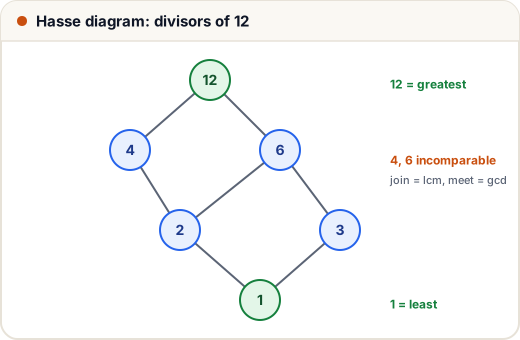
Examples: "divides" on {1, 2, 3, 4, 6, 12}; ⊆ on subsets; "must finish before" on tasks. With "divides", 4 and 6 are incomparable (neither divides the other).
A total order (chain) compares every pair — like ≤ on numbers.
2. Hasse diagrams
Draw the poset without clutter:
- put smaller elements lower;
- draw an edge only for covering relations (a < b with nothing in between);
- omit self-loops and edges implied by transitivity.
D = [1, 2, 3, 4, 6, 12]
leq = lambda a, b: b % a == 0          # a "divides" b

covers = [(a, b) for a in D for b in D
          if a != b and leq(a, b) and not any(c not in (a, b) and leq(a, c) and leq(c, b) for c in D)]
print("Hasse edges:", covers)
print("incomparable pairs:", [(a, b) for i, a in enumerate(D) for b in D[i + 1:] if not leq(a, b) and not leq(b, a)])
Hasse edges: [(1, 2), (1, 3), (2, 4), (2, 6), (3, 6), (4, 12), (6, 12)]
incomparable pairs: [(2, 3), (3, 4), (4, 6)]
3. Special elements and bounds
| Term | Meaning (in the divisors-of-12 poset) |
|---|---|
| Maximal | nothing above it → 12 |
| Minimal | nothing below it → 1 |
| Greatest (top) | above everything → 12 |
| Least (bottom) | below everything → 1 |
| Upper bound of {a, b} | anything ≥ both |
| LUB / join (a ∨ b) | the smallest upper bound → here lcm |
| GLB / meet (a ∧ b) | the largest lower bound → here gcd |
Maximal ≠ greatest: in {2, 3, 4} under divides, 3 and 4 are both maximal, but there's no greatest element.
4. Lattices
A lattice is a poset in which every pair has both a LUB and a GLB. Divisors of n under "divides" always form a lattice (join = lcm, meet = gcd). The power set under ⊆ is a lattice (join = ∪, meet = ∩).
from math import gcd

D = [1, 2, 3, 4, 6, 12]
lcm = lambda a, b: a * b // gcd(a, b)
print("join(4, 6) = lcm =", lcm(4, 6), "| meet(4, 6) = gcd =", gcd(4, 6))
print("is a lattice:", all(lcm(a, b) in D and gcd(a, b) in D for a in D for b in D))

S = [1, 2, 3, 4, 6]          # remove 12: is it still a lattice?
print("without 12 is a lattice:", all(lcm(a, b) in S for a in S for b in S), "(4 and 6 have no join)")
join(4, 6) = lcm = 12 | meet(4, 6) = gcd = 2
is a lattice: True
without 12 is a lattice: False (4 and 6 have no join)
Special lattices you'll meet: bounded (has top and bottom), distributive, complemented (every element a has a′ with a ∨ a′ = top and a ∧ a′ = bottom). A lattice that is both distributive and complemented is a Boolean algebra — the power set of a set is the classic example, and Boolean algebra of bits (∨ = OR, ∧ = AND, ′ = NOT) is the foundation of digital circuits (COA track).
5. Algebraic structures
A set with an operation *:
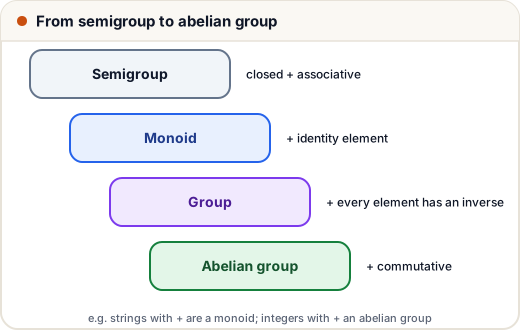
| Structure | Closure | Associative | Identity | Inverses | Commutative |
|---|---|---|---|---|---|
| Semigroup | ✓ | ✓ | |||
| Monoid | ✓ | ✓ | ✓ | ||
| Group | ✓ | ✓ | ✓ | ✓ | |
| Abelian group | ✓ | ✓ | ✓ | ✓ | ✓ |
Examples:
- (strings, concatenation) → monoid (identity = empty string; no inverses).
- (integers, +) → abelian group (identity 0, inverse −a).
- ({0, 1, 2, 3, 4}, + mod 5) → abelian group.
- ({1, 2, 3, 4}, × mod 5) → abelian group (5 is prime, so every element has an inverse).
- ({1, 2, 3}, × mod 4) → not closed (2 × 2 = 0).
Let's check the group axioms automatically:
from itertools import product

def check(S, op):
    closure = all(op(a, b) in S for a, b in product(S, S))
    assoc = closure and all(op(op(a, b), c) == op(a, op(b, c)) for a, b, c in product(S, S, S))
    identity = next((e for e in S if all(op(e, a) == a == op(a, e) for a in S)), None)
    inverses = identity is not None and all(any(op(a, b) == identity for b in S) for a in S)
    commutative = all(op(a, b) == op(b, a) for a, b in product(S, S))
    kind = ("abelian group" if inverses and commutative else "group" if inverses else
            "monoid" if identity is not None and assoc else "semigroup" if assoc else "not even a semigroup")
    return f"closed={closure} identity={identity} -> {kind}"

print("Z5 under + mod 5   :", check([0, 1, 2, 3, 4], lambda a, b: (a + b) % 5))
print("{1..4} under x mod 5:", check([1, 2, 3, 4], lambda a, b: a * b % 5))
print("{0..3} under x mod 4:", check([0, 1, 2, 3], lambda a, b: a * b % 4))
print("{1,2,3} under x mod 4:", check([1, 2, 3], lambda a, b: a * b % 4))
Z5 under + mod 5   : closed=True identity=0 -> abelian group
{1..4} under x mod 5: closed=True identity=1 -> abelian group
{0..3} under x mod 4: closed=True identity=1 -> monoid
{1,2,3} under x mod 4: closed=False identity=1 -> not even a semigroup
6. Cyclic groups and subgroups
- Order of a group = number of elements; order of an element a = smallest k with aᵏ = identity.
- A group is cyclic if one element (a generator) produces all elements by repeated operation. (Z₅, +) is cyclic, generated by 1 (or 2, 3, 4).
- Lagrange's theorem: the order of any subgroup divides the order of the group. So a group of prime order has no non-trivial subgroups and is cyclic.
These ideas power cryptography: Diffie–Hellman key exchange and elliptic-curve crypto (used in UPI and HTTPS) work inside large cyclic groups.
Common mistakes
- Drawing transitive edges in a Hasse diagram.
- Confusing maximal (nothing above) with greatest (above everything).
- Calling a monoid a group without checking that every element has an inverse.
- Forgetting to check closure first.
Quick recap
- Poset = reflexive + antisymmetric + transitive; Hasse diagram shows only covering edges.
- LUB = join, GLB = meet (for divisibility: lcm and gcd); lattice = every pair has both.
- Boolean algebra = complemented distributive lattice.
- Semigroup ⊂ monoid ⊂ group ⊂ abelian group (closure, associativity, identity, inverses, commutativity).
- Cyclic groups have a generator; Lagrange: subgroup order divides group order.