Placement Test Patterns Compared — TCS, Infosys, Wipro, Accenture and 7 More (2026)
Pankaj Sharma ·
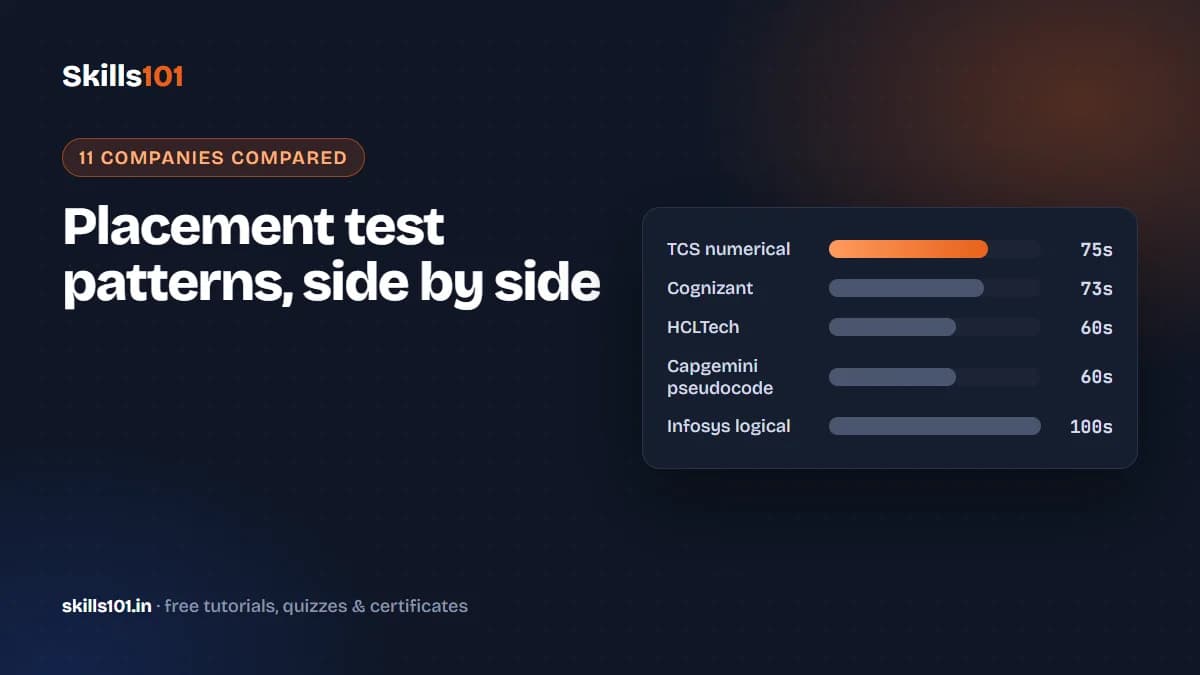
If your college has several companies visiting this season, you don't need eleven separate preparation plans. Most fresher tests share the same building blocks — aptitude, reasoning, English, and some coding or pseudocode — and differ mainly in how much time you get, whether wrong answers cost marks, and how much coding there is.
We keep a checked syllabus page for each company, compared against several prep sources with the disagreements called out. This article puts all eleven side by side.
In short: Every company tests aptitude and English. Most MCQ sections give you about 60–75 seconds per question. Negative marking is reported as absent for TCS NQT, HCLTech, LTIMindtree, Deloitte and Accenture, but reports conflict for Wipro and Tech Mahindra. Coding ranges from none (some LTIMindtree drives) to two problems in about 90 minutes (TCS NQT Advanced). Always confirm with your official test invitation — patterns change between drives.
The comparison table
| Company | Sections (as reported) | Total time | Negative marking | Coding |
|---|---|---|---|---|
| TCS NQT | Foundation: numerical, verbal, reasoning · Advanced: quant & reasoning, coding | about 190 min | none reported | 2 problems, about 90 min |
| Infosys | quant, logical reasoning, verbal, pseudocode, puzzle | about 100 min (90 min–3 h reported) | none in most reports; sectional cut-offs | extra rounds for DSE / SP roles |
| Accenture | cognitive & technical, coding, communication | about 90 min for round 1 (varies) | not reported | 2–3 problems, about 45–60 min |
| Wipro | aptitude, written essay, coding | about 128 min | sources disagree (none vs 0.25 per wrong answer) | 2 problems, about 60 min |
| Cognizant | quant, logical reasoning, verbal (about 80 questions) | about 95–100 min | not commonly reported | assessed separately (Automata Fix) |
| Capgemini | pseudocode, quant (some drives), game-based aptitude, English, behavioural | about 90–120 min | not stated in the reports we checked | a separate round in some drives |
| HCLTech | quant, logical, verbal, technical (about 15 each) | about 60–65 min | none reported | only in some drives |
| Tech Mahindra | aptitude + essay, psychometric, AI communication | sections vary | reports conflict | not in the most common pattern |
| LTIMindtree | quant, logical, verbal, computer-science MCQs | varies by drive | none reported | 2 problems in about 60 min — only some drives |
| Deloitte | English, quant & logical, technical, coding | about 90 min | none reported | 2 problems |
| IBM | cognitive games, English, coding | varies | not stated; no published cut-off | usually 2 problems |
Each row links to the full page, with the sources we checked and where they disagree.
How many seconds do you really get per question?
Reported section sizes let us work out the time per question. These are averages — some questions take 20 seconds, others two minutes — but they tell you the pace to practise at.
| Section | Questions | Time | Seconds per question |
|---|---|---|---|
| TCS NQT — numerical ability | about 20 | about 25 min | 75 |
| TCS NQT — verbal ability | about 25 | about 25 min | 60 |
| TCS NQT — reasoning ability | about 20 | about 25 min | 75 |
| TCS NQT — advanced quant & reasoning | 14–16 | about 25 min | 94–107 |
| Cognizant GenC — whole test | about 80 | 95–100 min | 71–75 |
| HCLTech — whole test | about 60 | about 60 min | 60 |
| Capgemini — pseudocode | 25–30 | 25–30 min | 60 |
| Accenture — cognitive (one report) | 50 | 50 min | 60 |
| Infosys — logical reasoning | about 15 | about 25 min | 100 |
| Infosys — verbal ability | about 20 | about 20 min | 60 |
| Infosys — pseudocode | about 5 | about 10 min | 120 |
What this means for practice:
- For most tests, practise at one question per minute. If you need two minutes for a percentage question, you will run out of time even if your method is right.
- Infosys gives more time per question in reasoning and pseudocode because its questions are longer — puzzles and code tracing. Practise those slowly and accurately, not fast.
- Advanced sections are slower on purpose (TCS Advanced: about 1.5–1.8 minutes per question). Don't panic if they feel hard; they are meant to.
What every test has in common
- Aptitude is everywhere. Percentages and time & work appear in nearly every syllabus we track — see the most important aptitude topics for placements, ranked by how many company syllabi include them.
- English is everywhere — usually error spotting and reading comprehension.
- Pseudocode is growing. Infosys, Accenture, Capgemini, Deloitte, HCLTech and LTIMindtree all report pseudocode or technical MCQs. Our pseudocode guide shows how to trace any snippet.
- Coding rounds are usually easy-to-medium. Arrays, strings and simple math — see coding questions for placement tests, with solutions in C++, Java and Python.
How to prepare for several companies at once
- Build the common core first: the high-frequency aptitude topics, error spotting, reading comprehension and basic pseudocode. This covers most of every test.
- Then add each company's special part a week before its drive: Wipro and Tech Mahindra's essay, Capgemini's games, Accenture's communication round, Infosys puzzles.
- Practise at the company's pace with its solved questions — for example TCS NQT, Infosys and Capgemini — and take a timed mock from the placement page.
- Read the negative-marking rule in your invite before the test, and decide in advance when you will guess — see negative marking: when should you guess?
Frequently asked questions
Which placement test is the hardest?
It depends on what you are good at. TCS NQT Advanced and Infosys puzzles and pseudocode are usually considered the most demanding parts; Capgemini's game-based round surprises students who have never seen it. Mass-recruiter tests are rarely hard question by question — they are hard because of the time limit and sectional cut-offs.
Do all placement tests have negative marking?
No. Reports say there is none for TCS NQT, HCLTech, LTIMindtree, Deloitte and Accenture. Reports conflict for Wipro and Tech Mahindra. The rule in your official test invitation is the only one that counts.
How much time do I get per question in placement aptitude tests?
Most reported MCQ sections work out to about 60–75 seconds per question. Infosys reasoning and pseudocode give more (100–120 seconds), and TCS NQT Advanced gives about 94–107 seconds.
Is coding compulsory in every placement test?
No. TCS NQT, Wipro, Accenture and Deloitte usually include coding problems; LTIMindtree includes them only in some drives; Cognizant assesses coding separately; Capgemini usually has pseudocode MCQs instead.
Where can I see each company's full syllabus?
Every company in the table links to its own syllabus and exam-pattern page on Skills101, with the sources we checked, plus solved practice questions in that company's style.