Negative Marking in Aptitude Tests — When Should You Guess? (The Maths, Worked Out)
Pankaj Sharma ·
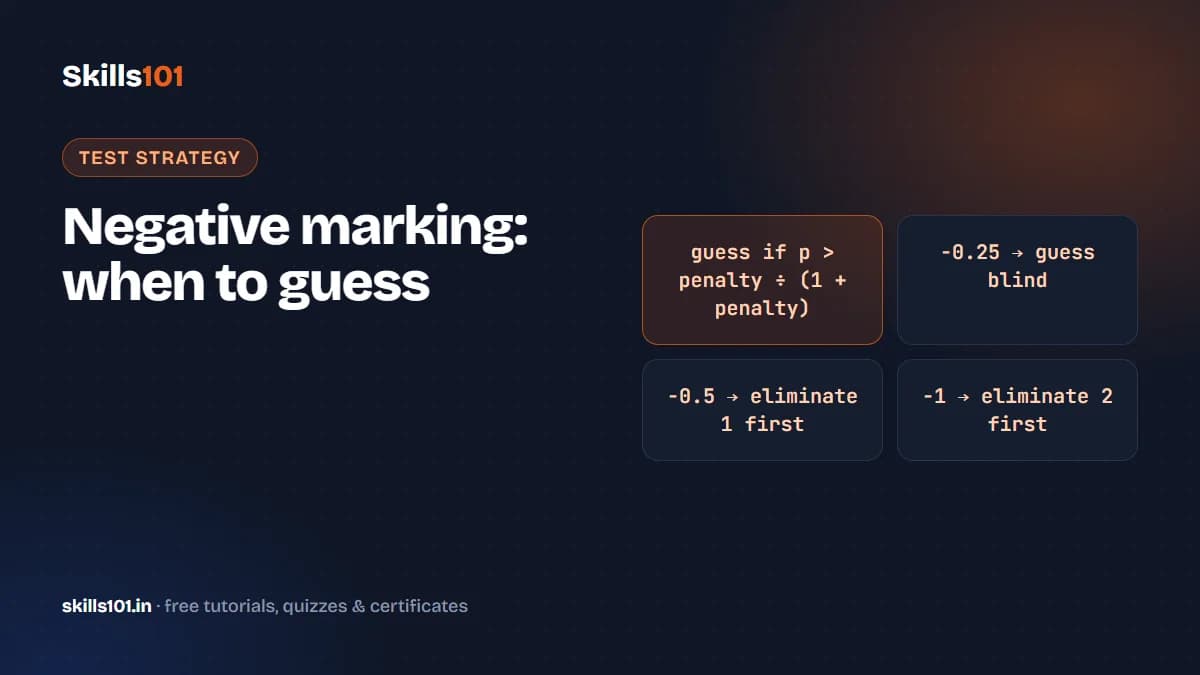
Every placement season, students ask the same thing: "Should I attempt questions I'm not sure about?" The honest answer depends on two things — the penalty for a wrong answer, and how many options you can rule out. It's a calculation, not a feeling, so we did it.
In short: With no negative marking (reported for TCS NQT, HCLTech, LTIMindtree, Deloitte and Accenture), answer every question. With a −0.25 penalty on four-option questions, even a blind guess gains marks on average. With −0.5, guess only after ruling out at least one option; with −1, only after ruling out two. Near a sectional cut-off, be more careful — guessing adds risk, not just expected marks.
The one formula you need
For a question with a +1 mark for a right answer and a penalty of x for a wrong one, a guess is worth taking when your chance of being right, p, is:
p > x ÷ (1 + x)
Where it comes from: the expected mark of a guess is p × 1 − (1 − p) × x. That is positive when p > x / (1 + x).
| Penalty for a wrong answer | Guess when your chance of being right is above | Meaning on a 4-option question |
|---|---|---|
| none | 0 | always answer |
| −0.25 | 0.20 | a blind guess (0.25) already qualifies |
| −1/3 | 0.25 | a blind guess just breaks even; rule out one option first |
| −0.5 | 0.33 | rule out at least one option |
| −1 | 0.50 | rule out two options |
Expected marks per guess, worked out
Assuming 4 options, +1 for right, and that the remaining options are equally likely:
| Penalty | 4 options left (blind) | 3 options left (1 ruled out) | 2 options left (2 ruled out) |
|---|---|---|---|
| none | +0.250 | +0.333 | +0.500 |
| −0.25 | +0.063 | +0.167 | +0.375 |
| −1/3 | 0.000 | +0.111 | +0.333 |
| −0.5 | −0.125 | 0.000 | +0.250 |
| −1 | −0.500 | −0.333 | 0.000 |
The pattern: ruling out even one option changes the decision more than anything else. At −0.25, a blind guess earns 0.063 marks on average; ruling out one option raises it to 0.167, and ruling out two to 0.375 — six times as much.
Average gain vs. real risk
Expected marks are averages over many guesses. On a single test, guessing can still cost you. Take 10 blind guesses at −0.25:
- Expected gain: 10 × 0.0625 = +0.625 marks.
- But there is about a 24% chance you get fewer than 2 of them right and lose marks overall, and about a 53% chance you gain nothing or lose (2 right gives exactly 0).
Now take 10 guesses where you've ruled out two options at −0.25: expected gain +3.75 marks — and far less risk. Narrowing down is where guessing pays.
How sectional cut-offs change the decision
Many tests (for example Infosys and Tech Mahindra) are reported to have sectional cut-offs — you must clear every section separately.
- Comfortably above the cut-off? Guess only where the table says it pays; you're adding marks, not protecting them.
- Right at the cut-off line? Blind guesses add risk (that 24%). Spend your remaining time checking answers you already have, or making educated guesses with options ruled out.
- Clearly below the cut-off with little time left? You need marks quickly, so the expected gain from guessing becomes more valuable than the risk.
Which placement tests have negative marking?
From the company pages we keep up to date:
| Company | Negative marking (as reported) |
|---|---|
| TCS NQT | none |
| HCLTech | none |
| LTIMindtree | none |
| Deloitte | none |
| Accenture | not reported |
| Infosys | none in most reports; sectional cut-offs |
| Wipro | sources disagree — none, or 0.25 per wrong answer |
| Tech Mahindra | reports conflict |
The rule printed in your test invitation and on the instructions screen is the only one that counts. Read it before the clock starts.
A time plan that uses this
Most placement MCQ sections give you about 60–75 seconds per question (see placement test patterns compared).
- First pass (about 70% of the time): answer everything you can solve confidently. If a question isn't moving after a minute, mark it and move on.
- Second pass (about 20%): go back to marked questions. Rule out options by estimating, checking units or plugging options back in.
- Last minutes (about 10%): apply the guessing rule — guess where you've narrowed it down enough for your test's penalty, and (with no negative marking) fill every remaining blank.
Frequently asked questions
Should I guess if there is negative marking of 0.25?
On four-option questions, yes — even a blind guess gains about 0.06 marks on average, and ruling out one option raises that to about 0.17. Near a sectional cut-off, prefer guesses where you've eliminated options.
What is the formula for when to guess with negative marking?
Guess when your chance of being right is greater than penalty ÷ (1 + penalty). For −0.25 that's 20%; for −1/3 it's 25%; for −0.5 it's 33%; for −1 it's 50%.
Should I leave questions blank in TCS NQT?
Sources report no negative marking in TCS NQT, so a blank earns nothing while a guess might earn a mark. Answer every question, but only after confirming the rule in your own test instructions.
Is it better to attempt more questions or fewer?
Attempt every question you can solve with confidence, then guess only where the maths favours it for your test's penalty. Accuracy on attempted questions matters more than the number attempted when wrong answers cost marks.