# TestNG for Automation — Annotations, Assertions, DataProvider, Groups, testng.xml and Listeners
Source: https://skills101.in/learn/test-automation/testng-tutorial-dataprovider-listeners — Skills101 free tutorial (Software Testing & Automation). Updated 2026-11-09.
**TestNG** is the test framework most Indian automation teams use with Selenium. It runs your tests, decides the order, feeds them data, groups them, and produces reports.
## 1. Annotations and their order
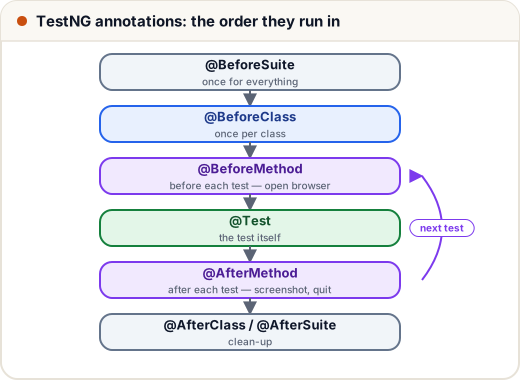
| Annotation | Runs | We use it for |
|---|---|---|
| `@BeforeSuite` / `@AfterSuite` | once for the whole run | start/stop shared services |
| `@BeforeClass` / `@AfterClass` | once per class | API base URL (see `CourseApiTest`) |
| `@BeforeMethod` / `@AfterMethod` | around every test | open the browser / screenshot + quit (see `BaseUiTest`) |
| `@Test` | the test | `@Test(groups = "smoke")`, `dataProvider`, `priority`, `enabled = false`, `expectedExceptions` |
`@AfterMethod(alwaysRun = true)` runs even if setup failed — important so browsers always close.
## 2. Assertions
- **Hard assertions** (`Assert.assertEquals`, `assertTrue`…) stop the test at the first failure.
- **Soft assertions** collect failures and report them together:
```java
// Not compiled: a short sketch of TestNG's SoftAssert
SoftAssert soft = new SoftAssert();
soft.assertEquals(page.title(), "Dashboard");
soft.assertTrue(page.hasLogoutLink());
soft.assertAll(); // without this line, failures are silently ignored!
```
## 3. Data-driven tests with @DataProvider
One test method, many rows of data — each row runs as a separate test:
```java
// File: src/test/java/com/skills101/qa/ui/LoginPageTest.java (excerpt)
@DataProvider(name = "badLogins")
public Object[][] badLogins() {
return new Object[][] {
{"asha@skills101.in", "wrong-password"},
{"nobody@skills101.in", "asha123"},
{"", ""},
};
}
// runs once per row of the data provider
@Test(dataProvider = "badLogins")
public void invalidLoginShowsError(String email, String password) {
LoginPage page = new LoginPage(driver).open(baseUrl).loginExpectingError(email, password);
assertEquals(page.errorMessage(), "Wrong email or password");
```
In our run this produces **three** passing tests (wrong password, unknown user, empty fields). Data can also come from Excel (Apache POI), CSV or JSON files.
## 4. Groups
`@Test(groups = "smoke")` tags quick, critical tests (we tagged `validLoginShowsDashboard` and `listCourses`). Run only them before a release: `./mvnw test -Dgroups=smoke`. Typical groups: `smoke`, `regression`, `sanity`.
> **Gotcha we hit while testing this lesson:** when you run only some groups, TestNG also skips `@BeforeMethod` / `@BeforeClass` methods that aren't in those groups — our first smoke run failed because no browser was opened. Mark setup and teardown methods `alwaysRun = true` (as `BaseUiTest` and `CourseApiTest` now do).
## 5. Suites in testng.xml
```xml
```
The suite file decides **what** runs (packages, classes, groups), **listeners**, and **parallel** execution, e.g. `` — each test then needs its own browser (ours already does: one per `@BeforeMethod`).
## 6. Listeners
A **listener** reacts to test events — logging, screenshots, sending results to a dashboard:
```java
// File: src/test/java/com/skills101/qa/base/TestLogger.java
package com.skills101.qa.base;
import org.testng.ITestListener;
import org.testng.ITestResult;
/** A TestNG listener (registered in testng.xml): prints one line per test — handy in CI logs. */
public class TestLogger implements ITestListener {
@Override
public void onTestSuccess(ITestResult result) {
System.out.println("PASS " + name(result));
}
@Override
public void onTestFailure(ITestResult result) {
System.out.println("FAIL " + name(result) + " — " + result.getThrowable().getMessage());
}
@Override
public void onTestSkipped(ITestResult result) {
System.out.println("SKIP " + name(result));
}
private static String name(ITestResult result) {
return result.getTestClass().getRealClass().getSimpleName() + "." + result.getMethod().getMethodName();
}
}
```
Our real run prints lines like `PASS LoginPageTest.validLoginShowsDashboard` for all 18 tests. Other hooks: `onStart`, `onFinish`; `IRetryAnalyzer` re-runs failed tests (use sparingly — fix flaky tests instead).
**Reports:** TestNG writes HTML and JUnit-XML reports to `target/surefire-reports/`; CI servers and tools like **Allure** or **ExtentReports** turn them into dashboards.
## Common mistakes
- Forgetting `soft.assertAll()`.
- Tests that depend on each other's order (`priority`, `dependsOnMethods`) — every test should run alone.
- Parallel runs with a shared static `WebDriver`.
- Hiding flaky tests behind automatic retries.
- Setup methods without `alwaysRun = true`, so group runs skip them.
## Quick recap
- Lifecycle: Suite → Class → Method around each `@Test`.
- Hard vs soft assertions; `@DataProvider` for data-driven tests; `groups` for smoke/regression.
- `testng.xml` defines suites, listeners and parallelism; listeners react to results.
Practice quiz and free certificate: https://skills101.in/learn/test-automation/testng-tutorial-dataprovider-listeners