# Selenium WebDriver with Java — Setup and Your First Automated Test
Source: https://skills101.in/learn/test-automation/selenium-webdriver-java-first-test — Skills101 free tutorial (Software Testing & Automation). Updated 2026-11-09.
**Selenium WebDriver** is the most used tool for browser automation. Your Java code tells a real browser — Chrome, Edge, Firefox — to open pages, type, click and read text, exactly like a user.
## 1. How it works
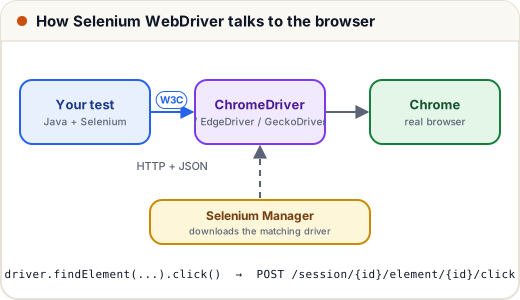
- Your test calls the **Selenium Java library**.
- Each call becomes an HTTP request in the **W3C WebDriver** standard, sent to a **driver** program (ChromeDriver, EdgeDriver, GeckoDriver for Firefox).
- The driver controls the browser and sends back the result.
Since Selenium 4.6, **Selenium Manager** finds or downloads the right driver for your browser version automatically — old tutorials that make you download `chromedriver.exe` by hand (or use WebDriverManager) are out of date.
## 2. Project setup
A Maven project with three test libraries:
```xml
4.0.0
com.skills101
test-automation
1.0.0
17
UTF-8
4.52.0
7.12.0
6.3.0
org.seleniumhq.selenium
selenium-java
${selenium.version}
test
org.testng
testng
${testng.version}
test
io.rest-assured
rest-assured
${restassured.version}
test
org.apache.maven.plugins
maven-surefire-plugin
3.5.4
testng.xml
```
- `test` — these libraries are only for tests, not for the shipped app.
- Surefire (Maven's test runner) runs the suite described in `testng.xml` (lesson 6).
- Java 17+, like the rest of our tracks.
## 3. Creating the browser
```java
// File: src/test/java/com/skills101/qa/base/DriverFactory.java
package com.skills101.qa.base;
import java.time.Duration;
import org.openqa.selenium.WebDriver;
import org.openqa.selenium.chrome.ChromeDriver;
import org.openqa.selenium.chrome.ChromeOptions;
import org.openqa.selenium.edge.EdgeDriver;
import org.openqa.selenium.edge.EdgeOptions;
import org.openqa.selenium.firefox.FirefoxDriver;
import org.openqa.selenium.firefox.FirefoxOptions;
/**
* Creates the browser chosen with -Dbrowser=chrome|edge|firefox (default chrome).
* -Dheadless=false shows the browser window while you write tests.
* Selenium Manager (built into Selenium 4) downloads the matching driver automatically.
*/
public final class DriverFactory {
private DriverFactory() {
}
public static WebDriver create() {
String browser = System.getProperty("browser", "chrome");
boolean headless = Boolean.parseBoolean(System.getProperty("headless", "true"));
WebDriver driver = switch (browser) {
case "edge" -> {
EdgeOptions options = new EdgeOptions();
if (headless) options.addArguments("--headless=new");
yield new EdgeDriver(options);
}
case "firefox" -> {
FirefoxOptions options = new FirefoxOptions();
if (headless) options.addArguments("-headless");
yield new FirefoxDriver(options);
}
default -> {
ChromeOptions options = new ChromeOptions();
if (headless) options.addArguments("--headless=new");
options.addArguments("--window-size=1280,900");
yield new ChromeDriver(options);
}
};
driver.manage().timeouts().pageLoadTimeout(Duration.ofSeconds(30));
return driver;
}
}
```
- Choose the browser with `-Dbrowser=edge` (default Chrome) — the same tests run on every browser (**cross-browser testing**).
- **Headless** mode runs the browser without a window — faster, and required on CI servers. Use `-Dheadless=false` to watch your test while writing it.
Every test needs a fresh browser and must close it afterwards, so we put that in a base class:
```java
// File: src/test/java/com/skills101/qa/base/BaseUiTest.java
package com.skills101.qa.base;
import java.io.IOException;
import java.nio.file.Files;
import java.nio.file.Path;
import org.openqa.selenium.OutputType;
import org.openqa.selenium.TakesScreenshot;
import org.openqa.selenium.WebDriver;
import org.testng.ITestResult;
import org.testng.annotations.AfterMethod;
import org.testng.annotations.BeforeMethod;
/** Every UI test class extends this: a fresh browser before each test, a screenshot if it fails, then close. */
public abstract class BaseUiTest {
protected WebDriver driver;
protected String baseUrl;
@BeforeMethod(alwaysRun = true) // alwaysRun: also when running only some groups (-Dgroups=smoke)
public void openBrowser() throws IOException {
baseUrl = PracticeSite.start();
driver = DriverFactory.create();
}
@AfterMethod(alwaysRun = true)
public void closeBrowser(ITestResult result) throws IOException {
if (driver == null) {
return;
}
if (result.getStatus() == ITestResult.FAILURE) {
Path folder = Files.createDirectories(Path.of("target", "screenshots"));
byte[] png = ((TakesScreenshot) driver).getScreenshotAs(OutputType.BYTES);
Files.write(folder.resolve(result.getName() + ".png"), png);
}
driver.quit(); // quit() closes every window and ends the driver process
}
}
```
`driver.quit()` closes all windows and the driver process; `driver.close()` closes only the current window. Forgetting `quit()` leaves zombie browsers eating your RAM.
The practice pages (a login page, a dashboard and a page full of tricky elements) are served from the test resources by a tiny local web server, so the tests need no internet:
```java
// File: src/test/java/com/skills101/qa/base/PracticeSite.java
package com.skills101.qa.base;
import com.sun.net.httpserver.HttpServer;
import java.io.IOException;
import java.io.InputStream;
import java.net.InetSocketAddress;
/** Serves the practice pages in src/test/resources/site/ on a free local port, so the UI tests need no internet. */
public final class PracticeSite {
private static HttpServer server;
private PracticeSite() {
}
public static synchronized String start() throws IOException {
if (server == null) {
server = HttpServer.create(new InetSocketAddress("localhost", 0), 0);
server.createContext("/", exchange -> {
String path = exchange.getRequestURI().getPath();
try (InputStream page = PracticeSite.class.getResourceAsStream("/site" + path)) {
if (page == null) {
exchange.sendResponseHeaders(404, -1);
} else {
byte[] body = page.readAllBytes();
exchange.getResponseHeaders().add("Content-Type", "text/html; charset=utf-8");
exchange.sendResponseHeaders(200, body.length);
exchange.getResponseBody().write(body);
}
}
exchange.close();
});
server.start();
}
return "http://localhost:" + server.getAddress().getPort();
}
}
```
## 4. The first test
```java
// File: src/test/java/com/skills101/qa/ui/FirstSeleniumTest.java
package com.skills101.qa.ui;
import static org.testng.Assert.assertEquals;
import static org.testng.Assert.assertTrue;
import com.skills101.qa.base.BaseUiTest;
import org.openqa.selenium.By;
import org.testng.annotations.Test;
public class FirstSeleniumTest extends BaseUiTest {
@Test
public void loginWithValidDetailsOpensDashboard() {
driver.get(baseUrl + "/login.html"); // 1. open the page
assertEquals(driver.getTitle(), "Skills101 Practice - Login");
driver.findElement(By.id("email")).sendKeys("asha@skills101.in"); // 2. find elements and act
driver.findElement(By.id("password")).sendKeys("asha123");
driver.findElement(By.id("login-btn")).click();
assertTrue(driver.getCurrentUrl().endsWith("dashboard.html?name=Asha")); // 3. check the result
assertEquals(driver.findElement(By.id("welcome")).getText(), "Welcome, Asha!");
}
}
```
Every UI test follows the same three steps: **open** a page, **find elements and act** (type, click), **check** the result with assertions. `assertEquals(actual, expected)` — in TestNG, *actual comes first*.
Run all tests with `./mvnw test` (Windows: `mvnw.cmd test`). In our build this test opens headless Chrome, logs in and lands on the dashboard — it passes.
## 5. Useful WebDriver methods
| Method | Does |
|---|---|
| `get(url)` | open a page and wait for it to load |
| `getTitle()`, `getCurrentUrl()` | read the page title / address |
| `findElement(By…)` | find one element (throws if missing) |
| `findElements(By…)` | find all matches (empty list if none) |
| `navigate().back()` / `.refresh()` | browser buttons |
| `manage().window().maximize()` | window size |
| `quit()` | end the session |
Element methods: `click()`, `sendKeys(text)`, `clear()`, `getText()`, `getDomAttribute(name)`, `isDisplayed()`, `isEnabled()`, `isSelected()`.
## Common mistakes
- Downloading driver .exe files by hand — Selenium Manager does it.
- Forgetting `driver.quit()` in an `@AfterMethod(alwaysRun = true)`.
- Sharing one browser across all tests — one test's state leaks into the next.
- Swapping actual/expected in TestNG's `assertEquals`.
## Quick recap
- Test code → W3C WebDriver over HTTP → driver → browser; Selenium Manager fetches drivers.
- Maven dependencies: selenium-java, testng (and rest-assured for APIs).
- Fresh browser per test in `@BeforeMethod`, `quit()` in `@AfterMethod`.
- Open → find and act → assert.
Practice quiz and free certificate: https://skills101.in/learn/test-automation/selenium-webdriver-java-first-test