Python Loops
Tripti Sharma ·
In Python, loops are used to repeatedly execute a block of code as long as a certain condition is met. Python supports two types of loops: for loops and while loops. Here's an explanation of each type with simple examples.
1. For Loop
The for loop in Python is used to iterate over a sequence (such as a list, tuple, dictionary, set, or string). It executes a block of code once for each item in the sequence.
Example 1: Iterating through a list
fruits = ["apple", "banana", "cherry"]

for fruit in fruits:
    print(fruit)
Output:
apple
banana
cherry
Example 2: Iterating through a string
for char in "hello":
    print(char)
Output:
h
e
l
l
o
Example 3: Using range()
for i in range(5):
    print(i)
Output:
0
1
2
3
4
2. While Loop
The while loop in Python repeatedly executes a block of code as long as a given condition is true.
Example 4: Basic while loop
count = 0

while count < 5:
    print(count)
    count += 1
Output:
0
1
2
3
4
Example 5: while loop with a condition
number = 10

while number > 0:
    print(number)
    number -= 2
Output:
10
8
6
4
2
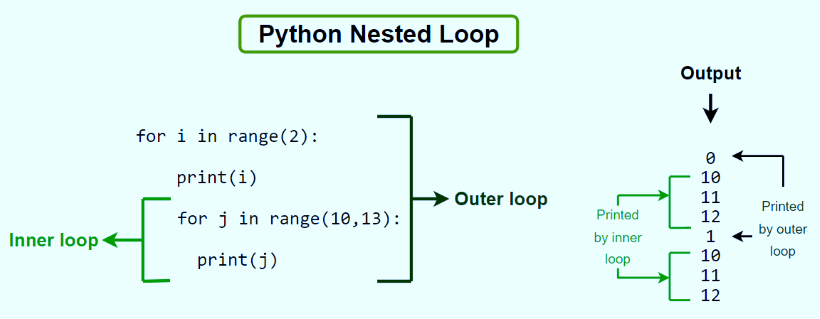
3. Nested Loops
You can also nest loops inside each other.
Example 6: Nested for loop
for i in range(3):
    for j in range(2):
        print(f"i={i}, j={j}")
Output:
i=0, j=0
i=0, j=1
i=1, j=0
i=1, j=1
i=2, j=0
i=2, j=1
4. Control Statements
Python provides several control statements to control the flow of loops:
break: Exits the loop prematurely.continue: Skips the rest of the code inside the loop for the current iteration and moves to the next iteration.else: Executes a block of code once when the loop is finished (only if the loop is not terminated by abreakstatement).
Example 7: Using break
for i in range(10):
    if i == 5:
        break
    print(i)
Output:
0
1
2
3
4
Example 8: Using continue
for i in range(10):
    if i % 2 == 0:
        continue
    print(i)
Output:
1
3
5
7
9
Example 9: Using else with loops
for i in range(5):
    print(i)
else:
    print("Loop finished")
Output:
0
1
2
3
4
Loop finished
Summary
forloop: Used to iterate over a sequence.whileloop: Repeatedly executes a block of code as long as a condition is true.- Nested loops: Loops inside loops for more complex iterations.
- Control statements:
break,continue, andelseto control the flow of loops.